

I'm not trying to be facetious. I want to really want consider whether or not, in 2026, in the age of vibe coding, agentic programming, loop or graph or whatever diagrammatic metaphor-based engineering is most popular, does it matters what web framework you use? More importantly (to me and my particular interests), and at the risk of Betteridge-ing myself: should we make new frameworks?
Stop learning frameworks
We are developers. We need to stay up to date with technology. Every day, we learn programming languages, frameworks, and libraries. The more modern tools we know — the better. Keeping up to date with Angular, React, Vue, Riot, Ember, Knockout is fun. But we are wasting our time.
Compilers are the New Frameworks
My current "investment thesis" is that what we call web frameworks are transforming from runtime libraries into optimizing compilers. When it comes to eking performance out of hand-authored JavaScript and accompanying runtime libraries, we've reached the point of diminishing returns.
Frameworks without the framework: why didn’t we think of this sooner?
You can’t write serious applications in vanilla JavaScript without hitting a complexity wall. But a compiler can do it for you.
JavaScript Frameworks - Heading into 2026
I suppose after three years, we can consider my review of JavaScript Frameworks an annual event now....

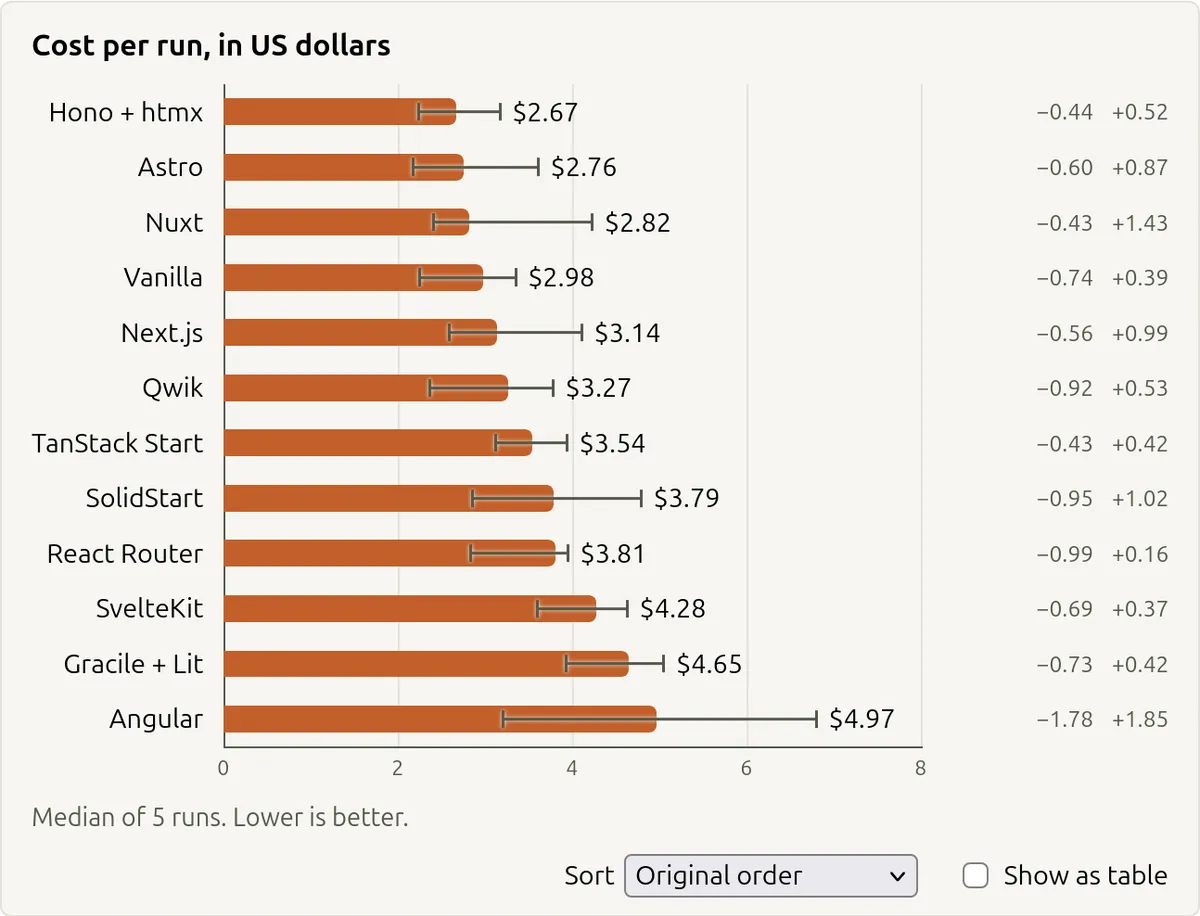
The AI cost of JavaScript frameworks
One of my pet peeves with the web development community is that so many of the decisions we make are vibes-based. Frameworks are “blazing fast,” tools will…
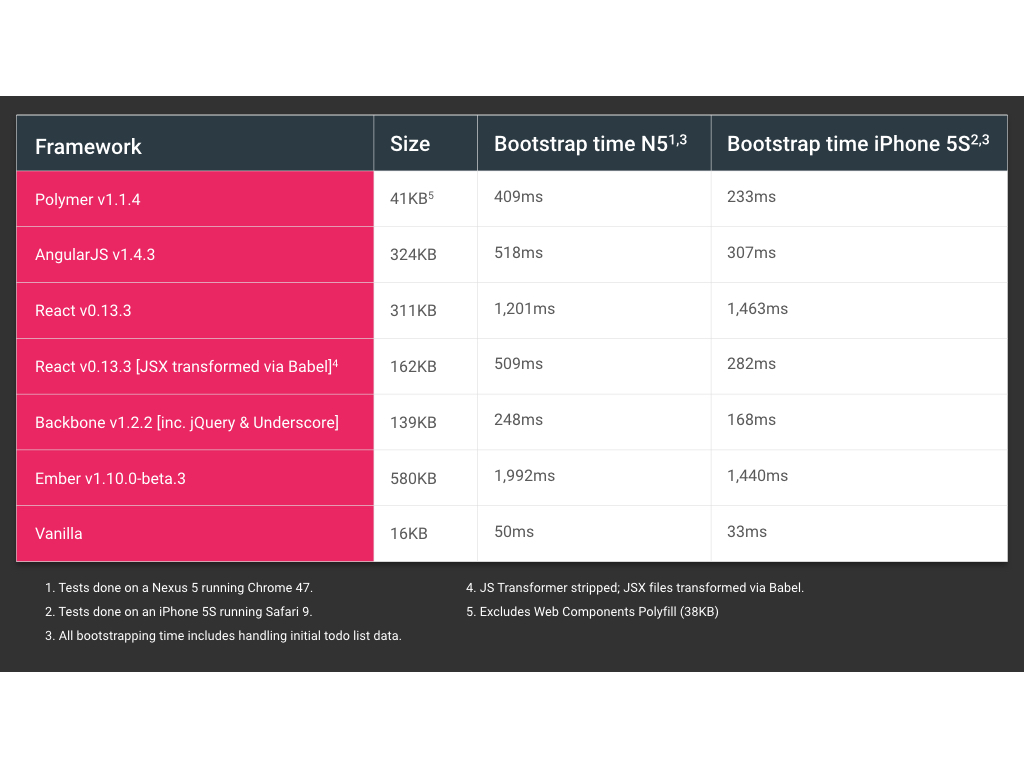
The Cost of Frameworks
I recently delivered a talk at FFConf in Brighton, called "You should use <insert library / framework here>, it's the bestestest!". I wanted to do a write-up of the presentation's content here, hopefully so it can start a broader conversation that I think we need to have, mainly around the cost of modern frameworks on mobile devices.
Elanis/web-to-desktop-framework-comparison
An objective comparison of multiple frameworks that allow us to "transform" our web apps to desktop applications.
Frontend Without the Browser–WTH?!?
What is the state of frontend frameworks and libraries in 2026? This is a question many frontend developers today are wrestling with, and it appears one answer is that frontend has moved deeper into the stack. Take gpuix-svelte, an experimental project built by Stanislav Khromov, a Svelte core team member, that renders the JavaScript framework

Fresh - The simple, approachable, productive web framework.
Fresh features just-in-time edge rendering, island based interactivity, and zero-configuration TypeScript support. Fast to write; fast to run.
The end of Framework Churn
Framework Churn: that breakneck pace of creation and abandonment that plagues the JavaScript community. Here one day, out the next. Hot today, obsolete in a year. Number one loved on the Hacker News frontpage, now number one hated on the Hacker News comments. Framework Churn is something every one of us deals with in the […]
Web Components Are Not the Future
A few years ago I wrote an article suggesting that Web Components might not be the most beneficial...

I Built the Same App 10 Times: Evaluating Frameworks for Mobile Performance | Loren Stewart
I needed to choose a framework for a mobile-first app at work. I started comparing Next.js, SolidStart, and SvelteKit, then expanded to 10 frameworks. The measurements revealed dramatic differences in bundle sizes, performance, and the real cost of framework choices.
Close to the metal: web design and the browser
Websites have evolved over the years, but in the name of evolution, there seems to be mistaken thinking that the process of building a website needs to get more complex, using Javascript frameworks and modern backend systems; when at the end of the day, browsers still only need static HTML content to interpret.
What is a framework? Understanding their purpose, value, development and use
Many frameworks exist across the sciences and science-policy interface, but it is not always clear how they are developed or can be applied. It is also often vague how new or existing frameworks are positioned in a theory of science to advance a specific theory or paradigm. This article examines these questions and positions the role of frameworks as integral but often vague scientific tools, highlighting benefits and critiques. While frameworks can be useful for synthesizing and communicating core concepts in a field, they often lack transparency in how they were developed and how they can be applied. Positioning frameworks within a theory of science can aid in knowing the purpose and value of framework use. This article provides a meta-framework for visualizing and engaging the four mediating processes for framework development and application: (1) empirical generalization, (2) theoretical fitting, (3) application, and (4) hypothesizing. Guiding points for scholars and policymakers using or developing frameworks in their research are provided in closing.

Which framework to learn?
As the title says, I have been exploring theory about AI agents and LLMs for a while and I want to learn frameworks and actually build some solid…
Thinking Frameworks | 2021
Sharing out the best meta-thinking tools I’ve learned this year
