

While our browser can render complex styles, visual effects, and animations, all of those apply basically just to text. Yet web pages contain a variety of non-text embedded content, from images to other web pages. Support for embedded content has powerful implications for browser architecture, performance, security, and open information access, and has played a key role throughout the web’s history.
Embed Everything!
These days it takes a diverse and complex collection of components to power a web browser. It’s fair to think of all those parts coming…

Making Content Accessible | Web Browser Engineering
So far, we’ve focused on making the browser an effective platform for developing web applications. But ultimately, the browser is a user agent. That means it should assist the user in whatever way it can to access and use web applications. Browsers therefore offer a range of accessibility features that take advantage of declarative UI and the flexibility of HTML and CSS to make it possible to interact with web pages by touch, keyboard, or voice.
Embedding The Web
We need to talk more The web is much more than browsers. What works great in browser development is missing in related spaces like embedding. Can we get together to collectively describe security and compatibility properties of user agents that are not browsers? Can we develop things that don’t ...

Close to the metal: web design and the browser
Websites have evolved over the years, but in the name of evolution, there seems to be mistaken thinking that the process of building a website needs to get more complex, using Javascript frameworks and modern backend systems; when at the end of the day, browsers still only need static HTML content to interpret.
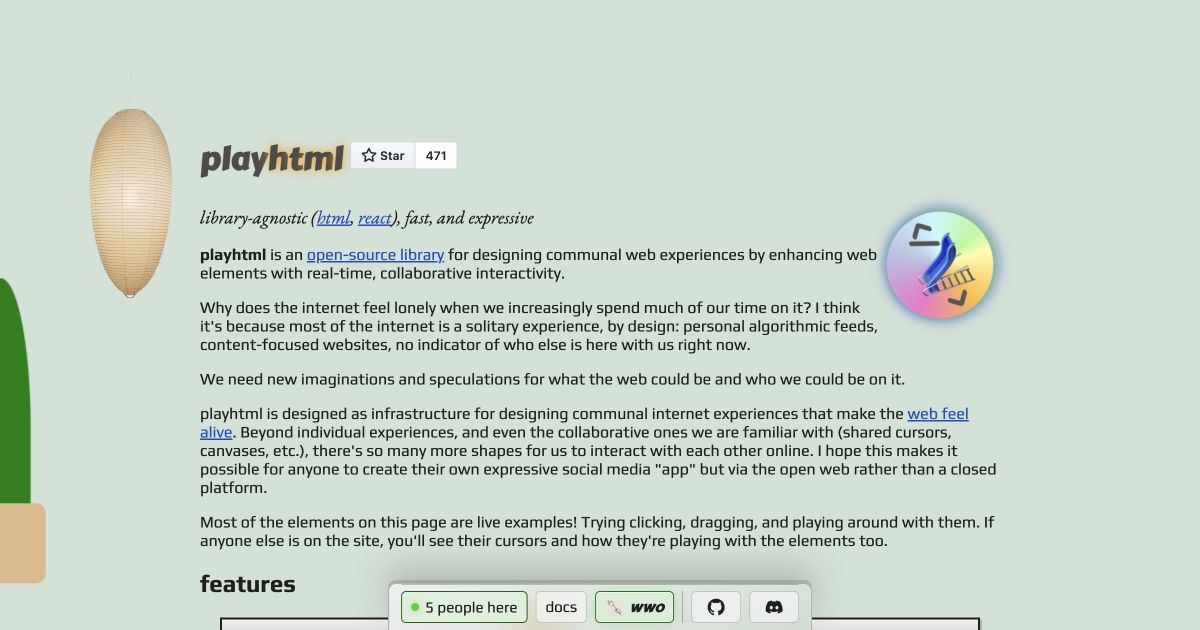
playhtml — make the web feel alive
Make the web feel alive with interactive, collaborative HTML elements and no backend to run.
Running Interactive Scripts | Web Browser Engineering
The first web applications were like the previous chapter’s guest book, with the server generating new web pages for every user action. But in the early 2000s, JavaScript-enhanced web applications, which can update pages dynamically and respond immediately to user actions, took their place. Let’s add support for this key web technology to our browser.
Client side include feature for HTML · Issue #2791 · whatwg/html
Spun off from HTML modules discussion There are certain amount of interest that including HTML snippet into an HTML document, without using JavaScript. That would be similar to <iframe>, but ...
HTML Can Do That
HTML has been gobbling up swathes of what used to be JavaScript’s remit. This page lists a bunch of dynamic functionality that we can now achieve with just HTML.

HTML Can Do That
HTML has been gobbling up swathes of what used to be JavaScript’s remit. This page lists a bunch of dynamic functionality that we can now achieve with just HTML.
Object-Oriented UX
We know big, monolithic webpages won’t meet the needs of responsive sites and endless screens. But we’re often still quilting together design patterns and content modules, rather than truly thinkin…

The HotJava Browser: A White Paper
Browsers allow people to treat the data spread across the Internet as a cohesive whole. Web browsers integrate the function of fetching the data with figuring out what it is and displaying it. One of the most important file types browsers understand is the hypertext markup language (HTML). HTML allows text data objects to embed simple formatting information and references to other objects.
Hypermedia Systems
The revolutionary ideas that empowered the Web. A simpler approach to building applications on the Web and beyond with htmx and Hyperview. Enhancing web applications without using SPA frameworks.
Laying Out Pages | Web Browser Engineering
So far, layout has been a linear process that handles open tags and close tags independently. But web pages are trees, and look like them: borders and backgrounds visually nest inside one another. To support that, this chapter switches to tree-based layout, where the tree of elements is transformed into a tree of layout objects before drawing. In the process, we’ll make web pages more colorful with backgrounds.
swup — Versatile and extensible page transition library for server-rendered websites
Versatile and extensible page transition library for server-rendered websites

Constructing an HTML Tree | Web Browser Engineering
So far, our browser sees web pages as a stream of open tags, close tags, and text. But HTML is actually a tree, and though the tree structure hasn’t been important yet, it will be central to later features like CSS, JavaScript, and visual effects. So this chapter adds a proper HTML parser and converts the layout engine to use it.