

The first web applications were like the previous chapter’s guest book, with the server generating new web pages for every user action. But in the early 2000s, JavaScript-enhanced web applications, which can update pages dynamically and respond immediately to user actions, took their place. Let’s add support for this key web technology to our browser.
The many, many, many JavaScript runtimes of the last decade
This last decade has seen an inundation of new JavaScript runtimes (and engines in equal measure), enabling us to run JavaScript in all manner of contexts...

Making Content Accessible | Web Browser Engineering
So far, we’ve focused on making the browser an effective platform for developing web applications. But ultimately, the browser is a user agent. That means it should assist the user in whatever way it can to access and use web applications. Browsers therefore offer a range of accessibility features that take advantage of declarative UI and the flexibility of HTML and CSS to make it possible to interact with web pages by touch, keyboard, or voice.
Web Browser Engineering
Web browsers are ubiquitous, but how do they work? This book explains, building a basic but complete web browser, from networking to JavaScript, in a couple thousand lines of Python.
Automation and customization of rendered web pages
The names of commands and objects are vital to the usability of a programming system. We are developing a web automation system in which users need to identify web page elements, such as hyperlinks and form fields, in pages written by other designers. ...
HTML Can Do That
HTML has been gobbling up swathes of what used to be JavaScript’s remit. This page lists a bunch of dynamic functionality that we can now achieve with just HTML.

HTML Can Do That
HTML has been gobbling up swathes of what used to be JavaScript’s remit. This page lists a bunch of dynamic functionality that we can now achieve with just HTML.
Launch HN: Browser Use (YC W25) – open-source web agents | Hacker News
Check out this video to see it in action: https://preview.screen.studio/share/r1h4DuAk. There are lots more demos at https://github.com/browser-use/browser-use on how we control the web with prompts.
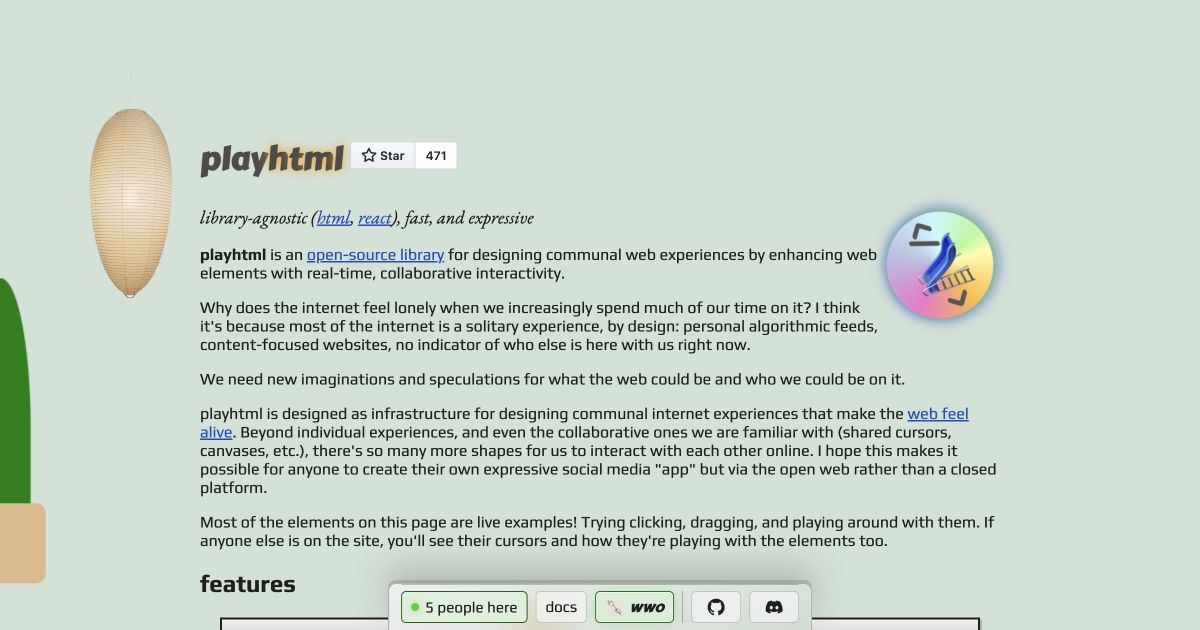
playhtml — make the web feel alive
Make the web feel alive with interactive, collaborative HTML elements and no backend to run.
Scripty - Automate your tasks with Javascript
Chrome extension to inject custom Javascript into a webpage.
Scheduling Tasks and Threads | Web Browser Engineering
Modern browsers must handle user input, request remote files, run various callbacks, and ultimately render to the screen, all while staying fast and responsive. That requires a unified task abstraction to keep track of the browser’s pending work. Moreover, browser work must be split across multiple CPU threads, with different threads running tasks in parallel to maximize responsiveness.
Supporting Embedded Content | Web Browser Engineering
While our browser can render complex styles, visual effects, and animations, all of those apply basically just to text. Yet web pages contain a variety of non-text embedded content, from images to other web pages. Support for embedded content has powerful implications for browser architecture, performance, security, and open information access, and has played a key role throughout the web’s history.
Intent to Prototype: Script Tools API
Script Tools enable authors to expose JavaScript APIs on their site for automated use by the user agent. They allow an author to annotate these APIs with descriptions and provide input schema, allowing automation frameworks a more specific method to access the site's functionality.
Sending Information to Servers | Web Browser Engineering
So far, our browser has seen the web as read-only—but when you post on Facebook, fill out a survey, or search Google, you’re sending information to servers as well as receiving information from them. In this chapter, we’ll start to transform our browser into a platform for web applications by building out support for HTML forms, the simplest way for a browser to send information to a server.
w3c/trusted-types
A browser API to prevent DOM-Based Cross Site Scripting in modern web applications.
Web Engines Hackfest 2025