Our browser has grown up and now runs (small) web applications. With one final step—user identity via cookies—it will be able to run all sorts of personalized online services. But capability demands responsibility: our browser must now secure cookies against adversaries interested in stealing them. Luckily, browsers have sophisticated systems for controlling access to cookies and preventing their misuse.
The web should remain anonymous by default | The Mozilla Blog
The unique architecture of the web enables a much higher degree of user privacy than exists on other platforms. Many factors contribute to this, but an ess

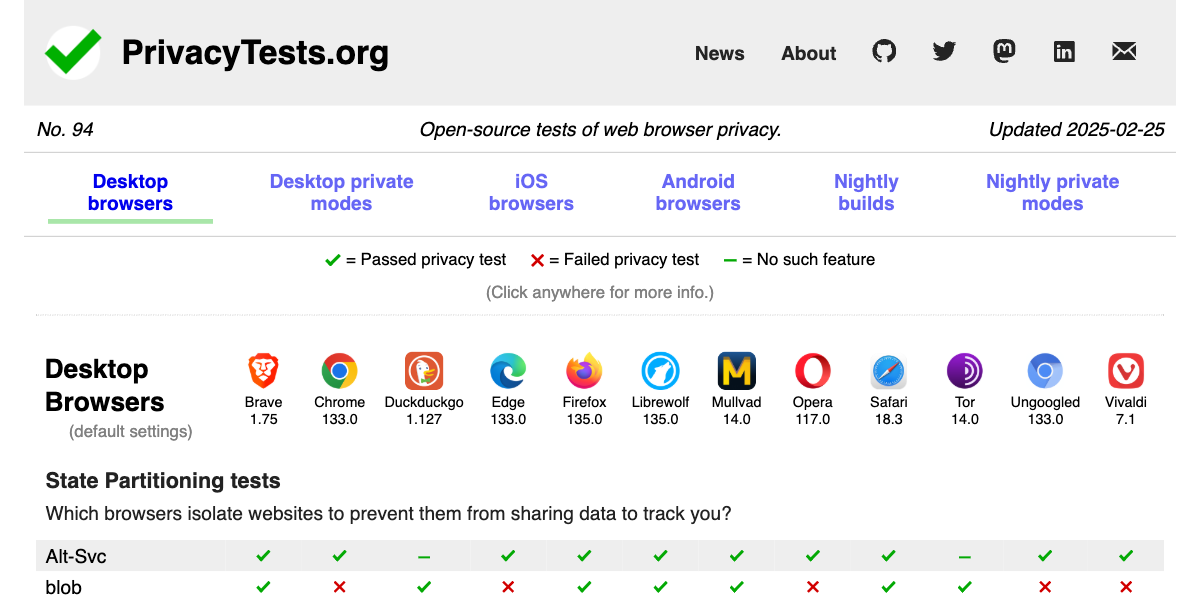
Which browsers are best for privacy?
An open-source privacy audit of popular web browsers.
Deconstructing Google’s excuses on tracking protection - CITP Blog
By Jonathan Mayer and Arvind Narayanan. Blocking cookies is bad for privacy. That’s the new disingenuous argument from Google, trying to justify why Chrome is so far behind Safari and Firefox in offering privacy protections. As researchers who have spent over a decade studying web tracking and online advertising, we want to set the record […]
Sending Information to Servers | Web Browser Engineering
So far, our browser has seen the web as read-only—but when you post on Facebook, fill out a survey, or search Google, you’re sending information to servers as well as receiving information from them. In this chapter, we’ll start to transform our browser into a platform for web applications by building out support for HTML forms, the simplest way for a browser to send information to a server.
The State of Mozilla: 2015 Annual Report
In addition to Cookies necessary for this site to function, we’d like your permission to set some additional Cookies to better understand your browsing needs and improve your experience. Rest assured — we value your privacy.

Kevin Boone: The privacy nightmare of browser fingerprinting
If you were worried about tracking cookies, you really don’t want to know about browser fingerprinting.
Welcome to MyHub | MyHub.AI
MyHub.ai saves very few cookies onto your device: we need some to monitor site traffic using Google Analytics, while another protects you from a cross-site request forgeries. Nevertheless, you can disable the usage of cookies by changing the settings of your browser. By browsing our website without changing the browser settings, you grant us permission to store that information on your device. More details in our Privacy Policy.
Award-winning security research reveals a host of never-seen, currently unblockable web-tracking techniques
Who Left Open the Cookie Jar? A Comprehensive Evaluation of Third-Party Cookie Policies won the Distinguished Paper prize at this year's Usenix Security Conference; its authors, researchers at Belgium's Catholic…

Antidetect Browser for Managing Multiple Accounts Safely | Gologin
Create and run multiple accounts on any platform without bans. Gologin antidetect browser helps you manage unlimited profiles safely with unique digital fingerprints.⚡️7-Days Trial!
Potential uses for the Privacy Sandbox
Today on The Keyword, we outlined our vision for an initiative aimed at evolving the web with architecture that advances privacy, while co...

Review | Goodbye, Chrome: Google’s Web browser has become spy software
Our latest privacy experiment found Chrome ushered more than 11,000 tracker cookies into our browser — in a single week.


Privacy Principles
Privacy is an essential part of the web. This document provides definitions for privacy and related concepts that are applicable worldwide as well as a set of privacy principles that should guide the development of the web as a trustworthy platform. People using the web would benefit from a stronger relationship between technology and policy, and this document is written to work with both.
Firefox: The fast, private browser that keeps you safe
The independent browser that has your back. Firefox blocks trackers, has a free built-in VPN, puts you in control of AI, and never sells your personal data.