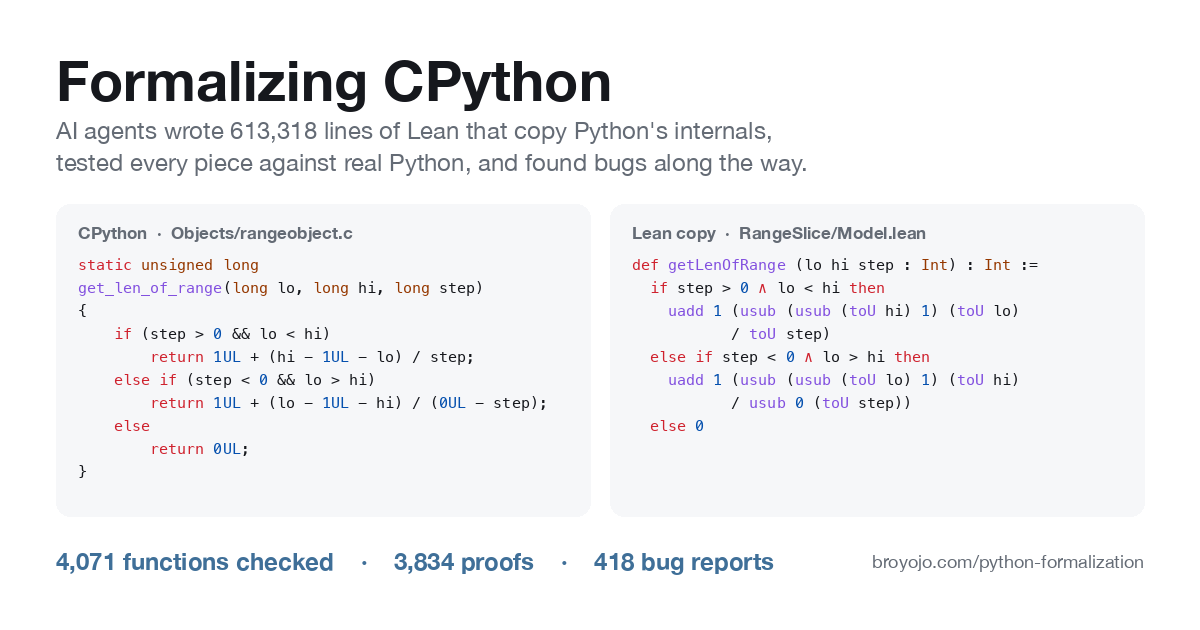
AI agents wrote 613,318 lines of Lean that copy Python's internals, tested every piece against real Python, and turned up 418 bug reports along the way.
Open-Source Python Code Shows Lowest Defect Density - Slashdot
cold fjord sends news that a study by Coverity has found open-source Python code to contain a lower defect density than any other language. "The 2012 Scan Report found an average defect density of .69 for open source software projects that leverage the Coverity Scan service, as compared to the acce...

The Story of Python and how it took over the world | Python: The Documentary
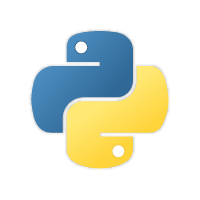
AI vs human code gen report: AI code creates 1.7x more issues
We analyzed 470 open-source GitHub pull requests, using CodeRabbit’s structured issue taxonomy and found that AI generated code creates 1.7x more issues.
Did Claude Increase Bugs in rsync?
In late May 2026, rsync blew up. GitHub, Hacker News, Lobsters: hundreds of people arguing about whether open-source maintainers can ship AI-written code and have it be reliable — and whether the people taking the code for free get to demand how it is made.
SciPy 1.0: fundamental algorithms for scientific computing in Python
SciPy is an open-source scientific computing library for the Python programming language. Since its initial release in 2001, SciPy has become a de facto standard for leveraging scientific algorithms in Python, with over 600 unique code contributors, thousands of dependent packages, over 100,000 dependent repositories and millions of downloads per year. In this work, we provide an overview of the capabilities and development practices of SciPy 1.0 and highlight some recent technical developments.

How Python is Fighting Open Source's 'Phantom' Dependencies Problem - Slashdot
Since 2023 the Python Software Foundation has had a Security Developer-in-Residence (sponsored by the Open Source Security Foundation's vulnerability-finding "Alpha-Omega" project). And he's just published a new 11-page white paper about open source's "phantom dependencies" problem — suggestin...
Jupyter Notebooks – a publishing format for reproducible computational workflows
It is increasingly necessary for researchers in all fields to write computer code, and in order to reproduce research results, it is important that this code is published. We present Jupyter notebooks, a document format for publishing code, results and explanations in a form that is both readable and executable. We discuss various tools and use cases for notebook documents.

Is legal the same as legitimate: AI reimplementation and the erosion of copyleft
Last week, Dan Blanchard, the maintainer of chardet—a Python library for detecting text encodings used by roughly 130 million projects a month— released a new…
marimo | a next-generation Python notebook
A reactive notebook for Python — run reproducible experiments, execute as a script, deploy as an app, and version with git.
marimo | a next-generation Python notebook
A reactive notebook for Python — run reproducible experiments, execute as a script, deploy as an app, and version with git.
Learning Python: From Zero to Hero
By TK First of all, what is Python? According to its creator, Guido van Rossum, Python is a: “high-level programming language, and its core design philosophy is all about code readability and a syntax which allows programmers to express concepts in ...
Stories | Cyrus
Insights, tutorials, and case studies on AI-powered development workflows. Learn how teams use Cyrus with Linear and Claude Code to ship 20x faster.
Goodbye Claude, Hello Pi
I’ve been a longtime Claude Code user, ever since it became available in the Claude Pro subscription plan over a year ago. I remember the first time I used it, feeling giddy as it spat out messy Python code for whatever random weekend project I was working on, all from a single prompt. I’m certain that in a few years we’ll all look back at its release as one of the major drivers of this new era of software development we’re in.
Rethinking Our Documentation
LangChain has seen some incredible growth in the last year and half. The Python open-source library is now downloaded over 7 million times per month, and has had more than 20,000 pull requests and 2,500 contributors!