

Some IGF Jurors released a statement about AI usage
I am proud of my husband, Brendon Chung, for joining with other IGF jurors in signing a letter about AI usage. The signers each posted the letter individuall...

How AI Saved My Company From a 2-Year Litigation Nightmare
After 2+ years and a tremendous waste of energy and money, my firm Calm Company Fund resolved a lawsuit against us on very favorable terms. What started as one of the most challenging periods of my life became an unexpected masterclass in using AI to level the playing field against well-funded opponents. If you’re an... Continue reading →
AI systems out-persuade expert humans
Many societal decisions are settled by contests of persuasion. Conversational AI is a powerful new entrant in these contests, but whether it can out-persuade skilled and highly incentivized humans has remained unclear. Here, in a series of four preregistered experiments (n = 18,978 conversations from 6,923 people), we pitted AI systems against a range of human persuaders, including laypeople, winners of a separately preregistered four-round online persuasion tournament, professional canvassers, and world championship debaters. We found that AI systems were reliably more persuasive than expert humans, even when expert humans chose their issues, researched in advance, underwent hours of live, structured practice, and were incentivized with £1,000 cash bonuses. In a follow-up study, AI's advantage persisted after experts received a coaching tool that let them practice against the AI that beat them, review their performance history, and see what AI would have said at key moments. We found converging evidence that AI's advantage stemmed from rapidly deploying larger quantities of information: after coaching, expert humans could tie an AI constrained to respond at human speeds and with human-length messages. In a final study, we show that AI's advantage extends to consequential real-world behavior: AI was nearly 3x more effective than professional canvassers from a UK fundraising firm at raising real-money donations to Save the Children. Together, these results establish that frontier AI systems out-persuade expert humans in conversation, with significant implications for political communication.

New evidence, new challenges: ICC judges’ perspectives on user-generated evidence and judging in an age of artificial intelligence
Evidence recorded on personal digital devices, or “user-generated evidence” (UGE), has profoundly shaped our ways of knowing about international crimes. UGE can be expected to play an important role in future cases before the International Criminal Court (ICC), yet few trials to date have relied extensively on UGE.. This research provides important insights into how ICC judges define UGE and perceive its strengths and weaknesses, and on the readiness of the Court to adapt to judging in an age of Artificial Intelligence. Using grounded theory to analyse interviews with ICC judges, we identified several key themes, including concerns about the perceived importance and potential bias of evidence sources; the practical challenges of employing UGE; the burden placed on the parties to ensure the reliability of the evidence, to rigorously challenge the opposing party’s evidence, and the importance of preparing legal professionals to address the risks associated with misinformation and disinformation.
Can AI Be a Fair Judge in Court? Estonia Thinks So
Estonia plans to use an artificial intelligence program to decide some small-claims cases, part of a push to make government services smarter.

How to Use AI to Do Stuff: An Opinionated Guide
Covering the state of play as of Summer, 2023
AI Is a Mass-Delusion Event
Three years in, one of AI’s enduring impacts is to make people feel like they’re losing it.

Judge Learns Lawyers on Both Sides of Case Used AI, Cancels Trial, Kicks Everyone Off the Case
When two AIs argue against each other, the legal system loses.

A Couple of Posts about AI and the IGF Awards
Hey everyone, I’ll be honest, I didn’t expect to write another letter so soon after sharing my thoughts on Penguin Colony, but maybe I should’ve been. Because by the time I was writing about that game, which I had played in consideration for this coming year’s

Lawyer Caught Using AI While Explaining to Court Why He Used AI
The attorney not only submitted AI-generated fake citations in a brief for his clients, but also included “multiple new AI-hallucinated citations and quotations” in the process of opposing a motion for sanctions.

More Than a Tool
What We Learned from a Year of Conversations About AI
Our Spreadsheet Overlords
Weatherby argues that the current discourse around AI, especially the buzz around “artificial general intelligence,” is a distraction from its actual impact: the expansion of bureaucracy through massive data systems…

FLF’s Epistemic Case Study Competition: Results — LessWrong
This summer, FLF ran a contest which asked entrants to help us “find the best workflows and methodologies for using AI to produce reliable, trustwort…
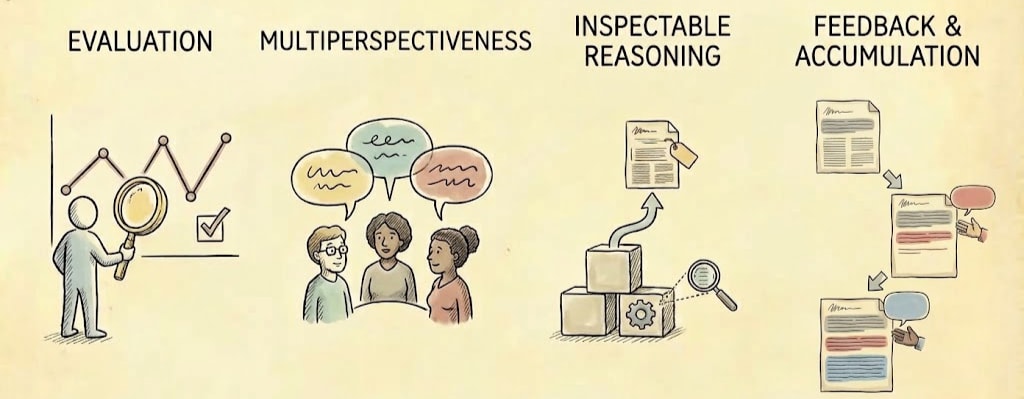
How AI agents shape experts’ judgment calls
In a randomized trial, professional analysts working with an AI coding agent went with the option the agent was randomly assigned to favor 86% of the time. We look at what this means for human oversight of AI-assisted work.

Checking In on AI and the Big Five
A review of the current state of AI through the lens of the Big Five tech companies.

Nassim Nicholas Taleb on Twitter / X
The problem isn’t that AI is intelligent. It isn’t. The problem is that too many adults (but not all) are at once mechanistic, imitative, unimaginative, stupid, formulaic, influenceable, & gullible, arrogant beyond their skill set, & too expensive to maintain.— Nassim Nicholas Taleb (@nntaleb) October 24, 2026
