

How do we get to more than just three web engines owned by three US companies? It's a gargantuan question, with no easy or right answer. I've put together a draft report, thinking about it through a very specific approach - please enjoy: Servo Readiness Report webtransitions.org/servo-readiness/
Mar 6, 2026 at 2:35 PM
Collective funding, governance and prioritization of a browser engine projects · Issue #11 · w3c/breakouts-day-2025
Session description Today, each of the three main, open source browser engine projects have a steward organization which contribute, by far, the lion's share of the project's commits - 75-9...

Leave big tech behind! How to replace Amazon, Google, X, Meta, Apple – and more
A handful of companies monopolise the web, with unprecedented access to our data. But there are many more ethical – and often distinctively European – alternatives

Why Do the Biggest Companies Keep Getting Bigger? It’s How They Spend on Tech
The secret of success for Amazon, Google and Microsoft is how much they invest in their own technology.

Servo Baseline Readiness
Servo is falling behind the web. It completes ~22 features/year at production quality, while the Baseline “Widely Available” set grows at ~52 features/year. At this pace, Servo plateaus around 80% by ~2037 and never catches up. Full velocity parity requires ~44 FTE (€8.8M/yr, €26.3M over 3yr). BWA features vary widely in real-world usage — a phased approach that prioritizes high-usage features first could reduce the initial headcount and cost by up to 40% while building toward full parity. The highest-leverage actions are unstalling 141 blocked features and fixing 51 regressions (features that lost >5 percentage points). This is a work-in-progress analysis focusing on one aspect of web engine development — feature-level readiness — and is not exhaustive. It is designed to orient thinking about cost and timelines. The central question: what would it cost in engineering investment alone to bring Servo to velocity parity within 3 years, excluding non-engineering and operational costs?
Scaling Engineering Teams: Lessons from Google, Facebook, and Netflix
After spending over a decade in engineering leadership roles at some of the world’s most chaotic innovation factories—Google, Facebook, and Netflix—I’ve learned one universal truth: scaling e…

Digital Sovereignty in Practice: Web Browsers as a Reality Check
Servo, a memory-safe browser engine, is kept alive by five engineers and a trickle of donations. A reality check on what an independent browser would actually cost the digital-sovereignty talk.

Decentralizing the Economic Power of the Web (A Reading List)
We recently hosted a panel discussion as part of our MozFest’s Dialogues & Debates series focused on interrogating the web’s reigning business model — d…

The Internet Economy
We are living in an era of bundling. The big five consumer tech companies — Google, Apple, Facebook, Amazon, and Microsoft — have moved far…
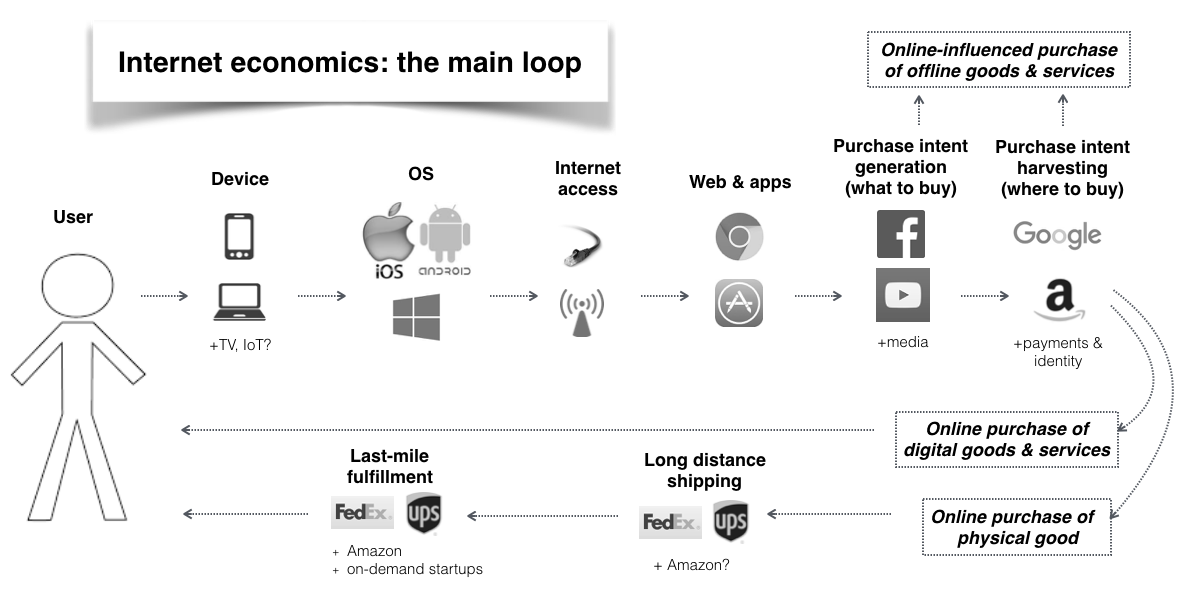
Coopting Disruption
Our economy is dominated by five aging tech giants – Alphabet, Amazon, Apple, Meta, and Microsoft. In the last twenty years, no company has commercialized a new

More performant, diverse Web engines – 26 March 2025
Slideset: https://docs.google.com/presentation/d/1f0fm5OpE7vwqQkKfNwvYuzH7O3WyPsK4xSIiegLplbg/edit#slide=id.p and archived PDF copy
The Web Browser Is All You Need - Paul Klein IV, Browserbase
Facebook, Amazon, Google, IBM and Microsoft come together to create the Partnership on AI | TechCrunch
The world's largest technology companies hold the keys to some of the largest databases on our planet. Much like goods and coins before it, data is
All four major web browsers are about to lose 80% of their funding | Hacker News
If you say browser developers need money from the search giant to compete in browser development, you are saying that - right now - you can't compete in browser development without it.
Investing in what moves the internet forward | The Mozilla Blog
Firefox is the only major browser not backed by a billionaire and our independence shapes everything we build. This independence allows us to prioritize bu

Atlassian Buys The Browser Company, Browser Wars, Why Atlassian
Atlassian bought The Browser Company, seeking to deliver an AI-enabled browser for work. It’s a reasonable bet, but I’m skeptical that browsers are the future.

