

I'm incredibly honored to be one of the inaugural winners of the Ctrl-Z award. The sequence of events preceding and following this retraction were harrowing (and are honestly still stressful), but I hope this will be an opportunity for more open dialogue about mistakes + self-retraction in science.

Retraction Watch
The Center for Scientific Integrity is proud to announce the inaugural winners of the 2026 Ctrl-Z Award. Named for the universal keyboard shortcut for “undo,” the Ctrl-Z Award this year honors @cetaceanneeded.bsky.social and @katelaskowski.bsky.social for choosing transparency over reputation.
Aug 4, 2026 at 4:54 PM

NAS 163rd Annual Meeting - Awards Ceremony
‘Cerebral torment’: IOP retracts nearly 100 conference papers for tortured phrases
IOP Publishing has retracted nearly 100 papers from three of its conference proceedings after the articles were flagged for containing tortured phrases. Tortured phrases are rephrasings and s…

Winners Take All — Anand Giridharadas
Anand Giridharadas is the author of Winners Take All. An insider’s groundbreaking investigation of how the global elite’s efforts to “change the world” preserve the status quo and obscure their role in causing the problems they later seek to solve.
BICS Essay Contest Winners
The winners were chosen based on the power of the arguments presented and on how persuasively the essays made the case for survival of human consciousness beyond a reasonable doubt as though you were in a courtroom. While the judges were reading and re-reading the 204 submitted essays, they were conscious of the great responsibility of choosing the top three. The judges chose these principal winners with exquisite care.
The State of Papers, Retractions, and Preprints: Evidence from the CrossRef Database (2004-2024)
A 20-year analysis of CrossRef metadata demonstrates that global scholarly output -- encompassing publications, retractions, and preprints -- exhibits strikingly inertial growth, well-described by exponential, quadratic, and logistic models with nearly indistinguishable goodness-of-fit. Retraction dynamics, in particular, remain stable and minimally affected by the COVID-19 shock, which contributed less than 1% to total notices. Since 2004, publications doubled every 9.8 years, retractions every 11.4 years, and preprints at the fastest rate, every 5.6 years. The findings underscore a system primed for ongoing stress at unchanged structural bottlenecks. Although model forecasts diverge beyond 2024, the evidence suggests that the future trajectory of scholarly communication will be determined by persistent systemic inertia rather than episodic disruptions -- unless intentionally redirected by policy or AI-driven reform.

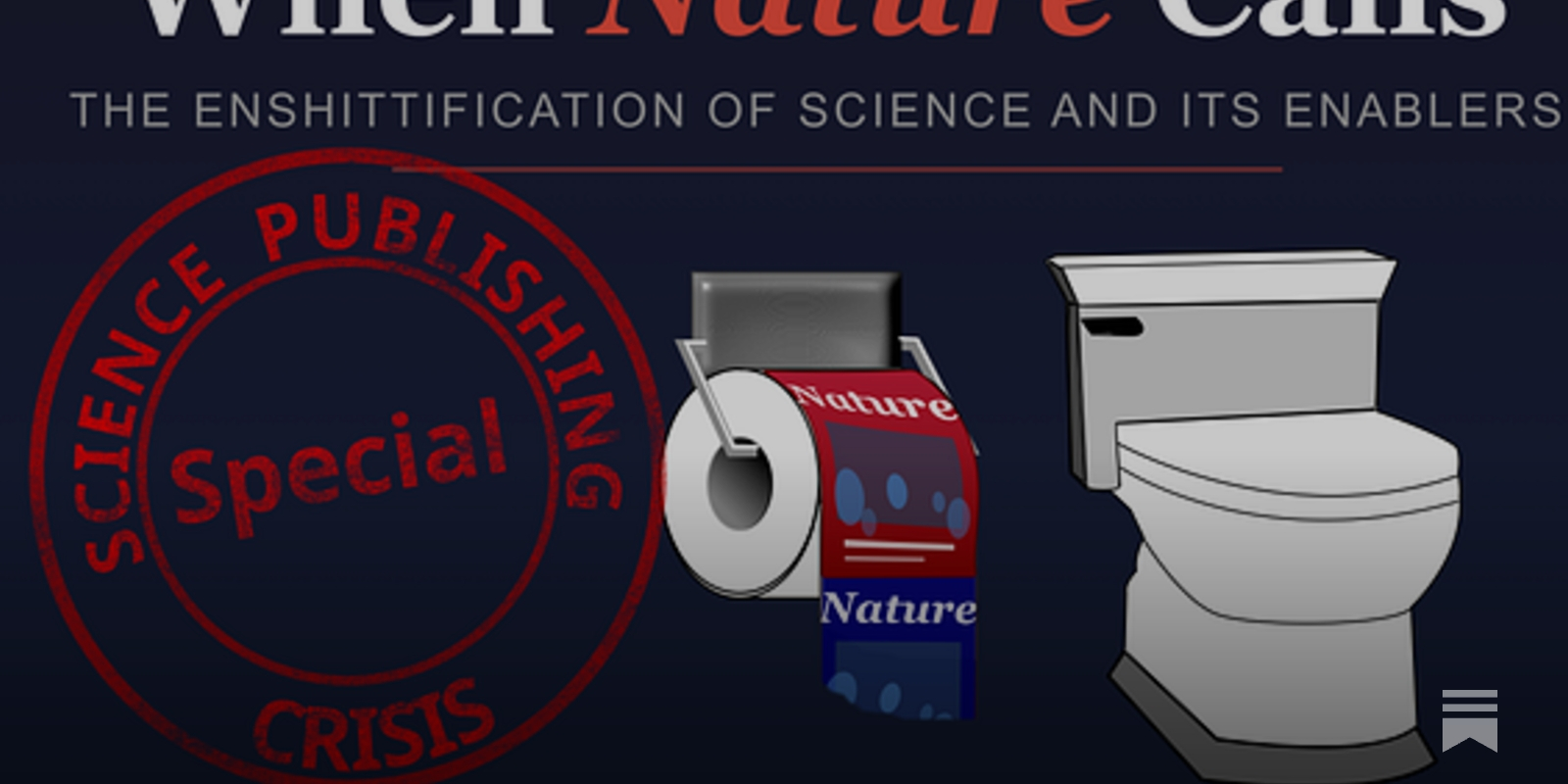
When Nature Calls: The Enshittification of Science and Its Enablers
Proof-of-work papers, policy laundering, and the collapse of self-correction
Science discussions of retracted articles on Bluesky: public scrutiny or misinformation spreading?
Post-publication peer review (PPPR) has emerged as an important supplement to traditional peer review, with social media playing a growing role in publicising potential problems in published research. However, it remains unclear whether social media discussions of retracted articles primarily reflect good practices, such as exposing flaws and acknowledging retraction status, or bad practices, such as overlooking retractions and continuing to disseminate scientific misinformation. In this study, we collected Bluesky posts referencing scholarly articles from Altmetric and retrieved metadata for the referenced articles using OpenAlex. The final dataset included 284 retracted articles with 79 pre-retraction posts and 857 post-retraction posts, 59 retraction notices with 186 posts, and 609,461 non-retracted articles with 1,344,756 posts. We manually coded Bluesky posts discussing retracted articles to identify instances of good and bad practice. The results show that posts demonstrating good practice (89.9%) substantially outnumbered those demonstrating bad practice (10.1%). Posts reflecting good practice also had more user engagement. In the pre-retraction phase, good practice posts constituted a slight minority (43.0%), whereas in the post-retraction phase they were dominant (94.2%). Most negative posts in the pre-retraction phase (90.0%) had good practice while only 17.3% positive posts in the post-retraction phase showed bad practice. Thus, sentiment analysis can be helpful to filter posts that could flag potential flaws before retraction, but it may struggle to accurately identify the spread of misinformation after retraction. More broadly, this study highlights the potential of Bluesky to support responsible scientific communication, public scrutiny, and research integrity.
Science discussions of retracted articles on Bluesky: public scrutiny or misinformation spreading?
Post-publication peer review (PPPR) has emerged as an important supplement to traditional peer review, with social media playing a growing role in publicising potential problems in published research. However, it remains unclear whether social media discussions of retracted articles primarily reflect good practices, such as exposing flaws and acknowledging retraction status, or bad practices, such as overlooking retractions and continuing to disseminate scientific misinformation. In this study, we collected Bluesky posts referencing scholarly articles from Altmetric and retrieved metadata for the referenced articles using OpenAlex. The final dataset included 284 retracted articles with 79 pre-retraction posts and 857 post-retraction posts, 59 retraction notices with 186 posts, and 609,461 non-retracted articles with 1,344,756 posts. We manually coded Bluesky posts discussing retracted articles to identify instances of good and bad practice. The results show that posts demonstrating good practice (89.9%) substantially outnumbered those demonstrating bad practice (10.1%). Posts reflecting good practice also had more user engagement. In the pre-retraction phase, good practice posts constituted a slight minority (43.0%), whereas in the post-retraction phase they were dominant (94.2%). Most negative posts in the pre-retraction phase (90.0%) had good practice while only 17.3% positive posts in the post-retraction phase showed bad practice. Thus, sentiment analysis can be helpful to filter posts that could flag potential flaws before retraction, but it may struggle to accurately identify the spread of misinformation after retraction. More broadly, this study highlights the potential of Bluesky to support responsible scientific communication, public scrutiny, and research integrity.
The Gutenberg Parenthesis
A 2024 CHOICE OUTSTANDING ACADEMIC TITLEPROSE AWARDS MEDIA AND CULTURAL STUDIES FINALIST 2024The Gutenberg Parenthesis traces the epoch of print from its fatefu…

Last weekend I received the Troland Research Award from the @nationalacademies.org. I’m so grateful to the communities who made this work possible. It's strange to receive this award at a time when much of the work being recognized is not eligible for federal funding. My remarks 👇 and a 🧵>>

NAS 163rd Annual Meeting - Awards Ceremony
www.youtube.comat this point no one cares, but i was invited to talk about the high-rep retraction saga, and once again, i find myself perplexed at the exclusion of confirmatory results in any calculation in a study making a key claim about the inclusion of confirmatory studies making results highly replicable.
Excited to announce that I will be giving the opening keynote for @newpublic.org + @publicspaces.net Open Social Award Show in Amsterdam next month! My keynote will discuss how we do community governance at @blackskyweb.xyz Best of luck to all applicants and hope to see you there!

Designing Technology for All #11: Open Socials Award Show
dezwijger.nlRegCheck ( regcheck.app) has received a Commendation from the Society for Improving Psychological Science! You can check the other awardees below too:

RegCheck
regcheck.app
Society for the Improvement of Psychological Science (SIPS)
🏆We are very pleased to announce the 2026 Awards Winners and Commendations recipients for the Society for the Improvement of Psychological Science! 👏Join us in celebrating the exceptional projects that have revolutionized the field of psychological science. buff.ly/2lUKGFd
I had the honor of giving a keynote at the International Conference on Machine Learning last week. I addressed the widespread anxiety about how we should adapt as AI capabilities increase. I was thrilled by the talk’s reception, so I have made my slides available cs.princeton.edu/~arvindn/talks/icml-2026-anno…

What will be left for us to work on?
www.cs.princeton.edu


