

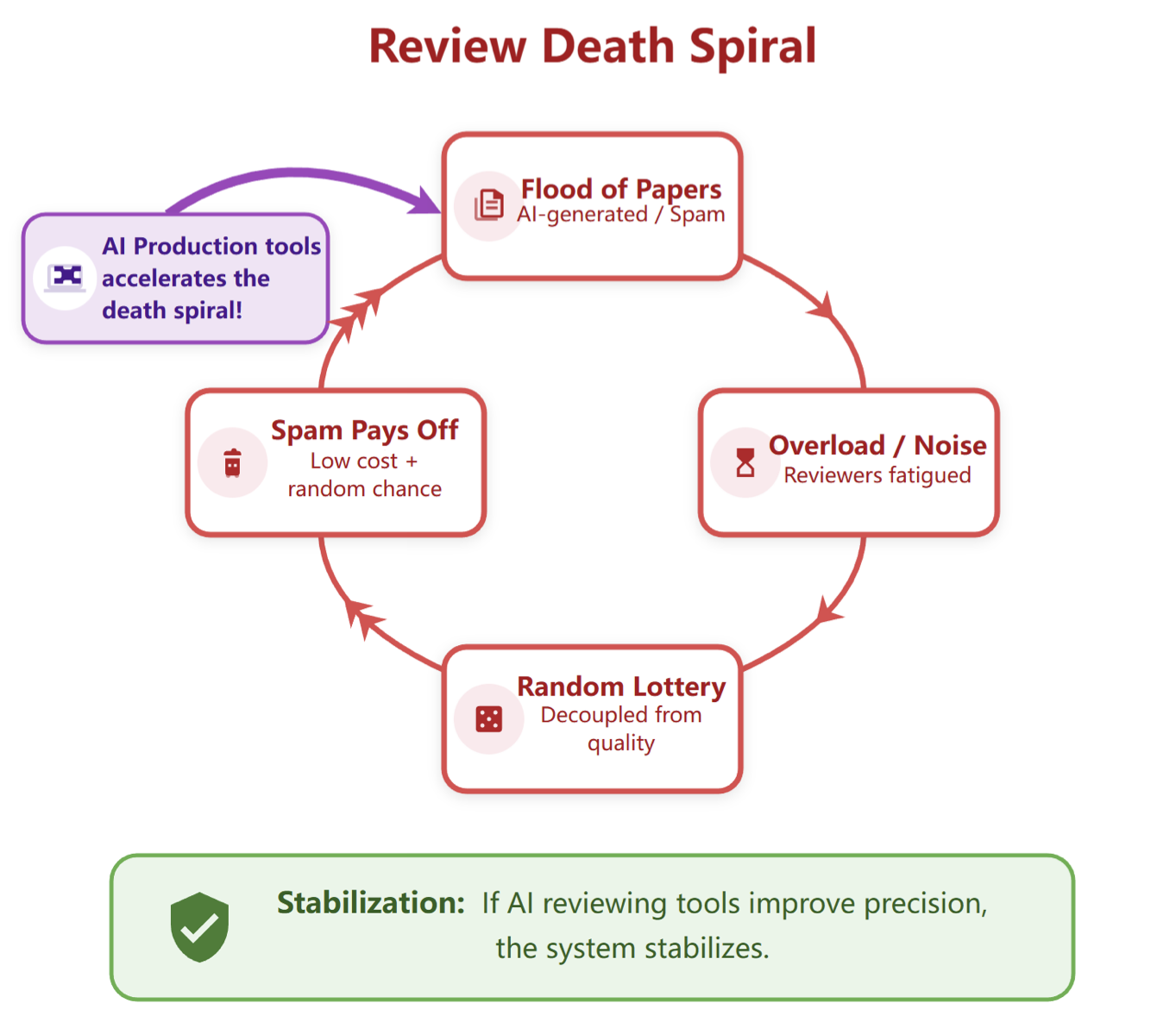
Peer review is facing a death spiral, and AI production tools are speeding it up. AI-assisted reviewing is necessary and should be open. We built OpenAIReview: open AI reviewing for everyone, for the cost of a coffee. openaireview.github.io/blog.html 🧵

AI-assisted Reviewing is Necessary and Should be Open
openaireview.github.ioMar 9, 2026 at 6:48 PM
AI-assisted Reviewing is Necessary and Should be Open
Peer review is facing a death spiral. AI production tools are speeding it up. AI-assisted reviewing is necessary and should be open.
AI-assisted Reviewing is Necessary and Should be Open
Peer review is facing a death spiral. AI production tools are speeding it up. AI-assisted reviewing is necessary and should be open.
Peer review is overwhelmed—can it survive in the AI era?
As research and AI-assisted papers surge, volunteer reviewers struggle to keep up.


AI-Assisted Peer Review at Scale: The AAAI-26 AI Review Pilot
Scientific peer review faces mounting strain as submission volumes surge, making it increasingly difficult to sustain review quality, consistency, and timeliness. Recent advances in AI have led the community to consider its use in peer review, yet a key unresolved question is whether AI can generate technically sound reviews at real-world conference scale. Here we report the first large-scale field deployment of AI-assisted peer review: every main-track submission at AAAI-26 received one clearly identified AI review from a state-of-the-art system. The system combined frontier models, tool use, and safeguards in a multi-stage process to generate reviews for all 22,977 full-review papers in less than a day. A large-scale survey of AAAI-26 authors and program committee members showed that participants not only found AI reviews useful, but actually preferred them to human reviews on key dimensions such as technical accuracy and research suggestions. We also introduce a novel benchmark and find that our system substantially outperforms a simple LLM-generated review baseline at detecting a variety of scientific weaknesses. Together, these results show that state-of-the-art AI methods can already make meaningful contributions to scientific peer review at conference scale, opening a path toward the next generation of synergistic human-AI teaming for evaluating research.

Major AI conference flooded with peer reviews written fully by AI
Nature - Controversy has erupted after 21% of manuscript reviews for an international AI conference were found to be generated by artificial intelligence.

AI’s Growing Role as Scientific Peer Reviewer | Stanford HAI
Stanford computer scientist James Zou is exploring how AI can accelerate scientific research and peer review. His finding: AI excels at spotting gaps, but judgment calls still need humans.

OpenAccess.ai — Rigorous Open Access Publishing
$20 to submit, free to read. AI peer review. Open to human and machine authors. All articles CC-BY 4.0.

How do authors want to use AI for review?
A survey of researchers who compared AI-generated scientific reviews with journal-agnostic human peer review reveals that they overwhelmingly prefer using AI as a self-checking tool before submission rather than as a replacement for human reviewers. It encourages an “author-centric” model in which AI helps researchers improve their manuscripts before they are reviewed by their peers.

AI-powered Literature Review & Synthesis
Recording from my workshop last week on smarter literature review with AI
Guest Post — Now is the Time for AI in Peer Review, and Publishing Policies Need to Recognize This - The Scholarly Kitchen
Today's post asks us to acknowledge the role of AI in peer review and ensure practical guidance and policies that help scholars respond with consistency and confidence.

ReviewBench: An Extensible Framework for Benchmarking Human and AI Manuscript Review
The volume of scientific manuscripts is rising faster than the available pool of expert reviewers, and AI tools are emerging as a possible response, ranging from frontier large language models applied directly to peer review to purpose-built multi-agent systems. Scalable, standardized benchmarks are needed to regularly evaluate how these tools compare to one another and to human reviewers. We present ReviewBench, an open-source, venue-agnostic framework that compares human and AI reviews across structure, alignment with a paper’s major claims, impact, and critique category. We apply ReviewBench to 145,021 review comments from human reviewers, frontier large language models (GPT-5.2, and Gemini 3 Pro), and Reviewer3.com (R3), a multi-agent peer review system. The dataset spans papers in computer science (ICLR 2025, n = 1,000), social science (Nature Human Behaviour, n = 142), and life science (eLife, n = 1,000). Across disciplines, AI reviews are more structured and engage more directly with a paper’s major claims, with R3 more often surfacing consequential comments, defined as comments capable of undermining those claims. When restricting to critical comments, however, human reviewers rank first on consequential rate on more individual papers than any AI source, despite a lower average. We identify a bimodal reviewer distribution with peaks near 0% and 100%, indicating that many reviewers outperform AI on this metric, but a substantial fraction of reviewers near 0% brings the average down. Critique typing demonstrates systematic differences, where humans emphasize contribution and clarity, while AI emphasizes validity, sufficiency, and transparency. Together, these findings argue against framing AI as a replacement for human review and instead support a complementary model in which AI scales technical verification of major claims while human judgment remains essential for evaluating contribution and shaping editorial decisions.

Position: The ML Community Must Build an AI-Augmented Peer-Review Ecosystem
Peer review, the bedrock of scientific advancement in machine learning (ML), is strained by a crisis of scale. Exponential growth in manuscript submissions to premier ML venues such as NeurIPS, ICML, and ICLR is outpacing the finite capacity of qualified reviewers, leading to concerns about review quality, consistency, and reviewer fatigue. This position paper argues that AI-assisted peer review must become an urgent research and infrastructure priority. We advocate for a comprehensive AI-augmented ecosystem, leveraging Large Language Models (LLMs) not as replacements for human judgment, but as sophisticated collaborators for authors, reviewers, and Area Chairs (ACs). We propose specific roles for AI in enhancing factual verification, guiding reviewer performance, assisting authors in quality improvement, and supporting ACs in decision-making. Crucially, we contend that the development of such systems hinges on access to more granular, structured, and ethically-sourced peer review process data. We outline a research agenda, including illustrative experiments, to develop and validate these AI assistants, and discuss significant technical and ethical challenges. We call upon the ML community to proactively build this AI-assisted future, ensuring the continued integrity and scalability of scientific validation, while maintaining high standards of peer review.
