

Are there other ways to organize our economy? Economic democracy expands the ideal of "one person, one vote" into the economy. Democracy in our economy is the next step in realizing a society that features genuine self-determination for all people.

After Capitalism: A Cooperative Economy (Documentary)
youtu.beAug 24, 2026 at 8:47 PM
The most powerful institution in most people’s lives is their workplace. We care deeply about governmental democracy but accept dictatorships where we spend most of our waking hours. The cooperative movement has proven it doesn’t have to be this way.
The Cooperative Economy (@cooperatives.bsky.social)
Advocating for a democratic, equitable, and inclusive world through cooperatives, worker ownership, unions, mutual aid, and workplace democracy. 💜 #EconomicDemocracy 🌲🌲 usworker.coop | ncbaclusa.coop | workers.coop | ica.coop

Consensus Democracy | The Paper Pilot
The Paper Pilot's digital garden of thoughts on philosophy, politics, and sociology
Power: A Primer for Perplexed Economists
Let's Assume an Unfettered Marketplace of Ideas! Or Actually, Let's Not.

Exocapitalism: economies with absolutely no limits
There is a touch of destiny with this one. We have real…

The Routledge Handbook of Cooperative Economics and Management
Cooperatives have spread across virtually all continents. Today, the International Cooperative Alliance (ICA) recognises over 3 million cooperatives with 1 billion cooperative members or about 12% of the human population and serving many more members of the public, collectively owning trillions in assets. This handbook provides a comprehensive introduction to the subject and the current state of affairs with regard to the study of cooperation in the economy generally and of the cooperative and related sectors particularly. It highlights the essential issues and debates; provides a future research agenda, outlining the distinctions and similarities between individual and (inter)organisational cooperation; and explores the connections of cooperative economics and management to fundamental ethical principles. This book examines coopetition and the similarities and differences between competitive economics and cooperative economics, identifying to what extent and how cooperative economics and management are more capable of addressing the problems of global neoliberalism, such as ecological collapse, wealth inequity, value capture, and distribution, including via online platforms and social/relational problems. This book offers a variety of new research and theory‑building from various disciplines, particularly focusing on the fields of economics and management but extending beyond these disciplines to domains such as sociology, psychology, anthropology, and political science. It will become the standard reference work for not only a broad and large audience of scholars, researchers, and students but also interested professionals, policymakers, regulators, and cooperators in the field wishing to orient themselves in a global, rapidly developing movement and field of study with reference to issues of producing and allocating resources and focusing on the impact of cooperation on issues like risk, trust, the development of preferences, institutional governance, networks, and inequity. The Open Access version of this book, available at https://www.taylorfrancis.com, has been made available under a Creative Commons Attribution-Non Commercial-No Derivatives (CC-BY-NC-ND) 4.0 license. The handbook has received an Honorable Mention for the Joyce Rothschild book prize.
Hope in Common
We seem to have reached an impasse. Capitalism as we know it appears to be coming apart. But as financial institutions stagger and crumble, there is no obvious alternative. Organized resistance appears scattered and incoherent; the global justice movement a shadow of its former self. There is good reason to believe that, in a generation […]
Three views on economic power
We investigate the concept of economic power in the three main paradigms of economic thinking in the 20th century: neoclassical, marxist and institutionalist. We propose a reconstruction, based on a new taxonomy, of the various forms of power conceptualized by each of them. In particular, we claim that the neoclassical paradigm contains a consistent although often implicit theory of power. We then show that many controversies between these paradigms were debates on power and that some shifts in mainstream economics in the 1970s and 1980s are a reaction to the criticisms leveled against the neoclassical conceptualization of power.
Goods Unite Us
Millions are taking action! Join the movement and start voting with your wallet.
Liquid Democracy: True Democracy for the 21st Century
Liquid Democracy, a subset of Delegative Democracy, is a powerful voting model for collective decision making in large communities. Liquid…
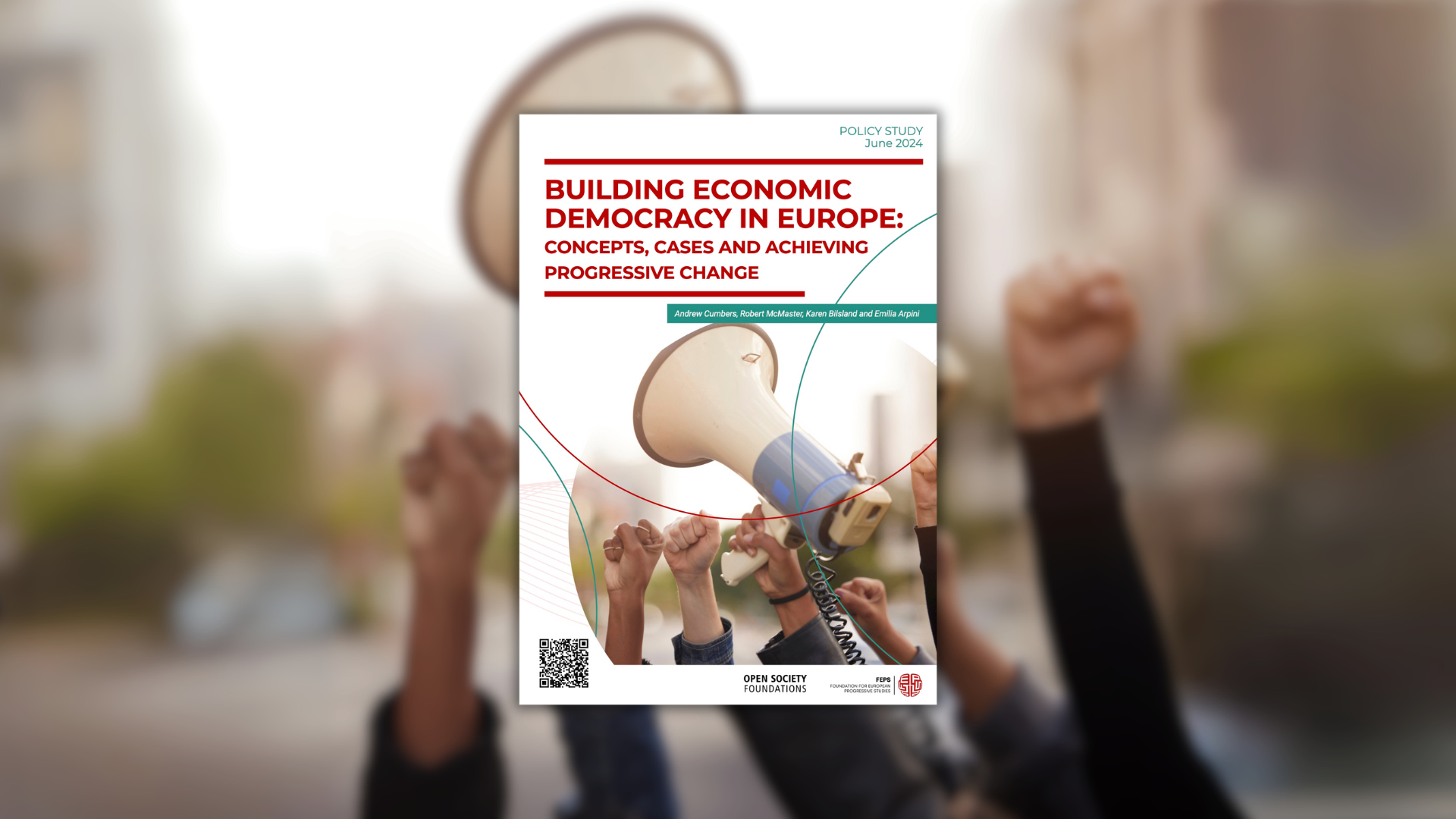
Building Economic Democracy in Europe - Foundation for European Progressive Studies
Concepts, Cases and Achieving Progressive Change
Liquid democracy uses blockchain to fix politics, and now you can vote for it | TechCrunch
Abraham Lincoln famously said that “government of the people, by the people, for the people, shall not perish from the earth,” but looking around these

Democracy Policy Network
Together, we can build the foundation for a deeper democracy.
Data-owning Democracy or Digital Socialism?
This article contrasts two reform proposals articulated in recent debates about how to democratize the digital economy: data-owning democracy and digital socialism. A data-owning democracy is a political-economic regime character-ized by the
Capitalism and markets are closely connected, but they aren't exactly the same thing. And once we recognize that it opens up a huge new terrain for different types of social organization. J.K. Gibson Graham wrote on this a lot. en.wikipedia.org/wiki/J._K._Gibson-Graham
J. K. Gibson-Graham - Wikipedia
en.wikipedia.org
