

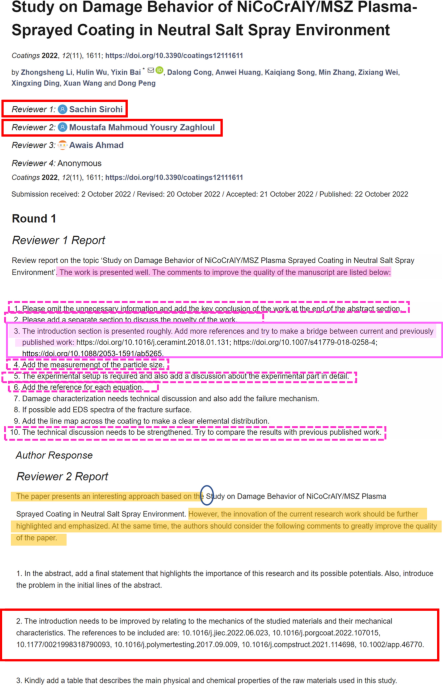
nothing like reviewing a half-assed, unedited, stretched out paper produced by a collaboration of bigwigs that's full of grammatical errors, typos, font changes, copy-paste massacres and doesn't even bother to define the key concept under study
Nov 26, 2025 at 11:10 PM
You can just review things: A digital ethnography of informal peer review
Across scholarly communities, manuscripts face similar evaluative rituals: editors invite experts to privately assess submissions through formal peer reviews. This closed, loosely structured, and...

Science should be machine-readable - Marginal REVOLUTION
One of the leading tasks of our time: We develop a machine-automated approach for extracting results from papers, which we assess via a comprehensive review of the entire eLife corpus. Our method facilitates a direct comparison of machine and peer review, and sheds light on key challenges that must be overcome in order to facilitate […]

Definition of REVIEW
an act or process of carefully looking at or examining the quality, condition, etc., of something or someone; revision… See the full definition

The review mills, not just (self-)plagiarism in review reports, but a step further
Review mills sum up a new category of reviewer misconduct that flies in the face of reviewer ethics and integrity. A pattern of generic, vague, and repeated affirmations (identical or very similar boilerplate phrasing) is noted in the analysis of 263 review reports, regardless of the scientific content of the papers under review, coupled with coercive citation (perhaps among the main reasons for such behavior), which when combined produce fake reviews. The misconduct associated with review mills is unlike mere plagiarism (self-plagiarism) of reviewer comments. It is important to quantify the problem and to take urgent measures: (a) to identify the review millers; (b) to rectify the published literature; and (c) to determine procedures for journals and publishers on procedures to counter this new type of misconduct.
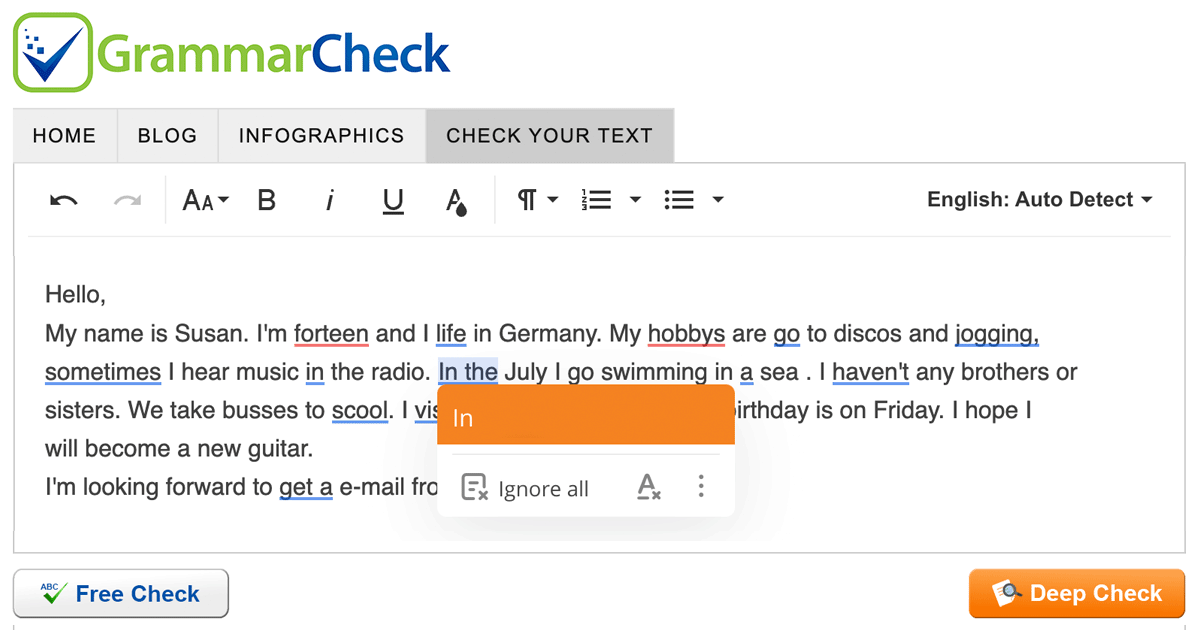
GrammarCheck — Free Writing Editor
Check grammar, track writing goals, measure readability, and time focused writing sessions.
You can just review things: A digital ethnography of informal peer review
Across scholarly communities, manuscripts face similar evaluative rituals: editors invite experts to privately assess submissions through formal peer reviews. This closed, loosely structured, and publisher-mediated process is now being supplemented by critiques on open, distributed platforms. We call this practice, a blend of three open peer review variants, informal peer review as it is accessible to outsiders, unmediated by publishers, and conducted across public platforms. Informal peer reviewers range from occasional error detectors to experienced sleuths who identify plagiarism, fraud, errors, conflicts of interest, and conceptual flaws. They may interpret methods, clarify jargon, assess value, and connect to related work. Here, we asked four questions: (1) Who are informal peer reviewers? (2) Where do they work? (3) How do they evaluate research? and (4) What are their impacts? To answer these questions, we conducted a cross-platform digital ethnography with participant observation. We traced discourse across communities over four months and revisited cases after nine and twelve months. From 15 communities, we selected 12 case mentions (10 unique cases) and 8 meta-commentaries from 26 reviewers. Using open and axial coding, we generated 1,080 codes and four themes: reviewers are a motley crew, they self-organize across subpar digital spaces, use deep, uncommon strategies, and they face resistance from authors, publishers, and editors. Informal peer review, we concluded, is a fragile, minimally governed patchwork of people, platforms, and practices, as well as an emerging evidence infrastructure that can be scaled up. We advise advocates and tool-builders to evolve informal review tools, communities, training, and governance by connecting to scholars' values, reducing participation friction, and rewarding attempts to extend the scholarly dialogue.
Vipul Gupta on Twitter / X
Feels bad to say, but paper writing/reviewing is definitely cooked.Reviewed 4 papers recently and genuinely felt like I spent more time reviewing them than the authors spent writing them.— Vipul Gupta (@vipul_1011) September 19, 2026
Scientific production in the era of Large Language Models
Large Language Models (LLMs) are rapidly reshaping scientific research. We analyze these changes in multiple, large-scale datasets with 2.1M preprints, 28K peer review reports, and 246M online accesses to scientific documents. We find: 1) scientists adopting LLMs to draft manuscripts demonstrate a large increase in paper production, ranging from 23.7-89.3% depending on scientific field and author background, 2) LLM use has reversed the relationship between writing complexity and paper quality, leading to an influx of manuscripts that are linguistically complex but substantively underwhelming, and 3) LLM adopters access and cite more diverse prior work, including books and younger, less-cited documents. These findings highlight a stunning shift in scientific production that will likely require a change in how journals, funding agencies, and tenure committees evaluate scientific works.
Policies Permitting LLM Use for Polishing Peer Reviews Are Currently Not Enforceable
A number of scientific conferences and journals have recently enacted policies that prohibit LLM usage by peer reviewers, except for polishing, paraphrasing, and grammar correction of otherwise human-written reviews. But, are these policies enforceable? To answer this question, we assemble a dataset of peer reviews simulating multiple levels of human-AI collaboration, and evaluate five state-of-the-art detectors, including two commercial systems. Our analysis shows that all detectors misclassify a non-trivial fraction of LLM-polished reviews as AI-generated, thereby risking false accusations of academic misconduct. We further investigate whether peer-review-specific signals, including access to the paper manuscript and the constrained domain of scientific writing, can be leveraged to improve detection. While incorporating such signals yields measurable gains in some settings, we identify limitations in each approach and find that none meets the accuracy standards required for identifying AI use in peer reviews. Importantly, our results suggest that recent public estimates of AI use in peer reviews through the use of AI-text detectors should be interpreted with caution, as current detectors misclassify mixed reviews (collaborative human-AI outputs) as fully AI generated, potentially overstating the extent of policy violations.
Open Evaluation: A Vision for Entirely Transparent Post-Publication Peer Review and Rating for Science
The two major functions of a scientific publishing system are to provide access to and evaluation of scientific papers. While open access (OA) is becoming a reality, open evaluation (OE), the other side of coin, has received less attention. Evaluation steers the attention of the scientific community and thus the very course of science. It also influences the use of scientific findings in public policy. The current system of scientific publishing provides only journal prestige as an indication of the quality of new papers and relies on a non-transparent and noisy pre-publication peer review process, which delays publication by many months on average. Here I propose an OE system, in which papers are evaluated post-publication in an ongoing fashion by means of open peer review and rating. Through signed ratings and reviews, scientists steer the attention of their field and build their reputation. Reviewers are motivated to be objective, because low-quality or self-serving signed evaluations will negatively impact their reputation. A core feature of this proposal is a division of powers between the accumulation of evaluative evidence and the analysis of this evidence by paper evaluation functions (PEFs). PEFs can be freely defined by individuals or groups (e.g. scientific societies) and provide a plurality of perspectives on the scientific literature. Simple PEFs will use averages of ratings, weighting reviewers (e.g. by H-factor) and rating scales (e.g. by relevance to a decision process) in different ways. Complex PEFs will use advanced statistical techniques to infer the quality of a paper. Papers with initially promising ratings will be more deeply evaluated. The continual refinement of PEFs in response to attempts by individuals to influence evaluations in their own favor will make the system ungameable. OA and OE together have the power to revolutionize scientific publishing and usher in a new culture of transparency, constructive criticism, and collaboration.

How LLMs Distort Our Written Language
Large language models (LLMs) are used by over a billion people globally, most often to assist with writing. In this work, we demonstrate that LLMs not only alter the voice and tone of human writing but also consistently alter the intended meaning. First, we conduct a human user study to understand how people actually interact with LLMs when using them for writing. Our findings reveal that extensive LLM use led to a nearly 70% increase in essays that remained neutral in answering the topic question. Significantly more heavy LLM users reported that the writing was less creative and not in their voice. Next, using a dataset of human-written essays that was collected in 2021 before the widespread release of LLMs, we study how asking an LLM to revise the essay based on the human-written feedback in the dataset induces large changes in the resulting content and meaning. We find that even when LLMs are prompted with expert feedback and asked to only make grammar edits, they still change the text in a way that significantly alters its semantic meaning. We then examine LLM-generated text in the wild, specifically focusing on the 21% of AI-generated scientific peer reviews at a recent top AI conference. We find that LLM-generated reviews place significantly less weight on clarity and significance of the research, and assign scores that, on average, are a full point higher. These findings highlight a misalignment between the perceived benefit of AI use and an implicit, consistent effect on the semantics of human writing, motivating future work on how widespread AI writing will affect our cultural and scientific institutions.
How LLMs Distort Our Written Language
Large language models (LLMs) are used by over a billion people globally, most often to assist with writing. In this work, we demonstrate that LLMs not only alter the voice and tone of human writing but also consistently alter the intended meaning. First, we conduct a human user study to understand how people actually interact with LLMs when using them for writing. Our findings reveal that extensive LLM use led to a nearly 70% increase in essays that remained neutral in answering the topic question. Significantly more heavy LLM users reported that the writing was less creative and not in their voice. Next, using a dataset of human-written essays that was collected in 2021 before the widespread release of LLMs, we study how asking an LLM to revise the essay based on the human-written feedback in the dataset induces large changes in the resulting content and meaning. We find that even when LLMs are prompted with expert feedback and asked to only make grammar edits, they still change the text in a way that significantly alters its semantic meaning. We then examine LLM-generated text in the wild, specifically focusing on the 21% of AI-generated scientific peer reviews at a recent top AI conference. We find that LLM-generated reviews place significantly less weight on clarity and significance of the research, and assign scores that, on average, are a full point higher. These findings highlight a misalignment between the perceived benefit of AI use and an implicit, consistent effect on the semantics of human writing, motivating future work on how widespread AI writing will affect our cultural and scientific institutions.
Metaudits
Audits of how completely research is described in DataCite, Crossref, ORCID, OpenAlex and repositories. In English, Spanish and German.
What if paper reading and reviewing was interactive and visual? Tools today assume a very passive way of engaging with a paper: you open a PDF and read linearly, top to bottom. But most of us already break that assumption: results first, figures before text, abstract then conclusion. 🧵 #scisci

