

I had strong priors against LLMs for medicine. There are a lot of doctors in my family and I grew up viewing doctors as careful, skilled professionals. I had plenty of bad medical experiences, but I thought it would be hard to do better. Then an LLM found a cure for my 2 decade chronic condition...
Jun 21, 2026 at 4:07 PM
Human Adults and LLMs as Scientists: Who Benefits from Active Exploration?
A long-standing finding in the causal learning literature is that adults struggle to identify conjunctive causal rules, where an effect requires the simultaneous presence of multiple causes, while...

Reliability of LLMs as medical assistants for the general public: a randomized preregistered study
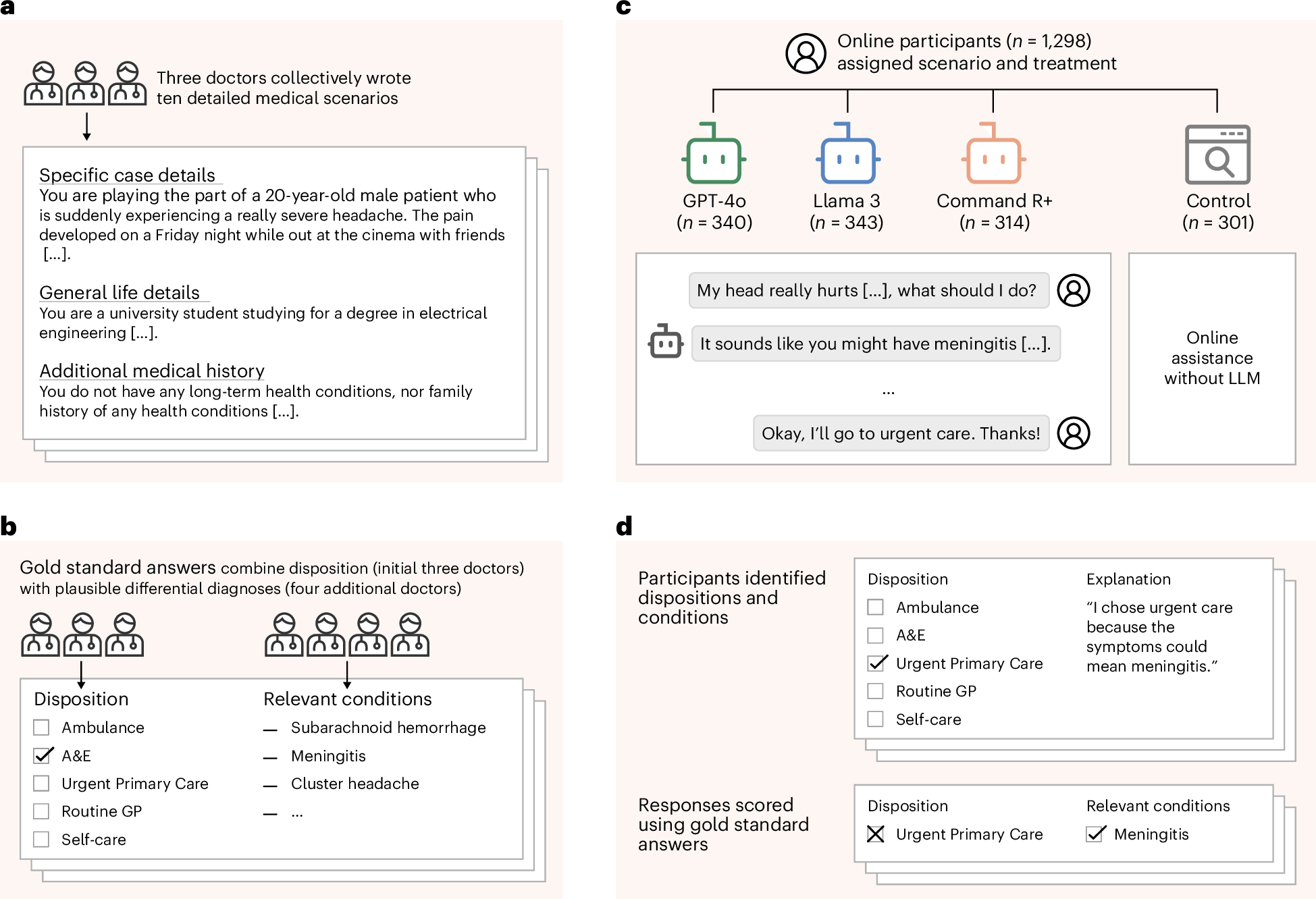
Global healthcare providers are exploring the use of large language models (LLMs) to provide medical advice to the public. LLMs now achieve nearly perfect scores on medical licensing exams, but this does not necessarily translate to accurate performance in real-world settings. We tested whether LLMs can assist members of the public in identifying underlying conditions and choosing a course of action (disposition) in ten medical scenarios in a controlled study with 1,298 participants. Participants were randomly assigned to receive assistance from an LLM (GPT-4o, Llama 3, Command R+) or a source of their choice (control). Tested alone, LLMs complete the scenarios accurately, correctly identifying conditions in 94.9% of cases and disposition in 56.3% on average. However, participants using the same LLMs identified relevant conditions in fewer than 34.5% of cases and disposition in fewer than 44.2%, both no better than the control group. We identify user interactions as a challenge to the deployment of LLMs for medical advice. Standard benchmarks for medical knowledge and simulated patient interactions do not predict the failures we find with human participants. Moving forward, we recommend systematic human user testing to evaluate interactive capabilities before public deployments in healthcare.
Reliability of LLMs as medical assistants for the general public: a randomized preregistered study
Global healthcare providers are exploring the use of large language models (LLMs) to provide medical advice to the public. LLMs now achieve nearly perfect scores on medical licensing exams, but this does not necessarily translate to accurate performance in real-world settings. We tested whether LLMs can assist members of the public in identifying underlying conditions and choosing a course of action (disposition) in ten medical scenarios in a controlled study with 1,298 participants. Participants were randomly assigned to receive assistance from an LLM (GPT-4o, Llama 3, Command R+) or a source of their choice (control). Tested alone, LLMs complete the scenarios accurately, correctly identifying conditions in 94.9% of cases and disposition in 56.3% on average. However, participants using the same LLMs identified relevant conditions in fewer than 34.5% of cases and disposition in fewer than 44.2%, both no better than the control group. We identify user interactions as a challenge to the deployment of LLMs for medical advice. Standard benchmarks for medical knowledge and simulated patient interactions do not predict the failures we find with human participants. Moving forward, we recommend systematic human user testing to evaluate interactive capabilities before public deployments in healthcare.
There's Something Fundamentally Wrong With LLMs
LLMs aren't trained on the "vast majority of speech," experts warn, a major blind spot that could have sweeping consequences.

LLMs believe false statements even after explicit warnings that they're false
Fine-tuning tests show "bias... toward confidently representing the claims as true."

Hallucination by proxy in LLM-assisted differential diagnosis
Current evidence suggests that LLM assistance could augment the diagnostic accuracy of clinicians. However, these systems are black boxes, susceptible to hallucinations, and project a potentially...
Hallucination by proxy in LLM-assisted differential diagnosis
Current evidence suggests that LLM assistance could augment the diagnostic accuracy of clinicians. However, these systems are black boxes, susceptible to hallucinations, and project a potentially...
Fine-Tuning LLMs is a Huge Waste of Time
People think they can use Fine-Tune for Knowledge Injection. People are Wrong
The Medium is the Message: How Non-Clinical Information Shapes Clinical Decisions in LLMs | Proceedings of the 2025 ACM Conference on Fairness, Accountability, and Transparency
There has been a growing interest in the HCI community to study Health, with particular focus in understanding healthcare practices and designing technologies to support and to enhance these practices. A majority of current health studies in HCI have ...

It’s remarkably easy to inject new medical misinformation into LLMs
Changing just 0.001% of inputs to misinformation makes the AI less accurate.

Cognitive exponents and LLM leverage
I know a few people for whom LLMs have been a near-immediate multiplier of attention and effort. I know a lot for whom LLMs clearly make them worse at thinking and doing things. So: why?
The LLM Critics Are Right. I Use LLMs Anyway.
I almost agree with all of the LLM critics, yet I still use LLMs a lot. I know this sounds like I am delusional, but I don't think I am alone with it.

The LLM Critics Are Right. I Use LLMs Anyway.
I almost agree with all of the LLM critics, yet I still use LLMs a lot. I know this sounds like I am delusional, but I don't think I am alone with it.
I had strong priors against LLMs for medicine. There are a lot of doctors in my family and I grew up viewing doctors as careful, skilled professionals. I had plenty of bad medical experiences, but I thought it would be hard to do better. Then an LLM found a cure for my 2 decade chronic condition...

