

Do our social media algorithms correctly reflect our values? Our new article published today in @pnas.org shows that the answer is often not, and that the content that gets promoted into their ranked feeds is often actively counter to our values.
Aug 19, 2026 at 1:19 PM
Value misalignment in X’s feed algorithm is a reflection of value tensions in engagement
Social media feed algorithms rank content that is purported to be preferred by users, but the engagement behaviors that drive these algorithms are (at best) indirect proxies for users’ explicitly self-stated values. Are the resulting feeds value aligned, and if not, why? We investigate this question by annotating the basic human values expressed in participants’ X (Twitter) feeds (N = 715 US users), analyzing the relationship between the posts’ value expressions and the posts’ amplification in the ranked “For You” Page feed, and then comparing the amplified values to users’ own values. We observe that the inventory of posts from followed accounts reflects users’ self-stated values—but that there is an overall negative correlation (misalignment) between users’ explicit values and the value expressions the algorithm is more likely to amplify. We turn to engagement behavior to understand this misalignment and observe that users’ engagement behaviors can be misaligned with their stated values—likely causing the algorithm to learn and reflect these misaligned values. We also detect partisan differences consistent with this theory: While the algorithm amplifies values negatively correlated with both Democrats’ and Republicans’ self-stated values, they are more misaligned for Democrats. And in fact replying, a heavily weighted form of engagement, is associated with values that are less aligned for both Democrats’ and Republicans’ self-stated values, and is even more misaligned for Democrats. Taken together, these findings offer a glimpse into the tensions between the values that people hold and those that provoke reactions, and how these value tensions can produce misaligned outcomes.

Value misalignment in X’s feed algorithm is a reflection of value tensions in engagement
Social media feed algorithms rank content that is purported to be preferred by users, but the engagement behaviors that drive these algorithms are (at best) indirect proxies for users’ explicitly self-stated values. Are the resulting feeds value aligned, and if not, why? We investigate this question by annotating the basic human values expressed in participants’ X (Twitter) feeds (N = 715 US users), analyzing the relationship between the posts’ value expressions and the posts’ amplification in the ranked “For You” Page feed, and then comparing the amplified values to users’ own values. We observe that the inventory of posts from followed accounts reflects users’ self-stated values—but that there is an overall negative correlation (misalignment) between users’ explicit values and the value expressions the algorithm is more likely to amplify. We turn to engagement behavior to understand this misalignment and observe that users’ engagement behaviors can be misaligned with their stated values—likely causing the algorithm to learn and reflect these misaligned values. We also detect partisan differences consistent with this theory: While the algorithm amplifies values negatively correlated with both Democrats’ and Republicans’ self-stated values, they are more misaligned for Democrats. And in fact replying, a heavily weighted form of engagement, is associated with values that are less aligned for both Democrats’ and Republicans’ self-stated values, and is even more misaligned for Democrats. Taken together, these findings offer a glimpse into the tensions between the values that people hold and those that provoke reactions, and how these value tensions can produce misaligned outcomes.
Social Media Feed Ranking Algorithms: Guide to Field Experiments
IC2S2'26 Tutorial | Social Media Feed Ranking Algorithms: Guide to Field Experiments
The Prosocial Ranking Challenge: Reducing Polarization on Social...
We report the first direct comparisons of multiple alternative social media algorithms on multiple platforms on outcomes of societal interest. We used a browser extension to modify which posts...

Social media algorithms can be redesigned to bridge divides — here’s how
"It falls to both the tech companies that built these systems and an engaged public to create technologies designed for social cohesion."

Reranking partisan animosity in algorithmic social media feeds alters affective polarization
Today, social media platforms hold the sole power to study the effects of feed-ranking algorithms. We developed a platform-independent method that reranks participants’ feeds in real time and used this method to conduct a preregistered 10-day field ...

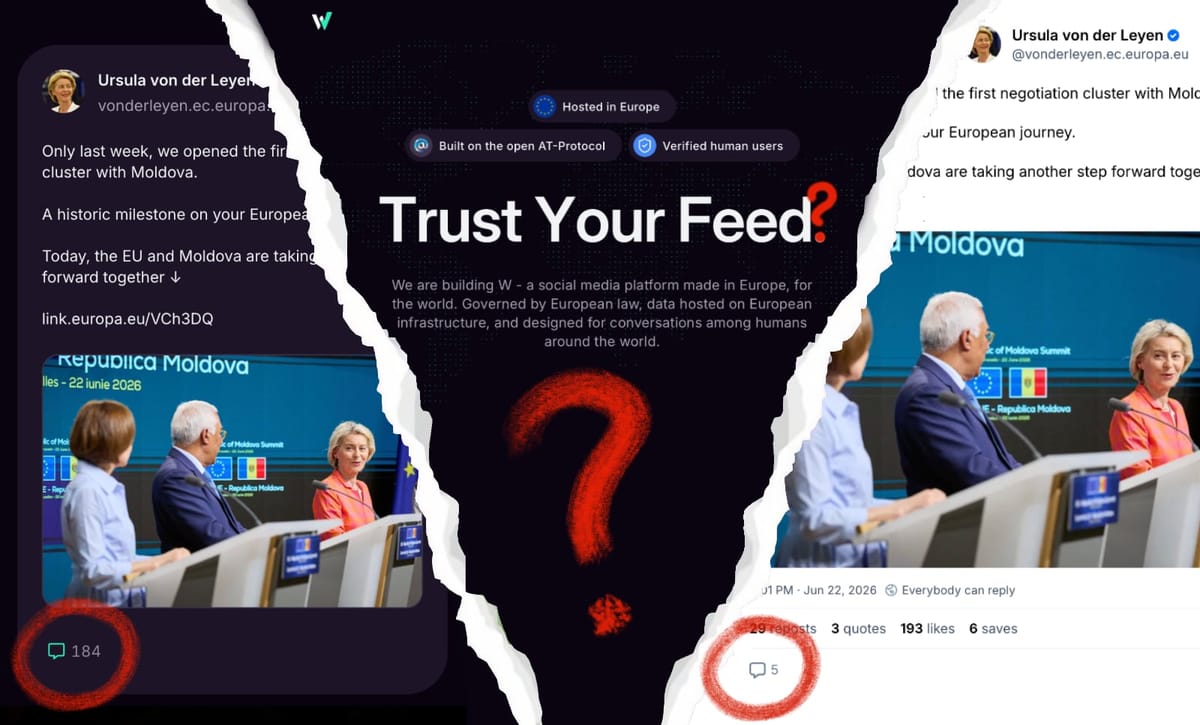
W Social, Fictional Metrics and the Beauty of Open Data
W Social's tagline is "Trust Your Feed" but the company's landing page displays inflated engagement metrics - a misrepresentation that contradicts its own promise.
Social Media Algorithms Distort Social Instincts and Fuel Misinformation - Neuroscience News
Social media algorithms, designed to boost user engagement for advertising revenue, amplify the biases inherent in human social learning processes, leading to misinformation and polarization.

Elena Rossini 🌈 (@_elena@mastodon.social)
SCOOP: #WSocial is doctoring metrics on its homepage, inflating the number of comments on posts by prominent people on its network. I suppose a more accurate tagline for them should be "Trust your feed?" My article about it: "W Social, Fictional Metrics and the Beauty of Open Data" 🔗 : https://blog.elenarossini.com/w-social-fictional-metrics-and-the-beauty-of-open-data/ #blog #BigTech #EUBigTech #TEP #TrustedEuropeanPlatforms #TrustYourFeed
From Feeds to Trails
To design the future of social media, rethink the interface before the algorithm.
The Algorithm, Singular
A new European ruling on algorithmic amplification determines if an operator controls how content spreads on a platform. But applying it to open social networks turns out to be a problem.

Bridging-Based Ranking
There is significant concern about the engagement-based ranking systems used by TikTok, Facebook, YouTube, etc. to recommend content. Bridging-based ranking systems can address one of the most dangerous aspects of such algorithmic recommendations—the push toward polarization and divisiveness that is tearing nations apart—and do so without reducing anonymity or increasing censorship. This report explores what bridging-based ranking is, how it helps (overcoming downsides of chronological feeds and middleware), addresses common objections, and provides early examples of its use and benefits in the wild. The report concludes by providing next steps for platforms, governments, funders, and researchers in order to accelerate the deployment of bridging.
Why are we incentivized to make social media worse? What makes KPIs so meaningless? Perverse incentives! #incentives #socialmediastrategist #tokenmaxxing #tokenburn #algorithms
✨New paper out @nature.com ✨ For 8 weeks around the 2024 US election, we randomly assigned 2,000 people to use social media algos we built ourselves. Do engagement-based algorithms amplify intergroup, moral & emotional (IME) content—and does that distort how we see political norms? 🧵🔗 👇
Do our social media algorithms correctly reflect our values? Our new article published today in @pnas.org shows that the answer is often not, and that the content that gets promoted into their ranked feeds is often actively counter to our values.
Social media algorithms don't allow us to understand or control what we see online and why... until now! Top scholars @jonathanstray.com and @noupside.bsky.social are sharing @mysky.social, a tool that allows users to adjust their feed’s priorities and explains why certain posts appear over others.

🎛️📲 Meet the algorithm you can actually control and understand
newpublic.substack.com

