We just finished a restructuring. The website is now the source of truth for governance, the schemas moved to Tangled, NSID resolution got a dedicated identity, and the process is lighter. The story is on the new blog: blog.lexicon.community/a/3mrlquupo2a23-reintroducing…
Jul 28, 2026 at 5:18 PM

Announcing Ibis, the federated Wikipedia Alternative — ibis.wiki
Wikipedia is the most popular online encyclopedia, and millions of people rely on it every day to provide trustworthy information on a wide variety of topics. It is not well known but there have been numerous scandals which put this trust into question. For example in 2012, a trustee of the Wikimedia Foundation UK used his position to place his PR client on Wikipedia's front page 17 times within a month. Wikipedia founder Jimmy Wales made extensive edits to the article about himself, removing mentions of co-founder Larry Sanger. In 2007, a prolific editor who claimed to be a graduate professor and was recruited by Wikipedia staff to the Arbitration Committee was revealed to be a 24-year-old college dropout. These are only a few examples, journalist Helen Buyniski has collected much more information about the the rot in Wikipedia.
Standard.site and Why Coordination Matters More Than You Think - Ewan’s Blog
Interoperability! …and more?
Standard.site and Why Coordination Matters More Than You Think - Ewan’s Blog
Interoperability! …and more?
Embedded Governance: Control That Works by Disappearing - Astral's Blog
A Knowledge Commons for the 21st Century
Truth-seeking infrastructure at scale
Steps Towards an Infrastructure for Scholarly Synthesis
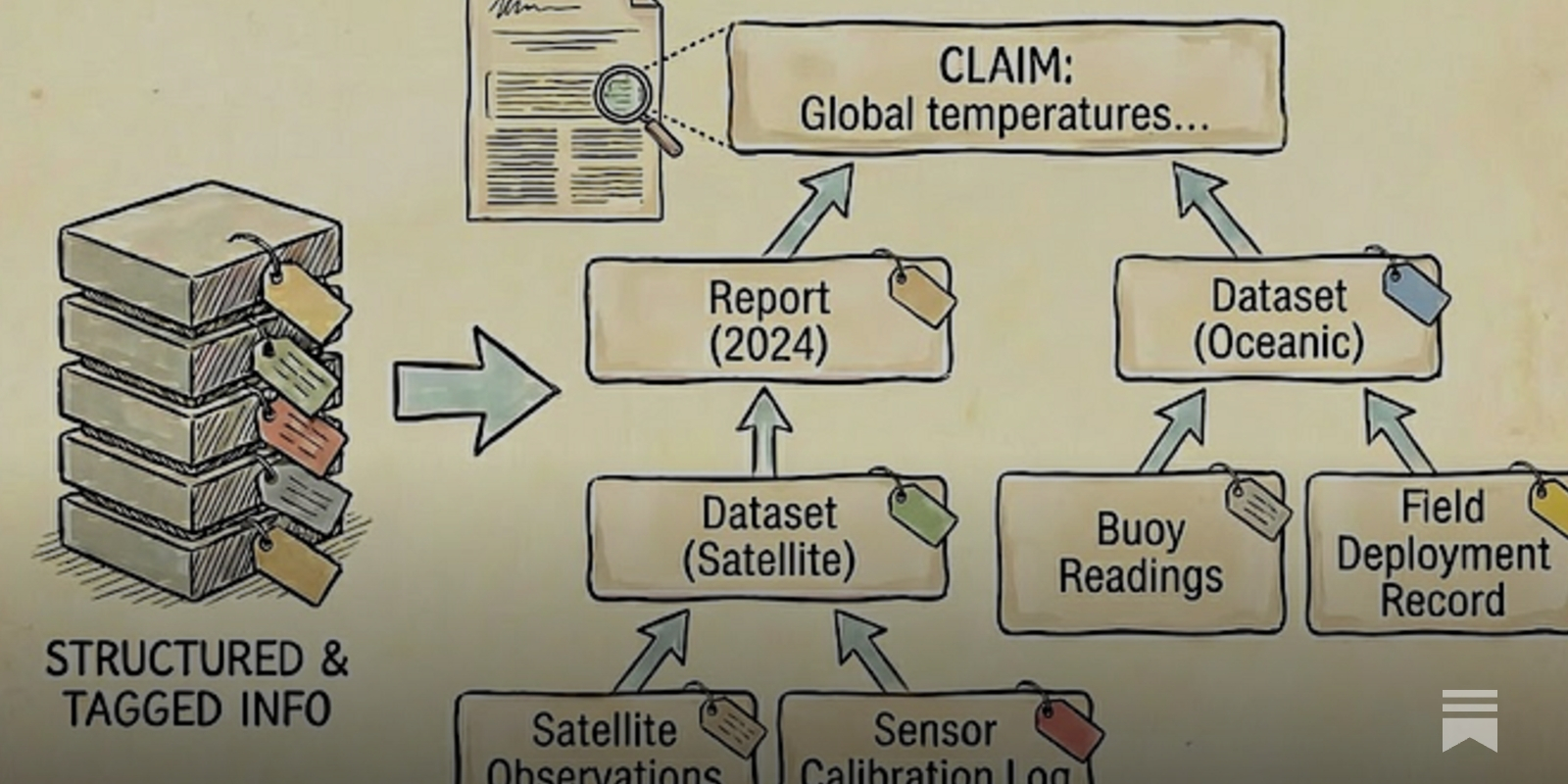
Sharing, reusing, and synthesizing knowledge is central to the research process, both individually, and with others. These core functions are not supported by our formal scholarly publishing infrastructure: instead of the smooth functioning of functional infrastructure, researchers resort to laborious ”hacks” and workarounds to ”mine” publications for what they need, and struggle to efficiently share the resulting information with others. Information scientists have proposed an alternative infrastructure based on the more appropriately granular model of a discourse graph of claims, and evidence, along with key rhetorical relationships between them. However, despite significant technical progress on standards and platforms, the predominant infrastructure remains steadfastly document-based. Drawing from infrastructure studies, we locate the current infrastructural bottlenecks in the lack of local systems that integrate discourse-centric models to augment synthesis work, from which an infrastructure for synthesis can be grown. Through 3 years of research through design and field deployment in a distributed community of hypertext notebook users, we elaborate a design vision of what can and should be built in order to grow a discourse-centric synthesis infrastructure: a thriving “installed base” of researchers authoring local, shareable discourse graphs to improve synthesis work, enhance primary research and research training, and augment collaborative research. We discuss how this design vision — and our empirical work — contributes steps towards a new infrastructure for synthesis, and increases HCI’s capacity to advance collective intelligence and solve infrastructure-level problems.

epistemic garden - mapping how ideas spread online
We're building tools to help communities understand their information landscape and protect against harmful coordinated narratives.
Steps Towards an Infrastructure for Scholarly Synthesis
Sharing, reusing, and synthesizing knowledge is central to the research process, both individually, and with others. These core functions are not supported by our formal scholarly publishing infrastructure: instead of the smooth functioning of functional infrastructure, researchers resort to laborious "hacks" and workarounds to "mine" publications for what they need, and struggle to efficiently share the resulting information with others. Information scientists have proposed an alternative infrastructure based on the more appropriately granular model of a discourse graph of claims, and evidence, along with key rhetorical relationships between them. However, despite significant technical progress on standards and platforms, the predominant infrastructure remains steadfastly document-based. Drawing from infrastructure studies, we locate the current infrastructural bottlenecks in the lack of local systems that integrate discourse-centric models to augment synthesis work, from which an infrastructure for synthesis can be grown. Through 3 years of research through design and field deployment in a distributed community of hypertext notebook users, we elaborate a design vision of what can and should be built in order to grow a discourse-centric synthesis infrastructure: a thriving "installed base" of researchers authoring local, shareable discourse graphs to improve synthesis work, enhance primary research and research training, and augment collaborative research. We discuss how this design vision -- and our empirical work -- contributes steps towards a new infrastructure for synthesis, and increases HCI's capacity to advance collective intelligence and solve infrastructure-level problems.

FediForum | Growing the Open Social Web un-workshop, 2026/03/02

Yep. This is what is missing in the ATProto vision. The lexicons should've been a like schema.org instead of domain name-based. Everyone who wants to improve it can discuss it, similar to, well, schema.org. The frontend must be separate from the content. It's beneficial in many ways.
jack
we have standard.site but wen standard.pics? rn I’m juggling between @grain.social, @flashes.blue & @sprk.so for image sharing 😭
Yep. This is what is missing in the ATProto vision. The lexicons should've been a like schema.org instead of domain name-based. Everyone who wants to improve it can discuss it, similar to, well, schema.org. The frontend must be separate from the content. It's beneficial in many ways.
jack
we have standard.site but wen standard.pics? rn I’m juggling between @grain.social, @flashes.blue & @sprk.so for image sharing 😭
Conversation here is very helpful framing for ATProto builders. The protocol has re-created the opportunity to restore the web as an open curation ecosystem that isn't controlled by any one platform, built not just on links between pages, but on the relationships between people, links and sources.
Building Through Every Wave: Mike Mcue on the Internet, Mobile, & AI Eras
www.youtube.comMy "Introduction to #ATProto" blog post that I've been working on for some time is ready 🙂 It goes through things like records, lexicons, DIDs, then PDS/AppView etc. and how it all works together. Let me know if anything is wrong! More parts later, with the Fedi comparisons & misconceptions etc.
Introduction to AT Protocol
mackuba.eu