

Frontiers In Research webinar on changes in science communication, the role of social media, and new infrastructure/tools - tomorrow (7/18) at 2 pm ET Looking forward to chatting with @ronentk.me & @joelchan86.bsky.social luma.com/7l18yyg4

Frontiers In Research: Open Science · Zoom · Luma
luma.comJun 17, 2026 at 7:28 PM
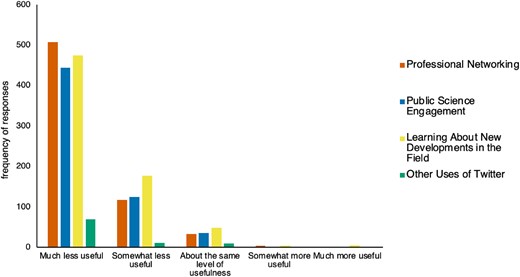
Scientists no Longer Find Twitter Professionally Useful, and have Switched to Bluesky
Synopsis Social media has become widely used by the scientific community for a variety of professional uses, including networking and public outreach. For the past decade, Twitter has been a primary home of scientists on social media. In recent years, new leadership at Twitter has made substantive changes that have resulted in increases in the prevalence of pseudoscience, conspiracy theory, and harassment on the platform, causing many scientists to seek alternatives. Bluesky has been suggested as a good alternative to Twitter, but the phenomenon of academics switching social media platforms has not previously been studied. Here we report on the results of a survey distributed to scientists on Twitter and Bluesky (n = 813). Results overwhelmingly confirm that changes to Twitter have made the social media platform no longer professionally useful or pleasant, and that many scientists have abandoned it in favor of Bluesky. Results show that for every reported professional benefit that scientists once gained from Twitter, scientists can now gain that benefit more effectively on Bluesky than on Twitter.
Sensemaking Networks: Project Introduction - Cosmik Labs
Incorporating science social media into the scientific process
Future of Science Social Media - ATmosphereConf 2026
The Astrosky Ecosystem: An independent online platform for science communication and social networking
While almost everything that astronomers study occurs in the vacuum of space, astronomy itself does not `happen in a vacuum'. Interactions between scientists, as well as outreach to members of the public, improve extensively from access to good communication tools. Social media has become a key tool for communication in astronomy, being widely used by individuals and organizations alike for networking, outreach, and more. However, traditional social media is reliant on benevolent corporations providing a free service without compromising on quality, and the recent takeover and decline of Twitter has shown how vulnerable these platforms can be. In this proceeding, we present The Astrosky Ecosystem, which is an initiative to develop open-source tools and integrations for social media, principally the Bluesky social network. We explain how our project enables the astronomy community to operate its own social media infrastructure, independent of for-profit corporations. We also discuss some of the project's technical aspects, including its use of the AT Protocol for social networking, before concluding with ideas for the future.

On open-science research labs on discord and online , and getting more people.
Scientists no Longer Find Twitter Professionally Useful, and have Switched to Bluesky
Synopsis. Social media has become widely used by the scientific community for a variety of professional uses, including networking and public outreach. For
Scientists no Longer Find Twitter Professionally Useful, and have Switched to Bluesky
Synopsis. Social media has become widely used by the scientific community for a variety of professional uses, including networking and public outreach. For
Sensemaking Networks: Transforming Social Media into a Sensemaking Layer for Science | Ronen Tamari
Sensemaking Networks is a project aiming to address three interrelated limitations of the current science publishing and communication infrastructure: (1) poor reach and feedback, (2) knowledge fragmentation, and (3) rigid formats. To address these issues, Sensemaking Networks combine two promising trends in science publishing and communication: science social media and semantic nanopublishing. While science social media significantly impacts scientific processes and public engagement, it lacks formal recognition and accessibility. On the other hand, nanopublications offer the benefits of formal scientific publishing and machine-readable knowledge representation. Their integration represents a promising direction that could serve as a transformative sensemaking layer for science, enhancing the collective synthesis, dissemination, and evaluation of research.

Sensemaking Networks Part 3: building partnerships and prototypes - Cosmik Labs
Semantic cross-posters for re-integrating science social media
Empowering science communities with open, democratic, researcher-owned infrastructure.
We’re building communities and tech for publishing, curating, sharing, and discussing research online using ATProto and other decentralized protocols.
Empowering science communities with open, democratic, researcher-owned infrastructure.
We’re building communities and tech for publishing, curating, sharing, and discussing research online using ATProto and other decentralized protocols.
Science Works on Twitter / X
London AI × Science Hackathon 👾Science Works × @inherent_labs • Oct 16-18Lots of scientific software is outdated, hard to use, and isn't interoperable – let alone making use of (or ready to interface with) AI.Or it's expensive. Join us to build better for the community pic.twitter.com/42Qq528DDw— Science Works (@sci_works) September 30, 2026
A new study suggests that scientists are leaving X (formerly known as Twitter) in significant numbers due to its declining professional value. Many now find Bluesky to be a more effective platform for networking, outreach, and staying updated on research.
36K votes, 1.1K comments. 34M subscribers in the science community. This community is a place to share and discuss new scientific research. Read…
Growing the Social Web
I'm going to be participating in the Growing the Open Social Web workshop at Fediforum on March 2, 2026. I'm excited to talk to other people who care about the Fediverse about ways to connect more people through ActivityPub. Fediforum invited attendees to publish position papers before the workshop. SWF has a number of hypotheses…

Science Communication as a Collective Intelligence Endeavor: A Manifesto and Examples for Implementation
Effective science communication is challenging when scientific messages are informed by a continually updating evidence base and must often compete against misinformation. We argue that we need a new program of science communication as collective intelligence—a collaborative approach, supported by technology. This would have four key advantages over the typical model where scientists communicate as individuals: scientific messages would be informed by (a) a wider base of aggregated knowledge, (b) contributions from a diverse scientific community, (c) participatory input from stakeholders, and (d) better responsiveness to ongoing changes in the state of knowledge.

Excited to invite you to a panel I'll be on next week w/ @richardsever.bsky.social @joelchan86.bsky.social! We’ll discuss the future of open-access, new modular research tools (eg @discoursegraphs.bsky.social) and the role of social media in scientific discourse (@cosmik.network @atproto.science ..)

Frontiers In Research: Open Science · Zoom · Luma
luma.com
