

Brandon Stewart on Twitter / X
1/ New @Nature! We study how powerful institutions shape the information environment for LLMs. Commercial LLM training is opaque, so we trace a path from state-coordinated media -> training data -> model responses. pic.twitter.com/5LdFvzbFaf— Brandon Stewart (@b_m_stewart) May 13, 2026
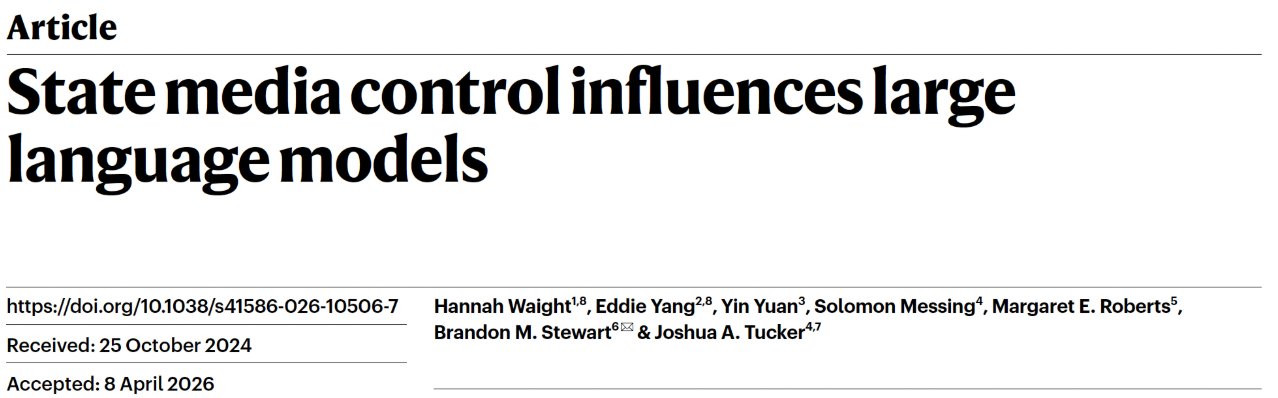
Curated retrieval versus open web search in public AI information...
Public institutions increasingly use large language models (LLMs) to answer citizens' questions, often pairing a curated knowledge base with live web search, yet whether the sources behind these...

Search has its own bitter lesson
Human incentives to make content findable to your search matter more than technology

Digital Sovereignty
Digital sovereignty has a bad reputation. In internet governance circles, sovereignty is considered awkward enough to be referred to by as the "s-word." It is often associated with misguided attempts at returning to the era of national champions, like building a French search engine or a European Google, or worse with the eternal boogeyman that is the "splinternet." It doesn't have to be this way!

How AI Will Reshape Public Opinion
Social media democratised public opinion, shifting influence away from elites and experts to ordinary people. LLMs will partly reverse this trend. They are a powerful, new technocratising force.

David Dill: Why Online Voting Is a Danger to Democracy
A Stanford computer scientist says Internet voting would be "a complete disaster."

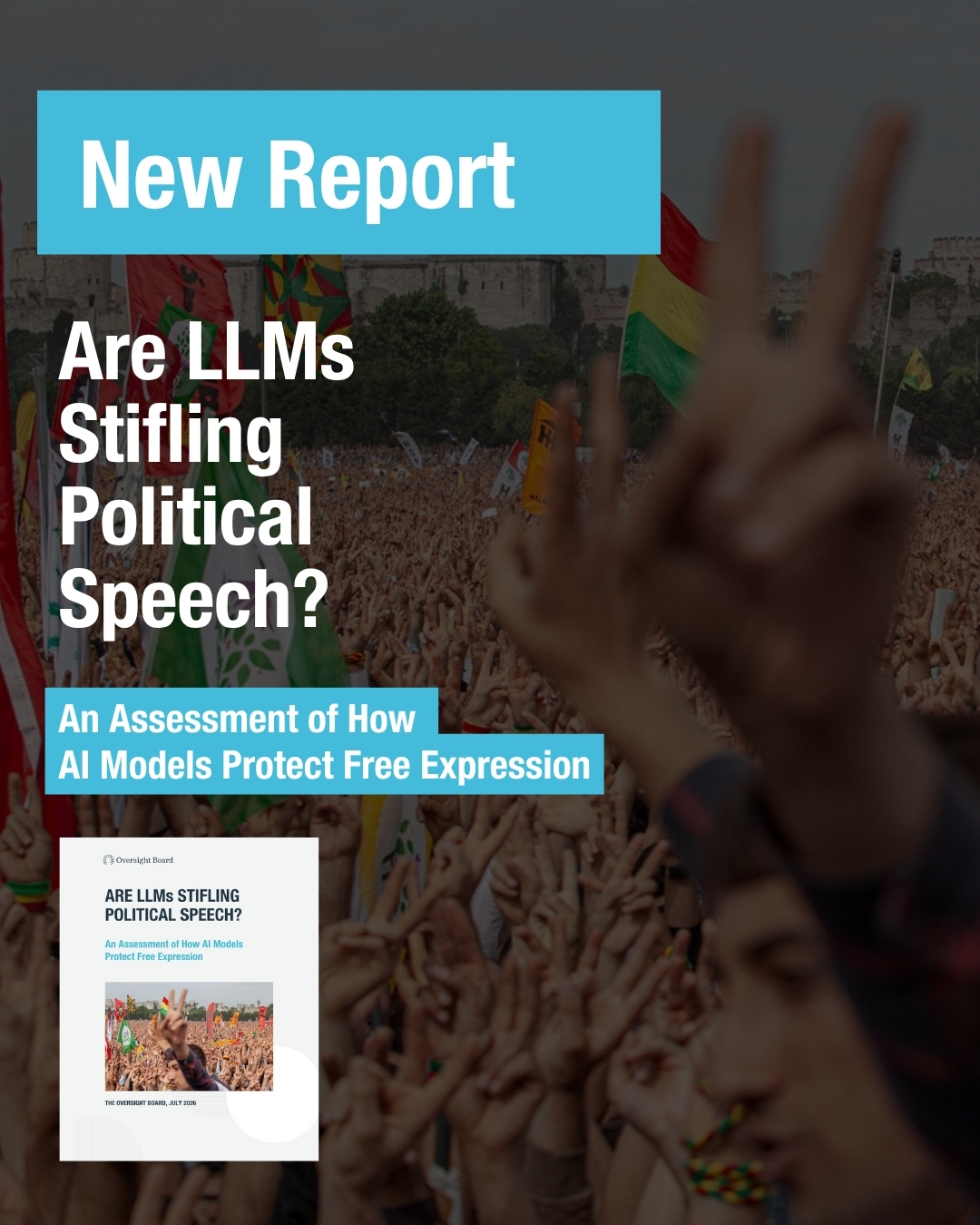
Are LLMs Stifling Political Speech? An Assessment of How AI Models Protect Free Expression | Oversight Board
The Oversight Board’s first evaluation of large language models (LLMs) shows that some of the world’s most-used models from Anthropic, DeepSeek, Google, Meta
The architecture of the internet creates risks for democracy
Will democracy survive the internet? Do we need to choose between Facebook’s surveillance capitalism or democracy? Layered lines of evidence can inform questions like these. When considered together, the evidence gives rise to a concerning picture, as summarized in a recent report for the European Commission that I co-led.

Reclaiming the Computing Commons
Resisting the commodification of information is a political struggle, not a technical one.

AI and the Future of Digital Public Squares
Two substantial technological advances have reshaped the public square in recent decades: first with the advent of the internet and second with the recent introduction of large language models (LLMs). LLMs offer opportunities for a paradigm shift towards more decentralized, participatory online spaces that can be used to facilitate deliberative dialogues at scale, but also create risks of exacerbating societal schisms. Here, we explore four applications of LLMs to improve digital public squares: collective dialogue systems, bridging systems, community moderation, and proof-of-humanity systems. Building on the input from over 70 civil society experts and technologists, we argue that LLMs both afford promising opportunities to shift the paradigm for conversations at scale and pose distinct risks for digital public squares. We lay out an agenda for future research and investments in AI that will strengthen digital public squares and safeguard against potential misuses of AI.
Fractured reality
The report examines the evolving impact of digital technologies on European democracy. In an era of a global struggle to control the information space, this report offers critical insights into the fracturing of perceived realities, the rise of the ‘fantasy-industrial complex’, and the systemic risks posed by the attention economy. It exposes how platforms algorithmically prioritise engagement over accuracy, reinforcing ideological echo chambers and amplifying mis- and disinformation that erode democratic resilience. The report highlights how structural incentives and foreign control of the most important players in the information space undermine information integrity, collective knowledge and civic discourse. In response, the report presents a number of recommendations from fostering alternative public spaces and crowd-sourced knowledge systems to reforming business models, restoring user agency, and advancing EU digital sovereignty through decentralised infrastructure
Reclaiming the Computing Commons
Hunter writes: The commodification and exploitation of nature; the enclosure of the intellectual and informational commons in medicine, agriculture, and other areas of technical knowledge; the expropriation of public space to secure profit-all define an economic system supposedly premised on freedom.
‘Doom Loop’: OpenAI and Microsoft Admits LLMs Are Destroying the Web and Built on Theft
"Millions of people around the world will soon consider large models ‘hoovering up’ all their work to be an astonishing theft of unprecedented proportions."

Lincoln Michel on Twitter / X
This was my read on AI from the beginning and it proved very true. Whatever hypothetical benefits LLMs have (and they have some), their main use is to waste everyone's time wading through slop. Longer colleague powerpoints. More spam emails. More slop clogging up all the systems. https://t.co/2gtGfqf7KF— Lincoln Michel (@TheLincoln) September 21, 2026
What the Hell is Going On? - David Perell
David shares how the new age of information abundance is transforming commerce, education, and politics. Read here.

Fix the internet, save democracy

The internet has evolved into a state that is actively hostile towards global democracy. A thesis is emerging that to save global democracy, you must fix the internet.

The IndieWeb Is Punk Manifesto

The Retweeting Class

Funding The Web: From Cartel to Covenant

Protocols, Not Platforms: A Technological Approach to Free Speech
The architecture of the internet creates risks for democracy