

If WSocial sold people on the idea that everyone they would interact with is ID-verified, then indeed, every single open ATProto community would act as a back door of sorts. The only way for them to deliver would be to de-federate entirely. And it's always a bad idea to bet against openness.

Wimster9030 🇪🇺 🇧🇪
I know, Daniel, but that's not the way WSocial "sold" it to us. We could only access trough ID-verification so we know for 100% they are EU and a "real person". That was the whole point. So we went trough that process, but now it seems that the backdoor are the other ATProt platforms to get in too.
Jul 6, 2026 at 12:37 PM
Ricardo J. Méndez (@ricardo.bsky.social)
If WSocial sold people on the idea that everyone they would interact with is ID-verified, then indeed, every single open ATProto community would act as a back door of sorts. The only way for them to deliver would be to de-federate entirely. And it's always a bad idea to bet against openness.

Wimster9030 🇪🇺 🇧🇪 (@wimster9030.wsocial.eu)
I know, Daniel, but that's not the way WSocial "sold" it to us. We could only access trough ID-verification so we know for 100% they are EU and a "real person". That was the whole point. So we went trough that process, but now it seems that the backdoor are the other ATProt platforms to get in too.
WG Community Standards
A community space for coordinating, convening, and collaboration around ATProto
Trust Infrastructure on ATproto
I agree with Nick that you have noted a big hard problem, with Zooko’s triangle type trade-offs. (For a semi-related example that is “easier” but still crazy difficult, see our “PeerFlow: Secure Load Balancing in Tor” https://doi.org/10.1515/popets-2017-0017 ) As noted or implied already in this thread: in the end, if someone can cheaply spin up indefinite unlinked identities and build good reputations for them, and if trust is based on such reputations, it is hard (impossible?) to avoid them s...
On verification and coordination authority - Connected Places
Who verifies the atproto developer community, and why can't it be the community itself?
[Proposal] WG for group/community standards and infrastructure in ATProto
Interested in contributing — specifically to Phase 1 (shared ontology and community archetypes). I’m a cognitive linguist and university researcher. My work on the AT Protocol side includes Mezzanine, an information networking system using opaque cashtag connectors as a routing layer, and two Leaflet pieces on community infrastructure as a gradient — from permissionless tag-based commons to credentialed spaces. The reason I’m flagging my disciplinary background: Phase 1 is where this WG will e...
Elena Rossini 🌈 (@_elena@mastodon.social)
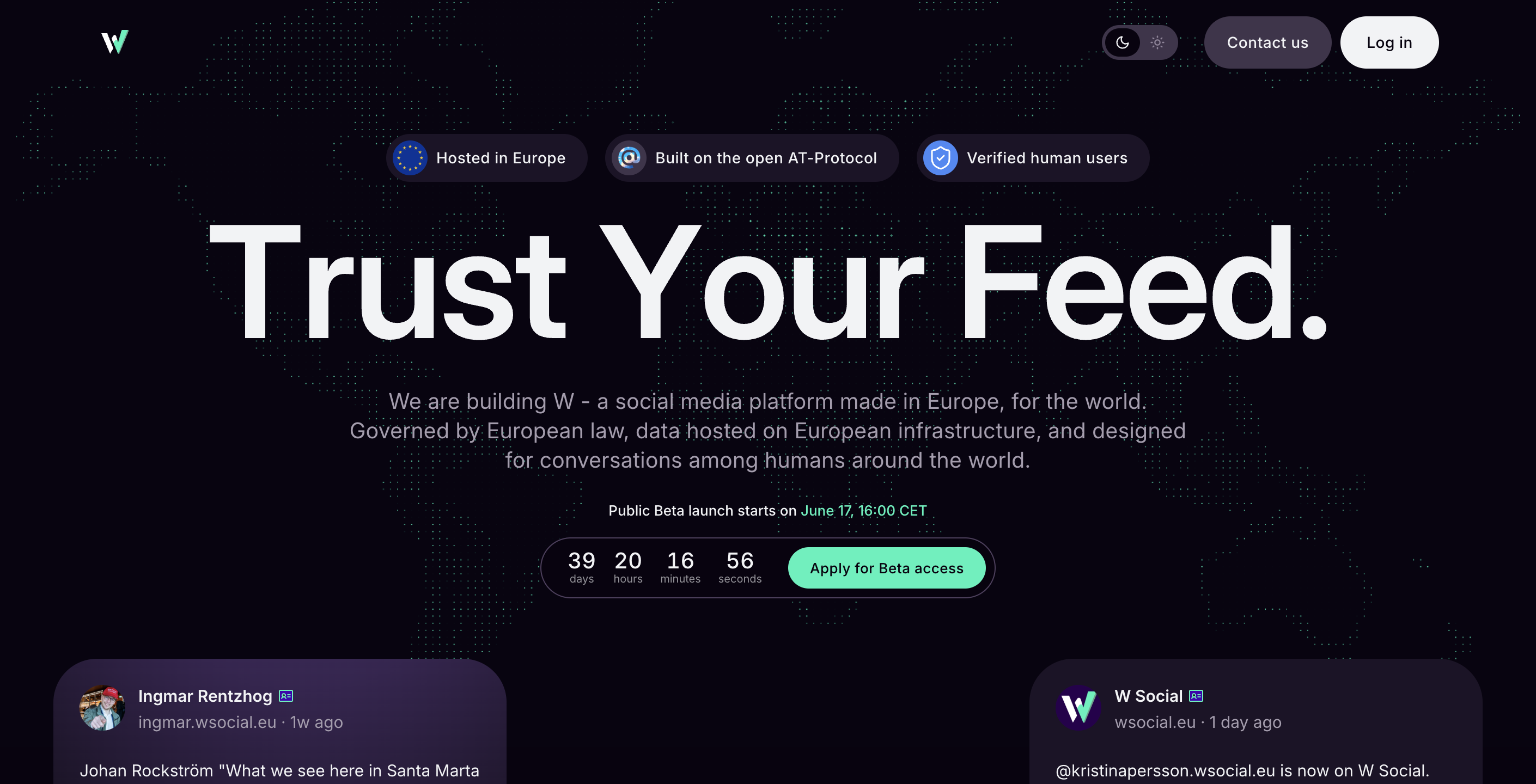
Attached: 2 images I just refreshed the #WSocial website and it's showing a MAJOR redesign... with a label at the top stating "built on the open AT-protocol." This is the first time ever they acknowledge this – I know, as I've been visiting their website for MONTHS and also never heard about this in any interviews. So the claims in my exposé stand (the Internet Archive's Wayback Machine would confirm this). Of note: they changed their URL from wsocial.eu to wsocial.news BTW thanks for all your feedback ❤️
Wimster9030 🇪🇺 🇧🇪 (@wimster9030.wsocial.eu)
@wsocial.eu - I was one of the first to subscribe after Davos, but now I wonder what's the use of WSocial. We had to show our ID to get access, but now it seems there are many backdoors without the need for verification. Maybe I just go back to Mastodon. Nice try, but I feel a little betrayed.
Adversarial PLC directory migration - microcosm
Contingency planning: what's our credible failover for the centralized underpinning of ATProto identities?
Adversarial PLC directory migration - microcosm
Contingency planning: what's our credible failover for the centralized underpinning of ATProto identities?
I don't deal in protocol wars, I place lots of bets on open tech. But there's a reason I don't typically expect durable open protocols to come from VC backed for-profit. If ATProto succeeds long term — it does show promise — it'll be in spite of Bluesky PBC, and thanks to the rest of the ecosystem.
So many people do not get this. Atproto identity is the closest thing to original-flavor OpenID that has been done in years. It's not OpenID (it has problems OpenID didn't and solves problems OpenID had), but it's very much in that spirit.

hailey
i guess in a way this is the most widely used one, but also one that is severely underused in other ways. definitely identity. i've long been of the opinion that there are obviously cool things that come from public data and all the public pieces of the proto, but identity is higher impact.
@wsocial.eu - I was one of the first to subscribe after Davos, but now I wonder what's the use of WSocial. We had to show our ID to get access, but now it seems there are many backdoors without the need for verification. Maybe I just go back to Mastodon. Nice try, but I feel a little betrayed.
Once you experience shared lexicons and the benefits of a single portable identity, it feels like a new open network. But the most important part is that it practically works as an extension of the web. We can add social features to our websites without even mentioning atproto. Frictionless adoption

P(aul) Frazee
The Atmosphere is a new open network. The features: - Your account works on all atmosphere apps - You can switch to a new provider with no fuss - Easy to make your own apps on it - Works great with personal websites And, Bluesky is an atmosphere app.


