

A Gentle Introduction To Graph Theory
So many things in the world would have never come into existence if there hadn’t been a problem that needed solving. This truth applies to…
Turán's theorem, from edges to eigenvalues
Turán's theorem is the founding result of extremal graph theory: among all graphs on $n$ vertices with no clique on $r+1$ vertices, the balanced complete multipartite graph has the most edges. We present the theorem through five classical proofs and follow one of them, the variational argument of Motzkin and Straus, upward into spectral graph theory, where Nikiforov's spectral strengthening returns and proves the original theorem in two lines. All mathematics herein is known; the contribution is the form of its presentation.
Przemek Chojecki | PC on Twitter / X
The Growing Map of Open Mathematical Problems.We mapped 15,000+ conjectures from UnsolvedMath to show potential links between concepts.It also shows how under formalized the frontier is (less than 10%). pic.twitter.com/nm0PCpXVPf— Przemek Chojecki | PC (@prz_chojecki) August 28, 2026

An OpenAI model has disproved a central conjecture in discrete geometry
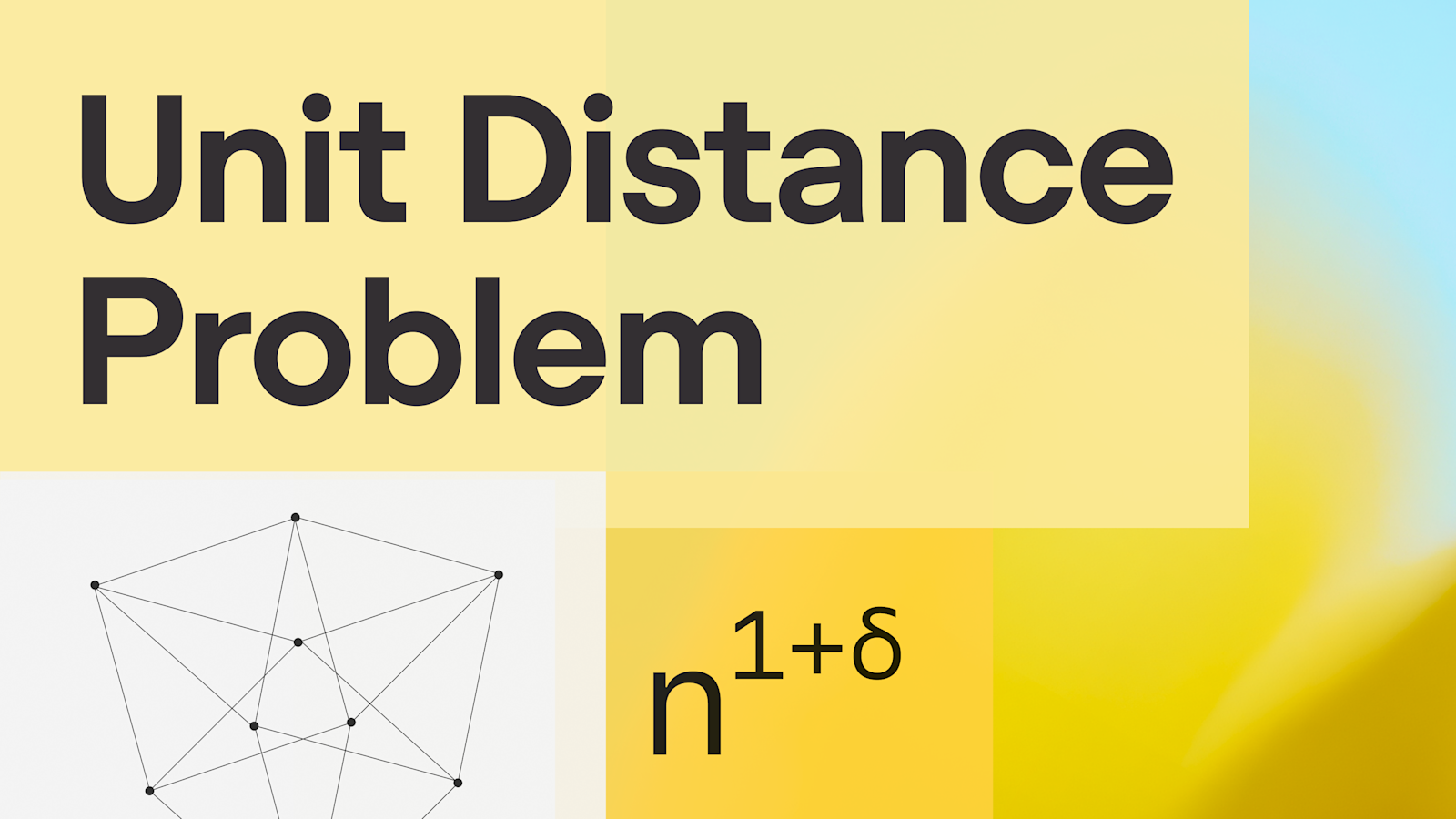
An OpenAI model solved the 80-year-old unit distance problem, disproving a major conjecture in discrete geometry and marking a milestone in AI-driven mathematics.
Truly Subquadratic 3SUM and Truly Subcubic APSP via Triangles in Sparse Lopsided Graphs
We give the first polynomial improvements over the textbook algorithms for $3$SUM and All-Pairs Shortest Paths (APSP): we show how to deterministically solve $3$SUM on $n$ integers of polynomial size in $O(n^{1.9992})$ time and APSP on directed $n$-vertex graphs with polynomially bounded integer weights in $O(n^{2.9995})$ time. This refutes the $3$SUM and APSP hypotheses. Using known reductions, we also refute the real-valued versions of the $3$SUM and APSP hypotheses, the Exact Triangle hypothesis, the Zero-Weight $k$-Clique hypotheses, and the three rectangular hinted Online Matrix--Vector conjectures of van den Brand, Nanongkai, and Saranurak, and we give polynomial speedups for a variety of other problems. All of these results follow from a single new algorithm for thin matrix products. Let $X$ be an $N\times D$ integer matrix and $Y$ a $D\times N$ integer matrix with $D\le N^{1/18}$, and let $W$ be any set of at most $N^2/\sqrt D$ positions. We compute the entries $(XY)[I,J]$, $(I,J)\in W$, in $O(N^2/D^{0.063})$ operations, which is polynomially less than the time needed to write down $XY$ or to compute $N^2/\sqrt D$ inner products one by one. We design this algorithm by modifying a variant of Coppersmith's rectangular matrix multiplication algorithm, built from a ten-multiplication identity of Schönhage, to perform only the operations needed for the entries in $W$, and show that few operations are needed. Interpreted as a graph algorithm, this solves the All-Edges Sparse Triangle problem in truly subquadratic time on sparse lopsided tripartite graphs where two parts have $n$ vertices but one part has $n^{\varepsilon}$ vertices for $\varepsilon<0.12$. By known reductions, Exact Triangle, and hence $3$SUM and APSP, reduce to this problem. We also give a data structure version that answers queries for single entries of $XY$, not known in advance.

Junyu Ren on Twitter / X
How we solved the 70-year-old Pierce–Birkhoff conjecture in real algebraic geometry with $400.One thing we kept noticing: models from different families (including the latest public models from GPT and Claude) seemed to complement each other, even when they were independently… pic.twitter.com/7MzWstXfy6— Junyu Ren (@junyu_r) September 9, 2026

Amateur armed with ChatGPT 'vibe-maths' a 60-year-old problem
A ChatGPT AI has proved a conjecture with a method no human had thought of. Experts believe it may have further uses
Terence Tao (@tao@mathstodon.xyz)
In traditional mathematics (or "Math 1.0"), a breakthrough proof of a long-standing open conjecture generates a large amount of subsequent activity and excitement in the field. The authors of the proof are invited to give many talks, and meet with other experts in the area. Workshops are set up to discuss the proof, as well as other recent developments. As a result, new connections and collaborations are formed, followup problems are shared, and other mathematicians (both junior and senior) are attracted to the field (including in some cases the authors themselves, if they initially came from a different subject). As a result of all this activity, the proofs naturally become digested, streamlined, placed in context with other results in the field, and ultimately become part of the textbooks and lecture notes for the next generation of mathematicians in the field. (1/4)
AI's solution to 87-year-old riddle takes mathematicians by surprise | New Scientist
Mathematicians have been trying to prove the Jacobian conjecture for nearly a century, but now the Claude Fable 5 AI has apparently found a counterexample that disproves it

Rules for the Millennium Prize Problems
The revised rules for the Millennium Prize Problems were adopted by the Board of Directors of the Clay Mathematics Institute on 26 September, 2018. Please read this document carefully before contacting CMI about a proposed solution. In particular, please note that:
How I Vibed a Proof of Conway’s Conjecture — overreacted
You can just prove things, apparently.
Timothy Gowers @wtgowers on Twitter / X
AI has now solved a major open problem -- one of the best known Erdos problems called the unit distance problem, one of Erdos's favourite questions and one that many mathematicians had tried.https://t.co/SD1vVPkrHR— Timothy Gowers @wtgowers (@wtgowers) May 20, 2026
Has an AI discovered new maths?

