

So much I could say about this. Safe to say all combined spend on anti-trans political ads/mailers/digital is easily north of a *half billion* since 2024. That has real political and human cost. Even when the ads are diminishing returns on actual persuasion. Tired.

Gillian Branstetter
Republicans have spent $184 million on anti-trans advertising this midterm cycle, per AP/AdImpact, which is more than they did in 2024. They've aired over 217,000 TV spots which, at 30 seconds each, equals 75 straight days worth of agitprop back-to-back
Oct 30, 2026 at 4:06 AM
Dare Obasanjo (@carnage4life@mas.to)
The decline of the advertising supported internet is inevitable yet sad. Tech has been unique in being an equalizer. A poor Nigerian kid, a techie in the US or Jeff Bezos all used the same apps and websites. Now many charge $5-$15 per month creating a huge financial divide. Online advertising is a progressive form of taxation as the rich, mostly US-based consumers who buy goods & services from ads subsidized the internet for everyone else. We now live in the flat tax version of the internet.
Midterm Political Ad Spending Hits Record $11.21 Billion
Political ad spending for the 2026 midterms has hit a record $11.21 billion, surpassing the 2024 presidential election cycle, according to AdImpact.
Democrats Lost the Propaganda War
The party used up about $5 billion on political ads in 2024. There’s a better way.

Dark Money Political Ads Proliferate on Facebook and Instagram
“Pink slime” newsrooms secretly backed by partisan donors are spending big on Facebook and Instagram ads in battleground states.
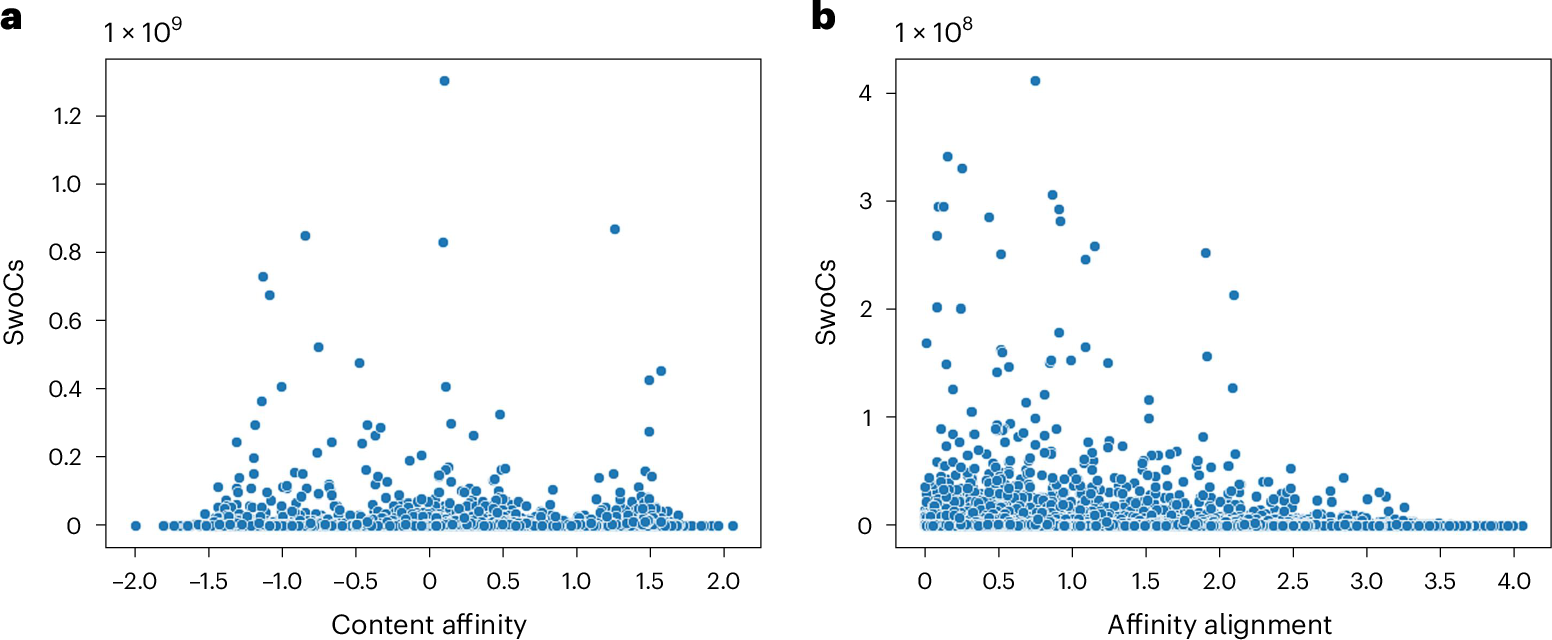
Sharing without clicking on news in social media
Social media have enabled laypersons to disseminate, at scale, links to news and public affairs information. Many individuals share such links without first reading the linked information. Here we analysed over 35 million public Facebook posts with uniform resource locators shared between 2017 and 2020, and discovered that such ‘shares without clicks’ (SwoCs) constitute around 75% of forwarded links. Extreme and user-aligned political content received more SwoCs, with partisans engaging in it more than politically neutral users. In addition, analyses with 2,969 false uniform resource locators revealed higher shares and, hence, SwoCs by conservatives (76.94%) than liberals (14.25%), probably because, in our dataset, the vast majority (76–82%) of them originated from conservative news domains. Findings suggest that the virality of political content on social media (including misinformation) is driven by superficial processing of headlines and blurbs rather than systematic processing of core content, which has design implications for promoting deliberate discourse in the online public sphere.
New study shows just how Facebook's algorithm shapes conservative and liberal bubbles
Research conducted at the height of the 2020 election reveals new details about how Facebook's algorithms handle political content. But it suggests there are no easy fixes to political polarization.
The Danger of Exaggerating the Political Importance of Social Media - Cal Newport
The Pew Research Center recently released a new study on American Twitter use. As Jennifer Rubin reported in the Washington Post, one of the most ... Read more
Shifts in U.S. Social Media Use, 2020–2024: Decline, Fragmentation, and Enduring Polarization
Using nationally representative data from the 2020 and 2024 American National Election Studies (ANES), this paper describes how U.S. social media use has shifted across platforms, demographics, and politics. Overall platform reach declined, driven by growth in the share of Americans — especially the youngest and oldest cohorts — who report using no social media. Visiting and posting activity on Twitter/X and Facebook have fallen by nearly 50% since 2020, with the decline on Twitter/X driven primarily by reduced participation among Democratic users. While Facebook, YouTube, and Twitter/X lost ground, TikTok and Reddit grew modestly, consistent with a more fragmented digital public sphere. Platform audiences aged and became slightly more educated and racially diverse. Politically, most platforms shifted toward Republican users while remaining, on balance, Democratic-leaning. Twitter/X experienced the largest change: among posters, the partisan balance swung over 70 percentage points from Democrats to Republicans. Across platforms, political posting remains closely tied to affective polarization, as the most partisan respondents are also the most active. As casual users disengage while polarized partisans remain vocal, online discourse becomes narrower and more ideologically extreme.
What If We Made Advertising Illegal?
What if we banned all advertising? Not regulate it—abolish it. This proposal would transform manipulation machines, and maybe save democracy itself. A thought experiment worth considering.
Anti-Trans Bills Keep Citing the New York Times
"By any objective measure, the paper seems clearly devoted to advocating against this care."

NEW: Some Dems are adopting anti-trans rhetoric in their campaigns While Republicans learn they can’t rely on it to win like they did in 2024 Inside how each party is navigating trans issues in 2026 — in ways they never have before w/ @alexroarty.bsky.social washingtonsun.com/campaigns/republican-transgen…

Republicans' Trans Attack Ads Aren’t Hitting the Same Way This Year
www.washingtonsun.comWe keep asking what social media does to voters. The wrong end of the pipe. Platforms don't just distribute politics — they teach political actors what kind of speech pays. So I measured the going rate: what X, Bluesky and Mastodon reward in public speech. 🧵 arxiv.org/abs/2607.04220
Is social media truly making us more politically polarized, or does it simply over-represent our most extreme opinions? In our new preprint, @small-schulz.bsky.social and I present *punishing evidence* that social media systematically overrepresents users’ most extreme political opinions. 1/n
A Bellingcat analysis of video ads purchased by the two largest AI-backed Super PACS has revealed that their political advertisements rarely ever mention their stances on AI, despite the advertisements being paid for by issue-specific PACs. bellingcat.com/news/2026/11/02/ai-super-pacs…

Inside the Secretive World of Campaign Ads Funded by AI Super PACs
www.bellingcat.com


