

America's Digital Demand Threatens Black Communities with More Pollution
The collective costs of artificial intelligence and data centers are disproportionately harming Black households.


“No One’s Coming to Save Us. Why Communities Must Build Their Own Internet” -Rudy Fraser, Blacksky
Toward People’s Community Control of Technology: Race, Access, and Education
This field review explores how the benefits of access to computing for racialized and minoritized communities has become an accepted fact in policy and research, despite decades of evidence that technical fixes do not solve the kinds of complex social problems that disproportionately affect these communities.

Analytic racecraft: Race-based averages create illusory group differences in perceptions of racism.
The future of the internet is likely smaller communities, with a focus on curated experiences
As brands look to hold onto the internet of the past, the term “community” will become a loaded word.

Blacksky Isn't Just Another Bluesky. Here's the Difference.
Blacksky is built on the same open social network as Bluesky and many other social apps. However, we're building ours with a different purpose, different priorities, and a different vision for online communities. Here's what sets us apart.
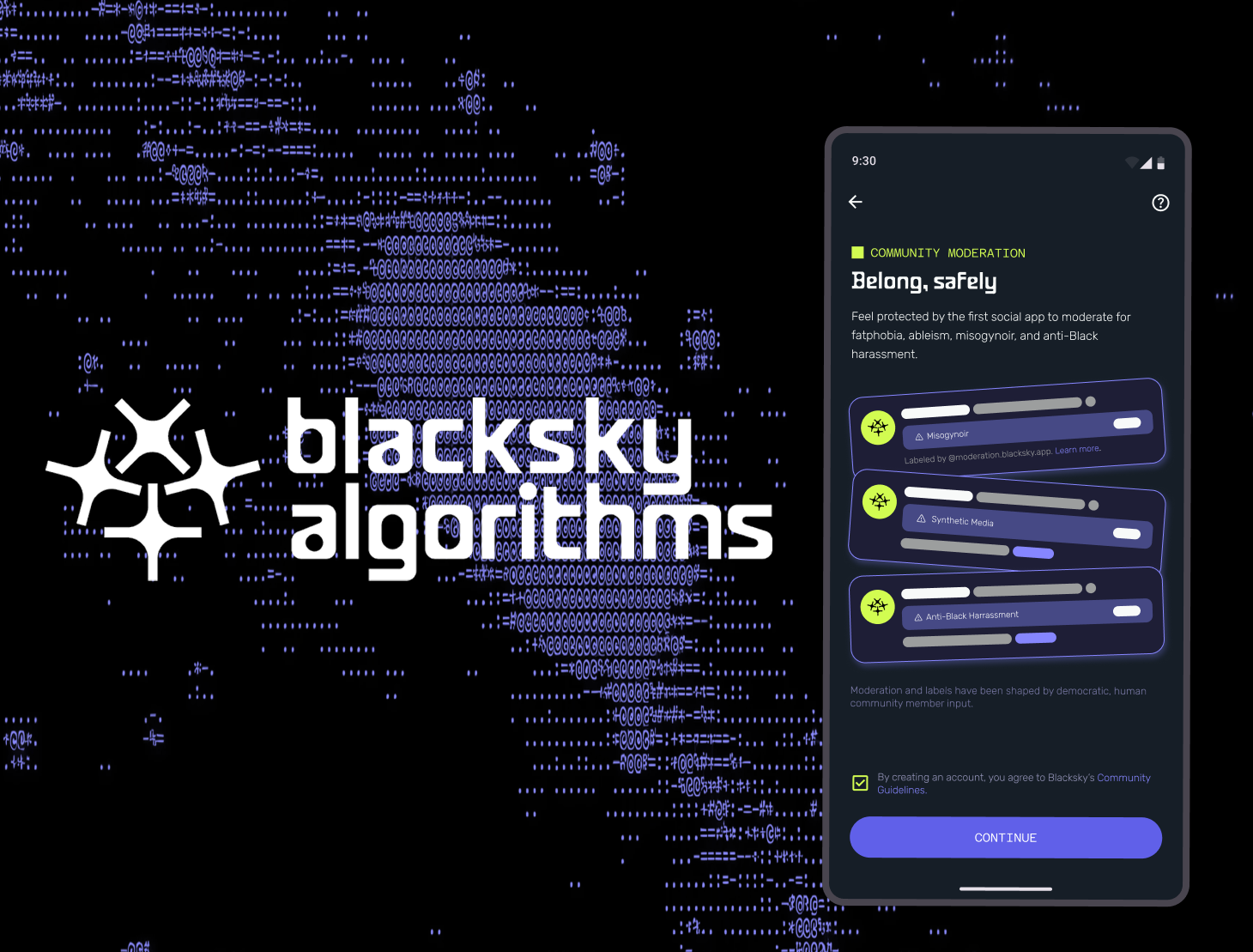
Blacksky
Blacksky is a social network. It is developed and maintained by Blacksky Algorithms. The project provides curated feeds and moderation tools to support Black social media users, many of whom previously used Black Twitter.

Home - Black Press Media
Truth MattersClarity MattersCommunity MattersPowered by more than 200 Journalists Any Time. Any Place. Any Device. We are dedicated to serving more than 80 communities across Canada and North America with credible and hyperlocal journalism, brought to our readers by passionate journalists who live where they work. Black Press Media is a catalyst for informed engagement […]

Overview
What is Blacksky? Blacksky Algorithms is building the future of self-governable online communities with tools that make complex infrastructure simple to deploy. Most social platforms control what users see, how communities operate, and who gets to feel safe online. Blacksky changes that by providing one-click infrastructure for independent, self-governed digital spaces. Our platform lets communities […]
Overview
What is Blacksky? Blacksky Algorithms is building the future of self-governable online communities with tools that make complex infrastructure simple to deploy. Most social platforms control what users see, how communities operate, and who gets to feel safe online. Blacksky changes that by providing one-click infrastructure for independent, self-governed digital spaces. Our platform lets communities […]
🔭🖤🚀 Social media’s next evolution: decentralized, open-source, and scalable
How Blacksky grew to millions of users without spending a dollar

Internet for the People: The Fight for Our Digital Future
"For all the informational convenience the internet offers, it is deeply flawed. How can it be improved? Writer Ben Tarnoff proposes one possibility in this intriguing book, which urges the development of 'a public lane on the information superhighway.' It's worth checking out for yourself." – Seth MacFarlane Why is the internet so broken, and what could ever possibly fix it? In Internet for the People, leading tech writer Ben Tarnoff offers an answer. The internet is broken, he argues, because it is owned by private firms and run for profit. Google annihilates your privacy and Facebook amplifies right-wing propaganda because it is profitable to do so. But the internet wasn't always like this—it had to be remade for the purposes of profit maximization, through a years-long process of privatization that turned a small research network into a powerhouse of global capitalism. Tarnoff tells the story of the privatization that made the modern internet, and which set in motion the crises that consume it today. The solution to those crises is straightforward: deprivatize the internet. Deprivatization aims at creating an internet where people, and not profit, rule. It calls for shrinking the space of the market and diminishing the power of the profit motive. It calls for abolishing the walled gardens of Google, Facebook, and the other giants that dominate our digital lives and developing publicly and cooperatively owned alternatives that encode real democratic control. To build a better internet, we need to change how it is owned and organized. Not with an eye towards making markets work better, but towards making them less dominant. Not in order to create a more competitive or more rule-bound version of privatization, but to overturn it. Otherwise, a small number of executives and investors will continue to make choices on everyone’s behalf, and these choices will remain tightly bound by the demands of the market. It's time to demand an internet by, and for, the people now.
Internet for the People: The Fight for Our Digital Future
"For all the informational convenience the internet offers, it is deeply flawed. How can it be improved? Writer Ben Tarnoff proposes one possibility in this intriguing book, which urges the development of 'a public lane on the information superhighway.' It's worth checking out for yourself." – Seth MacFarlane Why is the internet so broken, and what could ever possibly fix it? In Internet for the People, leading tech writer Ben Tarnoff offers an answer. The internet is broken, he argues, because it is owned by private firms and run for profit. Google annihilates your privacy and Facebook amplifies right-wing propaganda because it is profitable to do so. But the internet wasn't always like this—it had to be remade for the purposes of profit maximization, through a years-long process of privatization that turned a small research network into a powerhouse of global capitalism. Tarnoff tells the story of the privatization that made the modern internet, and which set in motion the crises that consume it today. The solution to those crises is straightforward: deprivatize the internet. Deprivatization aims at creating an internet where people, and not profit, rule. It calls for shrinking the space of the market and diminishing the power of the profit motive. It calls for abolishing the walled gardens of Google, Facebook, and the other giants that dominate our digital lives and developing publicly and cooperatively owned alternatives that encode real democratic control. To build a better internet, we need to change how it is owned and organized. Not with an eye towards making markets work better, but towards making them less dominant. Not in order to create a more competitive or more rule-bound version of privatization, but to overturn it. Otherwise, a small number of executives and investors will continue to make choices on everyone’s behalf, and these choices will remain tightly bound by the demands of the market. It's time to demand an internet by, and for, the people now.
Black people aren't monolithic nor should one's impression of where they reside on the Internet. Here, I make the case that focusing on numbers is a failure to put quality over quantity and ignores benefits for more curated online Black communities.

'There's More Black People Over There': False Equivalences in Platform Distribution and Gimmicks of Platform Capitalism
www.jacky.wtfSep 15, 2026 at 3:30 PM
‘Building a better web is much more universal. Empowering people to own their identity, publish more freely, form many kinds of communities, and leave without losing everything.’ manton.org/2026/07/18/social-web-disconn…
Social web disconnect
www.manton.org
