

I Was Right About ATProto Key Management - nora's notes
Note: this post has been revised to be split into two sections: a description of what happened, and my analysis. I hope to make it clear that, while I do not like ATProto in general, I am trying to make good-faith critcisms of specific design decisions and outcomes, and in fact, this post getting updoots on HackerNews appears to have gotten the attention of the team, so, mission accomplished. ref, ref My account has since been manually reinstated; this has not happened for any of the other users that have had this issue, as far as I know.
bnewbold.net
Bluesky released early documentation for the "AT Protocol" (atproto) a few weeks ago, and I've been noodling around with it. Technically, it strikes an appealing balance between rigid cryptographically signed content-addressable storage on the one hand, and familiar web-friendly schemas and integrations on the other. But at an ecosystem level, there are already a bunch of existing open social media projects. Does atproto bring anything interesting to the table? How might it fit in compared to other similar protocols?
ATProto Isn't What You Think
This post takes a look at ATProto from a different angle, and explores the value of some possibly less-noticed pieces of it.

About Atproto w/ Dan Abramov | Wireframe Live
About Atproto w/ Dan Abramov | Wireframe Live
ATProto in Practice #1: Identity
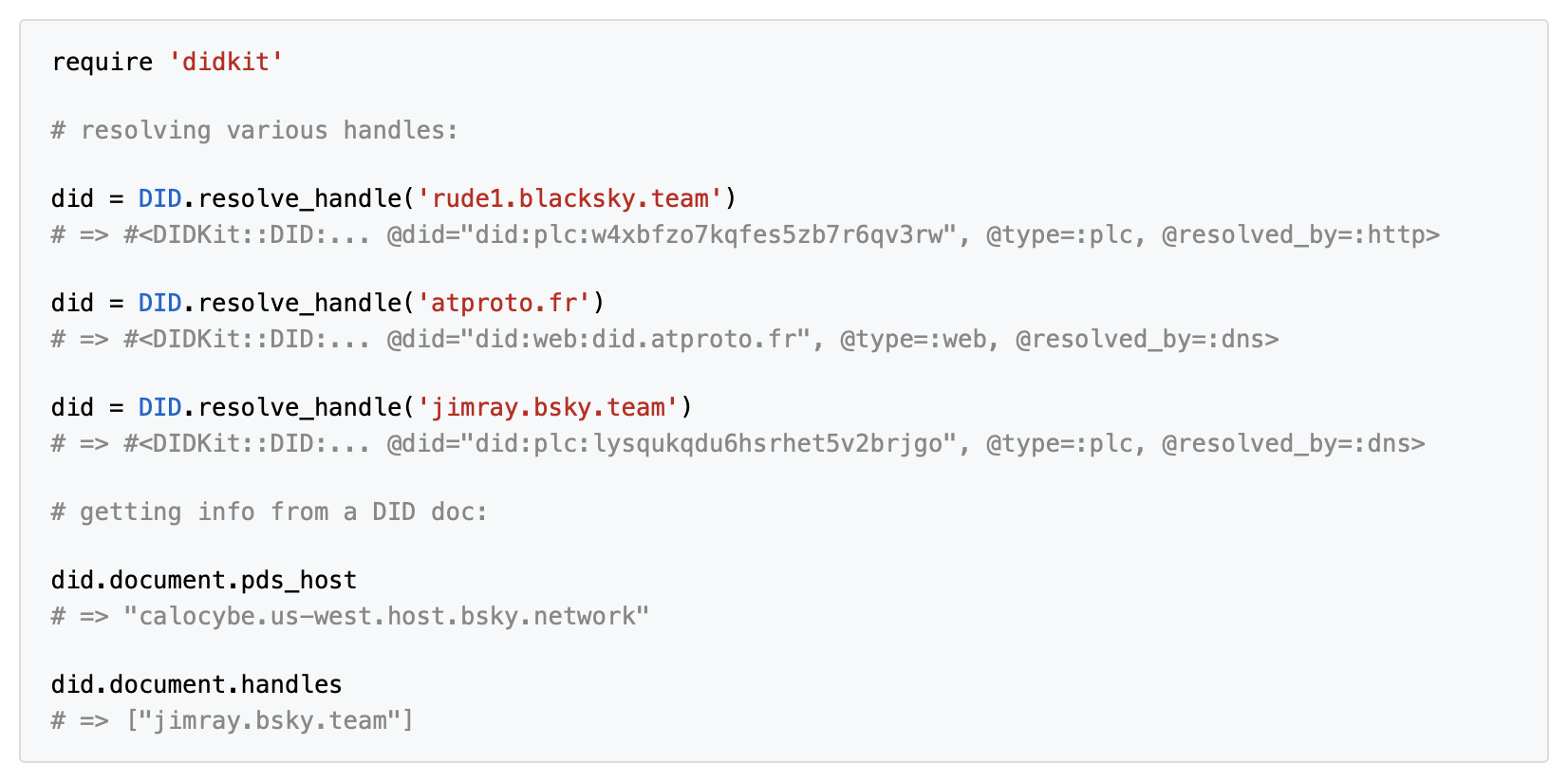
I’m starting a new blog post series that I’ve named “ATProto in Practice”. I want to go through some practical tasks that you’re likely to need when working with the protocol, using Ruby and my Ruby gems for the examples. These will (hopefully) be a bit shorter than my standard book-length blog posts here 🫠
Atproto Ethos - AT Protocol
A deep dive into the philosophical and aesthetic principles underlying the design of AT Protocol.

this is kinda another reason im starting to think more and more that there would be worth in splitting atprotos identity layer out as its own spec and standard. building up handles and oauth around a DID makes for a really flexible cross platform (and potentially cross ecosystem) identity system

Nelind
i kinda hate how atproto adopting DIDs has made people intrinsically associate DIDs with atproto ... it makes some people see me as some annoying bitch trying to shove atproto into places it obviously doesnt belong in when i suggest using DIDs as user identifiers for other systems
now updated my atproto oauth reference from last year! github.com/j4ckxyz/atproto-oauth-referen… - explains why to avoid `transition:generic` AND a skills file for your coding agent!!! github.com/j4ckxyz/atproto-oauth-referen… no reason to not have #atproto oauth anymore!
GitHub - j4ckxyz/atproto-oauth-reference
github.com@danabra.mov do you think it makes sense to frame atproto as providing a data and identity layer to the web, or as aiming to improve the web? I never want to overstep (see crypto claiming web3) but atproto is extremely web-brained like you said, and the web is where a lot of the utility shines
The fundamental strength of ATProto — and why I think it'll last — is that it is designed first and foremost to be built upon, by anyone, for any reason, rather than locking into one specific paradigm of its maintainers' choosing. Also tbh sex workers are the social media Mandate of Heaven, so.

♍ Bee 🐝
3000 commits later babesky.app
lowkey if the only incentive to do anything with atproto is for the fun of it, that does not bode well... not saying that there should be monetary incentives, but there's gotta be something more so it doesn't become "this is no longer fun because it got too big" and then the platform dies

posts inspector
we are rapidly approaching cult status. hunker down people we can get there
There's lots I haven't yet understood about atproto, but I simply won't do the standard.site thing whilst it offers a worse UX than… not doing it.

Guido X Jansen
It keeps confusing me that the main call to action in these cards (the button) does NOT go to the article but to the main website Is it just me that finds this weird...? The main visual CTA for a card about an article should go to that article no...?


