

Bluesky Custom Feeds - Built By You
Design, deploy, and grow custom feeds of any complexity on Bluesky with Graze.social.
Bluesky Custom Feeds - Built By You
Design, deploy, and grow custom feeds of any complexity on Bluesky with Graze.social.
Introducing Tap: Repository Synchronization Made Simple | Bluesky
Just about every app built on AT needs data from a repository at some point. For many use cases – feed generators, labelers, bots – streaming live data through a Relay or Jetstream works well. But some applications need to go beyond what Jetstream was designed for, like tracking specific subsets of a repo, automatically backfilling a database when adding new repos to monitor, or even mirroring the entire Atmosphere.
FreshRSS, a free, self-hostable feeds aggregator
FreshRSS is lightweight, easy to work with, powerful, and customizable.

FreshRSS, a free, self-hostable feeds aggregator
FreshRSS is lightweight, easy to work with, powerful, and customizable.
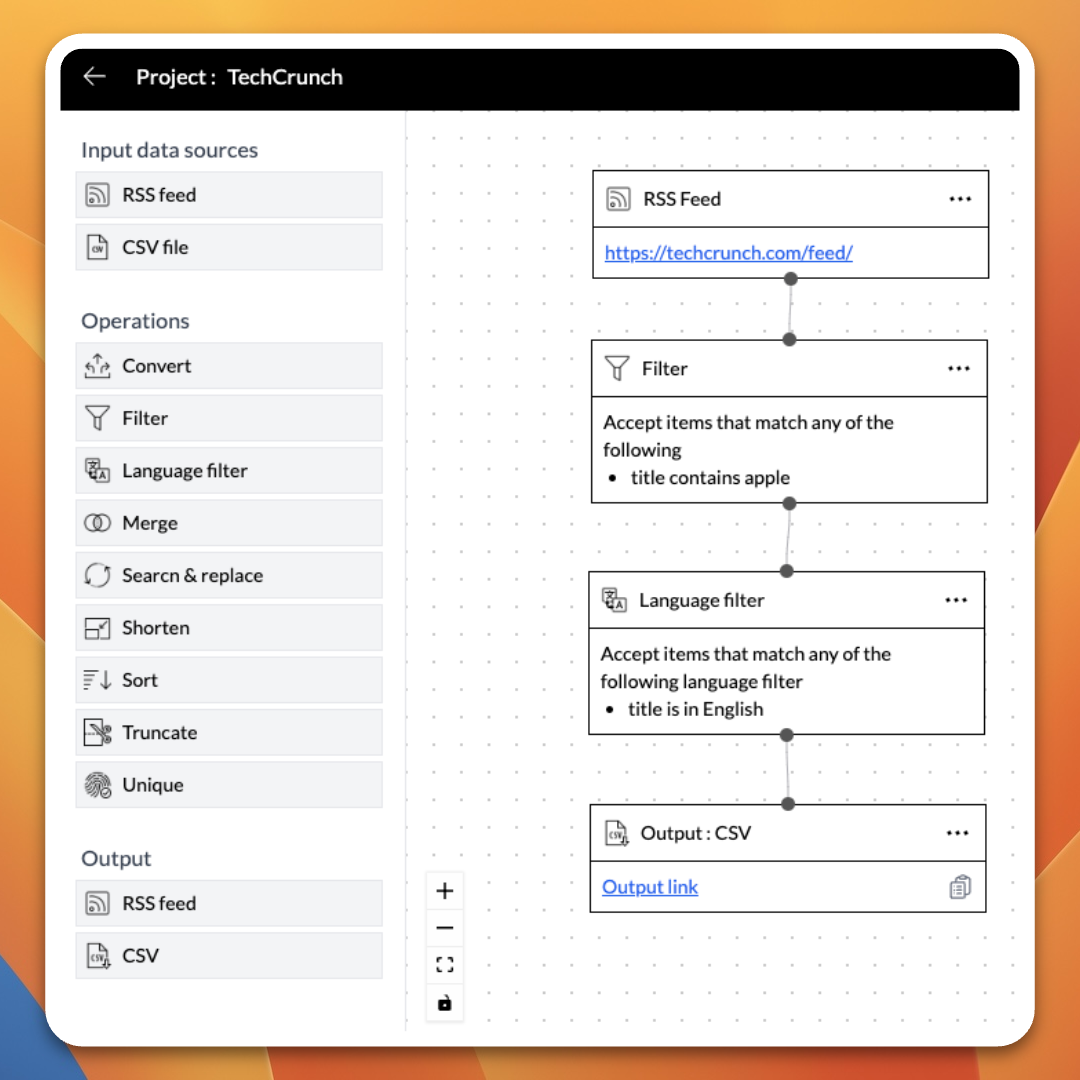
Mashups.io - Mix and Filter Data Feeds
Mix and filter data including RSS feeds and CSV files - a modern resurrection of Yahoo Pipes.
Middleware for Feed Recommendation in Practice: How Feed Creators Build, Maintain, and Sustain Custom Feeds on Bluesky
Scholars have long proposed third-party middleware as an alternative to centralized algorithmic feeds: feeds built and distributed by independent feed creators. This vision saw no large-scale instantiation until Bluesky, a decentralized microblogging platform, introduced custom feeds in 2023. Although central to the middleware ecosystem, we know little about how feed creators understand their role, build feeds, and sustain them. Through interviews with n = 26 feed creators and third-party developers of feed-building tools, and analysis of n = 88,302 custom feeds, we identify two creator orientations---utility-providing and community-building. Additionally, creators struggle to maintain feeds that fully realize middleware ideals: they lack granular interaction data, receive little feedback, and lack technical expertise to act on either. Finally, creators sustain their feeds as unpaid hobbyists with little platform support and are divided on whether to monetize beyond covering costs. We conclude with design and policy implications for strengthening the middleware feed ecosystem.

Speeding Up RSS | TechCrunch
I'm sorry, but RSS feeds are way too slow. I know this first-hand. As part of my job here at TechCrunch, I monitor a lot of RSS feeds for breaking news. We also produce our own feed and I can see how quickly it propagates to various feed readers and feed-powered news aggregation services. The lag time between posting a story and seeing it pop up in the RSS feed is usually a few minutes, and then it can take another 10 to 15 minutes or so for it to appear in something like Google Reader. And the TechCrunch feed is probably checked more frequently for updates than most other feeds. In our business, every second counts and RSS just isn't cutting it. While there is an argument to be made that RSS is dying, being replaced by more instantaneous forms of content delivery such as Twitter and other real time streams, many people aren't quite yet ready to give up on it. Instead, they want to save it by speeding it up. Tomorrow, at our Real Time Stream CrunchUp, we will see three demos of projects that do just that in slightly different ways.
neodb-social/neodb
🧩 a self-hosted server tracking what you read/watch/listen/play, powering a global distributed community federating via ActivityPub and ATProto.
Skyreader update - standard.site feeds, read-it-later workflow, and sustainability - Skyreader Dev Log
Skyreader now supports standard.site feeds and adds full read-it-later features with highlighting, read progress, and inbox/archive management
Matt Mullenweg Discusses Core Focuses, Downsides of a Consensus-Driven Model, and More on Apply Filters Podcast
Matt Mullenweg, co-founder of the WordPress open source project and CEO of Automattic, joined Pippin Williamson and Brad Touesnard on episode 81 of the Apply Filters podcast. Apply Filters is a pod…

Graze always works better together! Someone builds a filter once, publishes it, and anyone can drop it into a feed - that's what we call custom nodes. Now, they keep themselves current! Turn on Auto-Update to take every safe release, hold on the ones that need attention, and build with ease!
Sep 11, 2026 at 2:29 PM
Folks have been reaching out about how to support Graze beyond our core product. We think that support needs to go beyond Graze. That's why we've teamed up with our direct competitors @skyfeed.app and @blueskyfeedcreator.com to jointly support all our work:

Support Feed Builders Tip Jar
ko-fi.com
