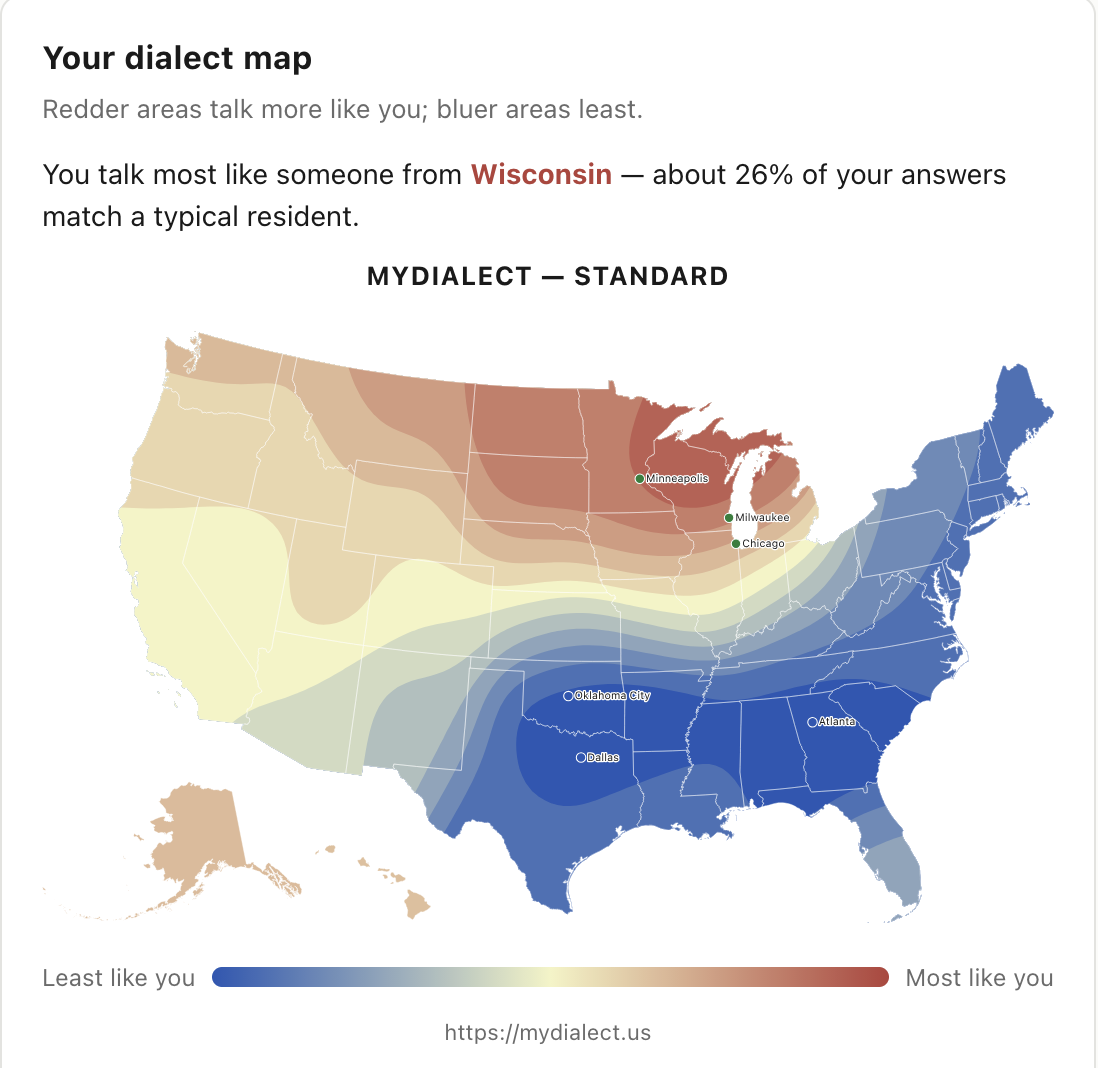
Well, well. I’ve been told I have a fairly “neutral” accent, but they guessed my home state based on the Standard Language Quiz with 60 questions (“about 50% of your answers match a typical resident”). mydialect.us/quiz-standard.html

Standard Language Quiz — Dialect Map Quiz
mydialect.usSep 4, 2026 at 4:02 AM
How Do You Talk? — American Accent Quiz & US Dialect Map
Discover where in the United States people talk like you with this interactive American Accent Quiz. Get a personalized dialect map based on the Harvard Dialect Survey.
How Y’all, Youse and You Guys Talk (Published 2024)
What does the way you speak say about where you’re from? Answer all the questions below to see your personal dialect map.

Why are all LLMs Obsessed with Japanese Culture? On the Hidden Cultural and Regional Biases of LLMs
LLMs have been showing limitations when it comes to cultural coverage and competence, and in some cases show regional biases such as amplifying Western and Anglocentric viewpoints. While there have been works analysing the cultural capabilities of LLMs, there has not been specific work on highlighting LLM regional preferences when it comes to cultural-related questions. In this work, we propose a new dataset based on a comprehensive taxonomy of Culture-Related Open Questions (CROQ). The results show that, contrary to previous cultural bias work, LLMs show a clear tendency towards countries such as Japan. Moveover, our results show that when prompting in languages such as English or other high-resource ones, LLMs tend to provide more diverse outputs and show less inclinations towards answering questions highlighting countries for which the input language is an official language. Finally, we also investigate at which point of LLM training this cultural bias emerges, with our results suggesting that the first clear signs appear after supervised fine-tuning, and not during pre-training.

Why are all LLMs Obsessed with Japanese Culture? On the Hidden Cultural and Regional Biases of LLMs
LLMs have been showing limitations when it comes to cultural coverage and competence, and in some cases show regional biases such as amplifying Western and Anglocentric viewpoints. While there have been works analysing the cultural capabilities of LLMs, there has not been specific work on highlighting LLM regional preferences when it comes to cultural-related questions. In this work, we propose a new dataset based on a comprehensive taxonomy of Culture-Related Open Questions (CROQ). The results show that, contrary to previous cultural bias work, LLMs show a clear tendency towards countries such as Japan. Moveover, our results show that when prompting in languages such as English or other high-resource ones, LLMs tend to provide more diverse outputs and show less inclinations towards answering questions highlighting countries for which the input language is an official language. Finally, we also investigate at which point of LLM training this cultural bias emerges, with our results suggesting that the first clear signs appear after supervised fine-tuning, and not during pre-training.
Ask don't tell: Reducing sycophancy in large language models
Sycophancy, the tendency of large language models to favour user-affirming responses over critical engagement, has been identified as an alignment failure, particularly in high-stakes advisory and...
Sycophancy Claims about Language Models: The Missing Human-in-the-Loop
Sycophantic response patterns in Large Language Models (LLMs) have been increasingly claimed in the literature. We review methodological challenges in measuring LLM sycophancy and identify five core operationalizations. Despite sycophancy being inherently human-centric, current research does not evaluate human perception. Our analysis highlights the difficulties in distinguishing sycophantic responses from related concepts in AI alignment and offers actionable recommendations for future research.
Sycophancy Claims about Language Models: The Missing Human-in-the-Loop
Sycophantic response patterns in Large Language Models (LLMs) have been increasingly claimed in the literature. We review methodological challenges in measuring LLM sycophancy and identify five core operationalizations. Despite sycophancy being inherently human-centric, current research does not evaluate human perception. Our analysis highlights the difficulties in distinguishing sycophantic responses from related concepts in AI alignment and offers actionable recommendations for future research.
Political Bias Audits of LLMs Capture Sycophancy to the Inferred Auditor
Large language models (LLMs) are commonly evaluated for political bias based on their responses to fixed questionnaires, which typically place frontier models on the political left. A parallel literature shows that LLMs are sycophantic: they adapt their answers to the views, identities, and expectations of the user. We show that these findings are linked: standard political-bias audits partly capture sycophantic accommodation to the inferred auditor. We employ a factorial experiment across three major audit instruments--the Political Compass Test, the Pew Political Typology, and 1,540 partisan-benchmarked Pew American Trends Panel items--administered to six frontier LLMs while varying only the asker's stated identity (N = 30,990 responses). At baseline, all six models lean left. When the asker identifies as a conservative Republican, responses shift sharply: the share of items closer to Democrats falls by 28-62 percentage points, and all six models move right of center. A mirror-image progressive-Democrat cue produces little change; rightward accommodation is 8.0$\times$ larger than leftward. When asked who the default asker is, models identify an auditor, researcher, or academic; when asked what answer that asker expects, they select the Democrat-coded option 75% of the time, nearly the rate under an explicit progressive cue. These patterns are inconsistent with a purely fixed model ideology and indicate that single-prompt audits capture an interaction between model and inferred interlocutor. Political bias in LLMs is therefore not a fixed point on an ideological scale but a response profile that must be mapped across realistic interlocutors.
On the Alignment of Large Language Models with Global Human Opinion
Today's large language models (LLMs) are capable of supporting multilingual scenarios, allowing users to interact with LLMs in their native languages. When LLMs respond to subjective questions posed by users, they are expected to align with the views of specific demographic groups or historical periods, shaped by the language in which the user interacts with the model. Existing studies mainly focus on researching the opinions represented by LLMs among demographic groups in the United States or a few countries, lacking worldwide country samples and studies on human opinions in different historical periods, as well as lacking discussion on using language to steer LLMs. Moreover, they also overlook the potential influence of prompt language on the alignment of LLMs' opinions. In this study, our goal is to fill these gaps. To this end, we create an evaluation framework based on the World Values Survey (WVS) to systematically assess the alignment of LLMs with human opinions across different countries, languages, and historical periods around the world. We find that LLMs appropriately or over-align the opinions with only a few countries while under-aligning the opinions with most countries. Furthermore, changing the language of the prompt to match the language used in the questionnaire can effectively steer LLMs to align with the opinions of the corresponding country more effectively than existing steering methods. At the same time, LLMs are more aligned with the opinions of the contemporary population. To our knowledge, our study is the first comprehensive investigation of the topic of opinion alignment in LLMs across global, language, and temporal dimensions.
What large language models know and what people think they know
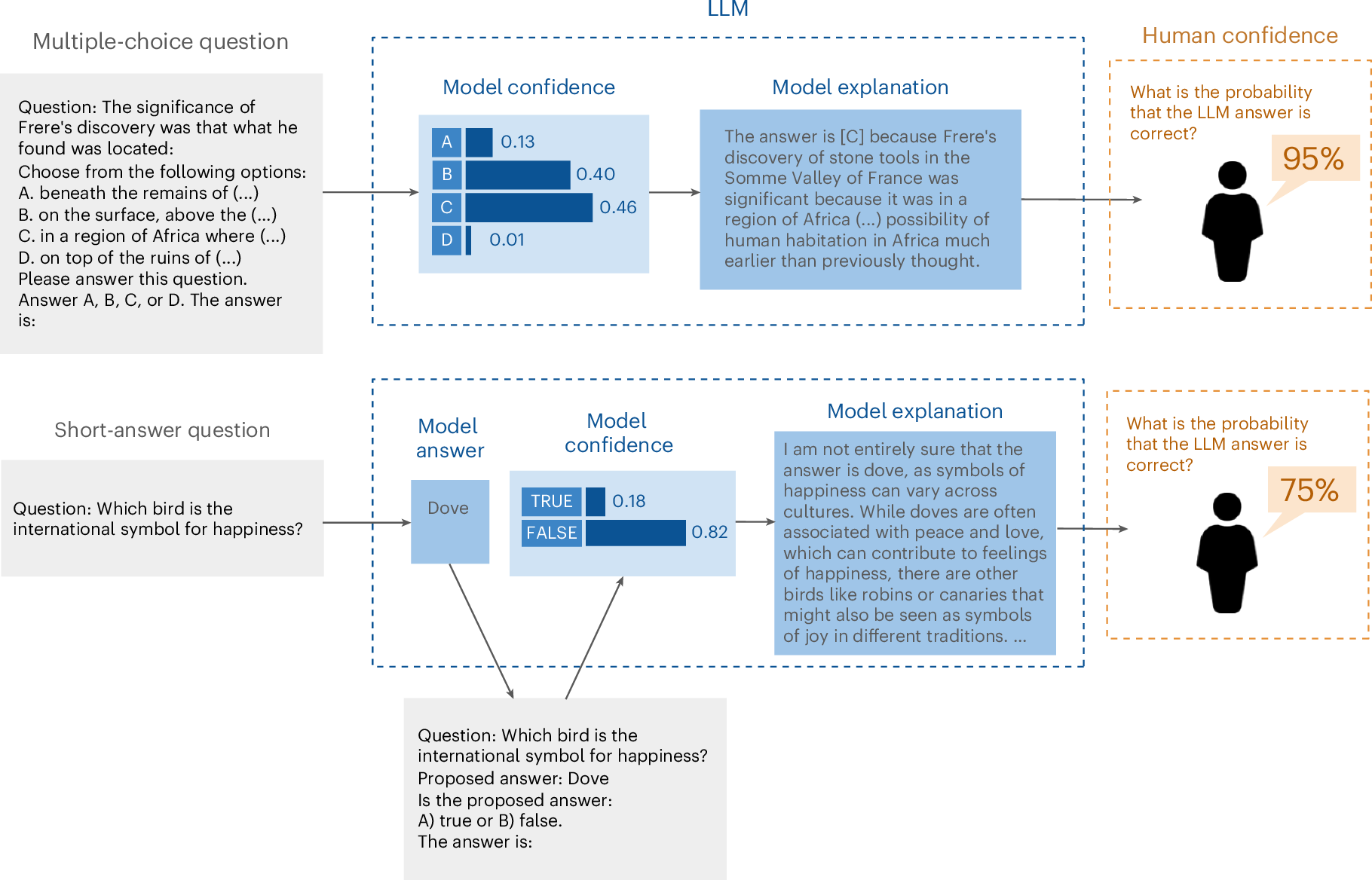
As artificial intelligence systems, particularly large language models (LLMs), become increasingly integrated into decision-making processes, the ability to trust their outputs is crucial. To earn human trust, LLMs must be well calibrated such that they can accurately assess and communicate the likelihood of their predictions being correct. Whereas recent work has focused on LLMs’ internal confidence, less is understood about how effectively they convey uncertainty to users. Here we explore the calibration gap, which refers to the difference between human confidence in LLM-generated answers and the models’ actual confidence, and the discrimination gap, which reflects how well humans and models can distinguish between correct and incorrect answers. Our experiments with multiple-choice and short-answer questions reveal that users tend to overestimate the accuracy of LLM responses when provided with default explanations. Moreover, longer explanations increased user confidence, even when the extra length did not improve answer accuracy. By adjusting LLM explanations to better reflect the models’ internal confidence, both the calibration gap and the discrimination gap narrowed, significantly improving user perception of LLM accuracy. These findings underscore the importance of accurate uncertainty communication and highlight the effect of explanation length in influencing user trust in artificial-intelligence-assisted decision-making environments.
LeftValues
LeftValues is a leftist quiz inspired by and based upon the 8values quiz that seeks to identify your position on the left-wing spectrum. If you are not a leftist, this quiz is obviously not suited for you. You will be presented with a statement, and then you will answer with your opinion on the statement, from Strongly Agree to Strongly Disagree, with each answer slightly affecting your scores. The questions for each axes are presented in order, rather than scattered. At the end of the quiz, your answers will be compared to the maximum possible for each value, thus giving you a percentage. Answer honestly! There are questions in the test.
Personalization Increases Affective Alignment but Has Role-Dependent Effects on Epistemic Independence in LLMs
Large Language Models (LLMs) are prone to sycophantic behavior, uncritically conforming to user beliefs. As models increasingly condition responses on user-specific context (personality traits, preferences, conversation history), they gain information to tailor agreement more effectively. Understanding how personalization modulates sycophancy is critical, yet systematic evaluation across models and contexts remains limited. We present a rigorous evaluation of personalization's impact on LLM sycophancy across nine frontier models and five benchmark datasets spanning advice, moral judgment, and debate contexts. We find that personalization generally increases affective alignment (emotional validation, hedging/deference), but affects epistemic alignment (belief adoption, position stability, resistance to influence) with context-dependent role modulation. When the LLM's role is to give advice, personalization strengthens epistemic independence (models challenge user presuppositions). When its role is that of a social peer, personalization decreases epistemic independence. In this role, extensively personalized user challenges causing LLMs to abandon their position at significantly higher rates. Robustness tests confirm that the effects are driven by personalized conditioning, not by additional input tokens per se or demographic information alone. Our work provides measurement frameworks for evaluating personalized AI systems, demonstrates the necessity of role-sensitive evaluation, and establishes a novel benchmark to assess goal alignment.
Adult Literacy in the United States
Using the data from the Program for the International Assessment of Adult Competencies (PIAAC), this Data Point summarizes the number of U.S. adults with low levels of English literacy and describes how they differ by nativity status1 and race/ethnicity.
This Treatment Works, Right? Evaluating LLM Sensitivity to Patient Question Framing in Medical QA
Patients are increasingly turning to large language models (LLMs) with medical questions that are complex and difficult to articulate clearly. However, LLMs are sensitive to prompt phrasings and can be influenced by the way questions are worded. Ideally, LLMs should respond consistently regardless of phrasing, particularly when grounded in the same underlying evidence. We investigate this through a systematic evaluation in a controlled retrieval-augmented generation (RAG) setting for medical question answering (QA), where expert-selected documents are used rather than retrieved automatically. We examine two dimensions of patient query variation: question framing (positive vs. negative) and language style (technical vs. plain language). We construct a dataset of 6,614 query pairs grounded in clinical trial abstracts and evaluate response consistency across eight LLMs. Our findings show that positively- and negatively-framed pairs are significantly more likely to produce contradictory conclusions than same-framing pairs. This framing effect is further amplified in multi-turn conversations, where sustained persuasion increases inconsistency. We find no significant interaction between framing and language style. Our results demonstrate that LLM responses in medical QA can be systematically influenced through query phrasing alone, even when grounded in the same evidence, highlighting the importance of phrasing robustness as an evaluation criterion for RAG-based systems in high-stakes settings.
In Defense of “Y’all,” a Perfect Word
A New York Times columnist says it’s “much too slangy, regional or what you might even call ethnic to ever gain universal acceptance.” We couldn’t disagree more.

What do "which is A.I.?" quizzes tell us?
This newsletter is brought to you by Squarespace.