

Introducing Slow Social
I’d like to introduce you to Slow Social. Slow Social is my idea of what I wish social networks...

Speeding Up RSS | TechCrunch
I'm sorry, but RSS feeds are way too slow. I know this first-hand. As part of my job here at TechCrunch, I monitor a lot of RSS feeds for breaking news. We also produce our own feed and I can see how quickly it propagates to various feed readers and feed-powered news aggregation services. The lag time between posting a story and seeing it pop up in the RSS feed is usually a few minutes, and then it can take another 10 to 15 minutes or so for it to appear in something like Google Reader. And the TechCrunch feed is probably checked more frequently for updates than most other feeds. In our business, every second counts and RSS just isn't cutting it. While there is an argument to be made that RSS is dying, being replaced by more instantaneous forms of content delivery such as Twitter and other real time streams, many people aren't quite yet ready to give up on it. Instead, they want to save it by speeding it up. Tomorrow, at our Real Time Stream CrunchUp, we will see three demos of projects that do just that in slightly different ways.
The echo chamber effect on social media
Significance We explore the key differences between the main social media platforms and how they are likely to influence information spreading and the formation of echo chambers. To assess the different dynamics, we perform a comparative analysis on more than 100 million pieces of content concerning controversial topics (e.g., gun control, vaccination, abortion) from Gab, Facebook, Reddit, and Twitter. The analysis focuses on two main dimensions: 1) homophily in the interaction networks and 2) bias in the information diffusion toward like-minded peers. Our results show that the aggregation in homophilic clusters of users dominates online dynamics. However, a direct comparison of news consumption on Facebook and Reddit shows higher segregation on Facebook. , Social media may limit the exposure to diverse perspectives and favor the formation of groups of like-minded users framing and reinforcing a shared narrative, that is, echo chambers. However, the interaction paradigms among users and feed algorithms greatly vary across social media platforms. This paper explores the key differences between the main social media platforms and how they are likely to influence information spreading and echo chambers’ formation. We perform a comparative analysis of more than 100 million pieces of content concerning several controversial topics (e.g., gun control, vaccination, abortion) from Gab, Facebook, Reddit, and Twitter. We quantify echo chambers over social media by two main ingredients: 1) homophily in the interaction networks and 2) bias in the information diffusion toward like-minded peers. Our results show that the aggregation of users in homophilic clusters dominate online interactions on Facebook and Twitter. We conclude the paper by directly comparing news consumption on Facebook and Reddit, finding higher segregation on Facebook.

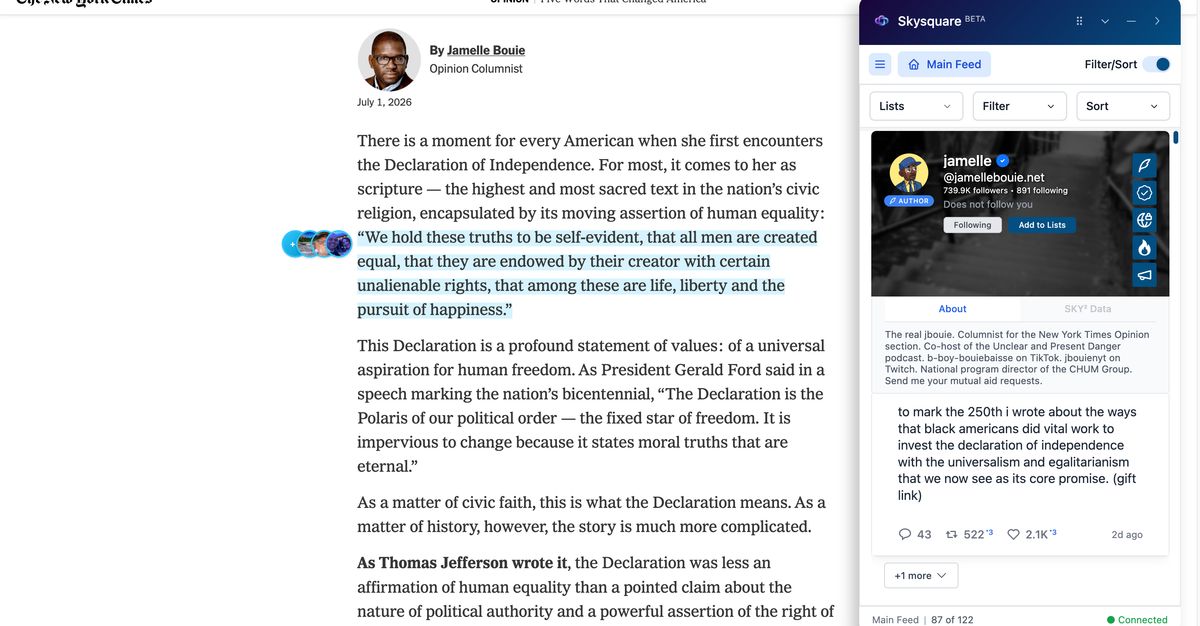
Skysquare — Public conversation, anchored to the web
Skysquare is a Chrome extension that brings public Bluesky conversation back to the articles, passages, and source pages being discussed.
feeds.social — Minimalist Bluesky Client
Shifts in U.S. Social Media Use, 2020–2024: Decline, Fragmentation, and Enduring Polarization
The social media ecosystem appears to be in flux. Twitter’s rebranding to X has come to symbolize a broader reorganization of online publics – political reshuffling, user attrition, and uncertainty over the role of legacy platforms. Simultaneously, the shift from text-based, networked feeds toward algorithmically curated, short-form video has accelerated, with TikTok setting the pace for the wider ecosystem [18, 14, 16]. At the same time, everyday communication increasingly migrates from large, open networks to semi-private spaces such as group chats and messaging apps. Commentators describe a digital public sphere in transition: smaller, more fragmented, less dominated by traditional social networking sites, and rise of more broadcast-oriented forms of media – with some even suggesting that we are seeing the beginning of the end of the social media era.
One way to mitigate these effects is to move social discourse out of the high-velocity feed entirely—to use something like @skysquare.app where you can read conversation in context without subjecting yourself to the rapid novelty, constant switching, and algorithmic mechanisms of the feeds. 👀👇🤷

Skysquare — Public conversation, anchored to the web
skysquare.app
T.W. Simpson
I have an MA in broadcasting and early in my career worked in corporate filmmaking. One through-line from my studies through the industrial practice of audiovisual communications was that the shorter the asl, the easier it was to capture the viewer's attention. This effect is what is "addicting"...
Sep 10, 2026 at 11:14 PM
More @skyreader.app updates! - the discussion section now organized into conversation/connections/related. - conversation now includes @leaflet.pub comments - create connections to your other @semble.so cards - see related articles on @semble.so and add to your reading list in one tap 1/2
Big improvements to @skyreader.app making it more social! Articles you share are now published as a @standard.site linkblog. Follow Skyreader linkblogs in any @standard.site reader (or traditional RSS reader!) Finding your people in Skyreader is also now much improved. Let me know what you think!

Skyreader update - Linkblogs, standard.site, and discussions
skyreader-dev.leaflet.pub🧵 On social media, we feel trapped in “filter bubbles” and “echo chambers.” Often, we see this as a problem with the algorithm. Our new essay argues the problem is the feed interface itself: it constrains our movement—all we can do is scroll. We lay out an alternative vision:

From Feeds to Trails
leaflet.pubDon't want to start Discourse, but tbh it kinda annoys me when every time something is launched here, some people complain: meh, this is stupid, bad design, vibe coded, you can tell by the colors it's from Claude, it relies on app.bsky lexicons, still uses Bluesky AppView, not decentralized enough,
Today's @skyreader.app update improves the discussion for every article you read. - commentary across bluesky, @semble.so, and @margin.at - semble collections the article appears in - semble typed connections to other articles with one-tap save to read later
🧵 On social media, we feel trapped in “filter bubbles” and “echo chambers.” Often, we see this as a problem with the algorithm. Our new essay argues the problem is the feed interface itself: it constrains our movement—all we can do is scroll. We lay out an alternative vision:
From Feeds to Trails
leaflet.pubBig improvements to @skyreader.app making it more social! Articles you share are now published as a @standard.site linkblog. Follow Skyreader linkblogs in any @standard.site reader (or traditional RSS reader!) Finding your people in Skyreader is also now much improved. Let me know what you think!
Skyreader update - Linkblogs, standard.site, and discussions
skyreader-dev.leaflet.pubAtmosphere social client apps should make it easier to broadcast beyond the protocol. Ex. In-app mirroring tools for Threads, X, and other microblogging platforms. As well as having post scheduling. Let people share across the social internet, but make sure ATproto feels like home base.
Social media algorithms don't allow us to understand or control what we see online and why... until now! Top scholars @jonathanstray.com and @noupside.bsky.social are sharing @mysky.social, a tool that allows users to adjust their feed’s priorities and explains why certain posts appear over others.

🎛️📲 Meet the algorithm you can actually control and understand
newpublic.substack.com


