

The political effects of X’s feed algorithm
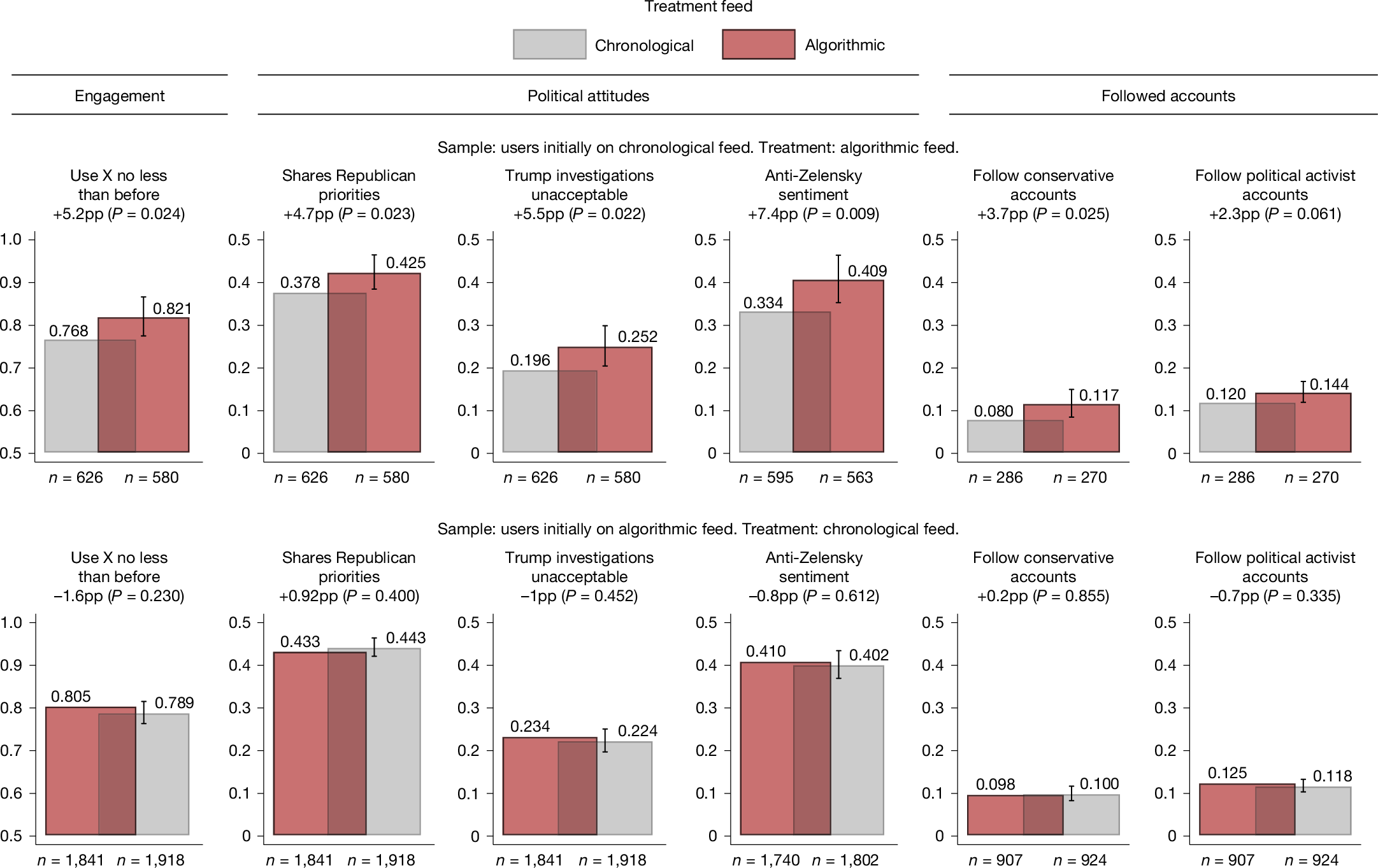
Feed algorithms are widely suspected to influence political attitudes. However, previous evidence from switching off the algorithm on Meta platforms found no political effects1. Here we present results from a 2023 field experiment on Elon Musk’s platform X shedding light on this puzzle. We assigned active US-based users randomly to either an algorithmic or a chronological feed for 7 weeks, measuring political attitudes and online behaviour. Switching from a chronological to an algorithmic feed increased engagement and shifted political opinion towards more conservative positions, particularly regarding policy priorities, perceptions of criminal investigations into Donald Trump and views on the war in Ukraine. In contrast, switching from the algorithmic to the chronological feed had no comparable effects. Neither switching the algorithm on nor switching it off significantly affected affective polarization or self-reported partisanship. To investigate the mechanism, we analysed users’ feed content and behaviour. We found that the algorithm promotes conservative content and demotes posts by traditional media. Exposure to algorithmic content leads users to follow conservative political activist accounts, which they continue to follow even after switching off the algorithm, helping explain the asymmetry in effects. These results suggest that initial exposure to X’s algorithm has persistent effects on users’ current political attitudes and account-following behaviour, even in the absence of a detectable effect on partisanship.
The political effects of X’s feed algorithm
Feed algorithms are widely suspected to influence political attitudes. However, previous evidence from switching off the algorithm on Meta platforms found no political effects1. Here we present results from a 2023 field experiment on Elon Musk’s platform X shedding light on this puzzle. We assigned active US-based users randomly to either an algorithmic or a chronological feed for 7 weeks, measuring political attitudes and online behaviour. Switching from a chronological to an algorithmic feed increased engagement and shifted political opinion towards more conservative positions, particularly regarding policy priorities, perceptions of criminal investigations into Donald Trump and views on the war in Ukraine. In contrast, switching from the algorithmic to the chronological feed had no comparable effects. Neither switching the algorithm on nor switching it off significantly affected affective polarization or self-reported partisanship. To investigate the mechanism, we analysed users’ feed content and behaviour. We found that the algorithm promotes conservative content and demotes posts by traditional media. Exposure to algorithmic content leads users to follow conservative political activist accounts, which they continue to follow even after switching off the algorithm, helping explain the asymmetry in effects. These results suggest that initial exposure to X’s algorithm has persistent effects on users’ current political attitudes and account-following behaviour, even in the absence of a detectable effect on partisanship.
The Illusion of Asymmetric Insight
The Misconception: You celebrate diversity and respect others’ points of view. The Truth: You are driven to create and form groups and then believe others are wrong just because they are oth…

Living with two clocks
Staying with unbearable thoughts, and searching for a politics that’s equal to these times.

on place and person - encyclopedia eidolica
In several conversations with a friend I was invited to revisit some prior beliefs I had posited on the relationship between the environment and the self; at various times in my life this position has reversed, then reversed again, but I think it’s reaching a more nuanced, unified position.
The Retweeting Class
I have often found myself confounded by the behaviour of some people who seem impervious to reality — like the people still on X today. Here, I try to understand what grounds their epistemology and its consequences, and what that means for the rest of us. Being committed to a better future is where genuine seriousness is, and that seriousness can only be approached in a spirit of embodied, determined, relentless hope.

Left & Right: The Psychological Significance of a Political Distinction
This book brings together for the first time an updated, revised collection of influential essays and articles that capture some of the most exciting scientific and scholarly contributions to the topic ...

The fastest way to lose someone in a climate conversation? Start with the facts. Climate scientist Katharine Hayhoe explains why people are more likely to engage when we begin with shared values… | TED Countdown
The fastest way to lose someone in a climate conversation? Start with the facts. Climate scientist Katharine Hayhoe explains why people are more likely to engage when we begin with shared values instead. ⬇️
Retraction Note: High replicability of newly discovered social-behavioural findings is achievable
Nature Human Behaviour - Retraction Note: High replicability of newly discovered social-behavioural findings is achievable
Exclusive | X Algorithm Feeds Users Political Content—Whether They Want It or Not
A WSJ experiment found that accounts supporting Trump and Harris dominate feeds of new X users who wanted cooking and crafts.

X users’ views of politics, experiences on the site differ by party %page%
Most X users say their recent experiences using the platform have been mostly positive or neutral.

Alasdair MacIntyre’s Philosophy in Practice
It is a curious thing when an artist, thinker, or writer gains influence outside the audience he intends or is comfortable with. When a thinker associated with the right becomes popular on the left, or a novelist associated with the progressive left becomes popular among conservative readers, there can be a sort of strain felt between the audience in fact and the “true” audience, or between those who feel themselves to be the authentic recipients of a work’s message and meaning and those who, to the true believers, come across as opportunistic in their enjoyment of works in tension with their own views. The same is true when a writer working within an academic discipline gets picked up by those outside it: Those working within that discipline may find the co-opting of these thinkers misplaced at best or malicious at worst.

Misplaced Divides? Discussing Political Disagreement With Strangers Can Be Unexpectedly Positive
Differences of opinion between people are common in everyday life, but discussing those differences openly in conversation may be unnecessarily rare. We report three experiments ( N = 1,264 U.S.-based adults) demonstrating that people’s interest in discussing important but potentially divisive topics is guided by their expectations about how positively the conversation will unfold, leaving them more interested in having a conversation with someone who agrees versus disagrees with them. People’s expectations about their conversations, however, were systematically miscalibrated such that people underestimated how positive these conversations would be—especially in cases of disagreement. Miscalibrated expectations stemmed from underestimating the degree of common ground that would emerge in conversation and from failing to appreciate the power of social forces in conversation that create social connection. Misunderstanding the outcomes of conversation could lead people to avoid discussing disagreements more often, creating a misplaced barrier to learning, social connection, free inquiry, and free expression.

The marketplace of rationalizations
Recent work in economics has rediscovered the importance of belief-based utility for understanding human behaviour. Belief ‘choice’ is subject to an important constraint, however: people can only bring themselves to believe things for which they can find rationalizations. When preferences for similar beliefs are widespread, this constraint generates rationalization markets, social structures in which agents compete to produce rationalizations in exchange for money and social rewards. I explore the nature of such markets, I draw on political media to illustrate their characteristics and behaviour, and I highlight their implications for understanding motivated cognition and misinformation.

I tried to explain to myself the behaviour of some people who only seem to reheat one another's ideas — and are the same people still on X today, irrespective of political alignment. berjon.com/rt/

The Retweeting Class
berjon.comJun 18, 2026 at 4:00 PM
Trying out another idea to make For You more balanced with respect to your past likes.

Re-balancing For You
blog.foryou.club
