

Thinking about this more: If the goal is to attract more writers I feel like linking to a document doesn’t do much unless that page also encourages it Looking at an example if I’m a first time user, I have no way of knowing that this page is on a Writing platform.

Atproto for small makers
queergeometry.pckt.blogJul 20, 2026 at 3:30 PM
In Defense of Readers
As web designers, we concern ourselves with how users move from page to page, but forget the needs of those whose purpose is to be still. Learn the design techniques that create a mental space for …


Writing copy for landing pages
Write copy that delights visitors, persuades prospects, and wins customers.

Do people click on links in Google AI summaries?
In a March 2025 analysis, Google users who encountered an AI summary were less likely to click on links to other websites than users who did not see one.

Hyperlink Academy
It's a lightweight collaborative publishing tool for quick tiny docs that can grow into rich creative surfaces ✨🌱
X makes it 1,900 percent more expensive to post links | The Verge
archived 21 Apr 2026 18:32:10 UTC

Death by a thousand likes: How Facebook and Twitter are killing the open web
Here’s one way to understand the symbiotic relationship between publications and platforms in the digital age. Publications depend on advertising dollars to keep producing content, so they need to hold readers’ attention. Big platforms like Facebook and Twitter already have plenty of attention, but they need vast quantities of content to fill up their newsfeeds. It seems natural, then, that publications have started relying on platforms to drive readership.

How is science clicked on Twitter? Click metrics for Bitly short links to scientific publications
Abstract To provide some context for the potential engagement behavior of Twitter users around science, this article investigates how Bitly short links to scientific publications embedded in scholarly Twitter mentions are clicked on Twitter. Based on the click metrics of over 1.1 million Bitly short links referring to Web of Science (WoS) publications, our results show that around 49.5% of them were not clicked by Twitter users. For those Bitly short links with clicks from Twitter, the majority of their Twitter clicks accumulated within a short period of time after they were first tweeted. Bitly short links to the publications in the field of Social Sciences and Humanities tend to attract more clicks from Twitter over other subject fields. This article also assesses the extent to which Twitter clicks are correlated with some other impact indicators. Twitter clicks are weakly correlated with scholarly impact indicators (WoS citations and Mendeley readers), but moderately correlated to other Twitter engagement indicators (total retweets and total likes). In light of these results, we highlight the importance of paying more attention to the click metrics of URLs in scholarly Twitter mentions, to improve our understanding about the more effective dissemination and reception of science information on Twitter.

Jim Nielsen (@jim-nielsen.com)
If you haven’t seen it yet the new @aworkinglibrary.com website is dope aworkinglibrary.com Lots of things to love. A few that stand out to me: - It's _fast_ - Every page has a “footer” that’s essentially just the home page — enthralled by this idea. - ❤️ the treatment for citations on post pag…

Information Scent: How Users Decide Where to Go Next
When deciding which links to click on the web, users choose those with the highest information scent — which is a mix of cues that they get from the link label, the context in which the link is shown, and their prior experiences.

Paper page - Knowledge Navigator: LLM-guided Browsing Framework for Exploratory Search in Scientific Literature
Join the discussion on this paper page

What the ephemerality of the Web means for your hyperlinks
Hyperlinks are a powerful tool for journalists and their readers. Diving deep into the context of an article is just a click away. But hyperlinks are a double-edged sword; for all of the internet’s boundlessness, what’s found on the Web can also be modified, moved, or entirely vanished. The fragility of the Web poses an […]

Vision and Reality of Hypertext and GUIs: 2.1.13 Microcosm @mprove
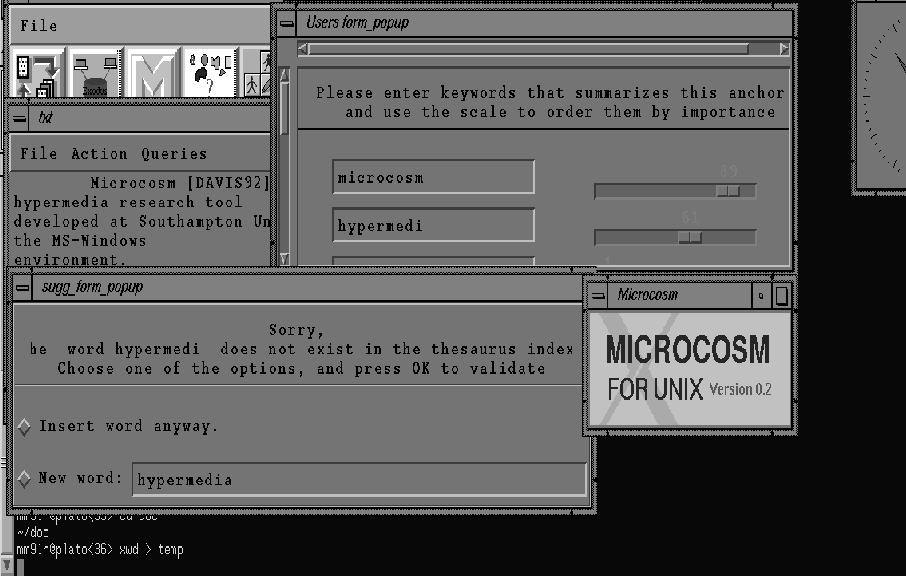
Microcosm (cf. 2.1.13) is a research project at the University of Southampton. Like Intermedia five years before, Microcosm is designed around the idea that material of diverse sources and formats should be tied together into one hypertext. To achieve this goal links have to be separated from the documents. They are stored and maintained in special link databases. In contrast to Intermedia, Microcosm plays the active role in gathering the necessary data out of the documents. For each topic it stores data on which documents contain information about it and also where inside the documents the information is located. This elaborated conception of links can be seen more as a kind of Memex’ trails than simple one-to-one links. Given this structure dynamic linking becomes possible. This means that links can be associated with generic text strings. Wherever this string shows up a link is placed automatically. This has the effect that documents that are imported for the first time into Microcosm can have links immediately.
we’re rolling out the first phase of the Bluesky + standard.site integration today! now, when you share an article from writing platforms that support standard.site (like @leaflet.pub, @pckt.blog, @offprint.app), you’ll notice the link card has more to it than a typical link card.

Bluesky
v1.122 is rolling out today, featuring a better way to discover and share articles, blog posts and newsletters across the Atmosphere via new, dynamic Standard.site link cards. 🧵


