

Overview · vlpds docs
An atproto PDS whose only durable storage is an object store. Any node serves any request, one node can run a personal server for free, and a few nodes can carry all of Bluesky's write load.
Embracing ATProto, part 1: Setting up a PDS
In this series of posts, I'll explore my journey into setting up my workflows and services for atproto. The first step is setting up my PDS. Let's start with a bit of explanation for all this lingo.

PDS operator guide — atproto-crates
Operating atproto-pds: production status, endpoint surface, storage profiles, build flags, the full environment variable reference, and the deployment modes that are deliberately not wired up.
Entryway operator guide — running atproto-entryway
Operating atproto-entryway: the account service and OAuth authorization server in front of one or more PDS instances. What it owns, keys, pairing a member PDS, the full environment reference, reconciliation, and the traps.
Adversarial ATProto PDS Migration | Blog
An ATProto account lives on a Personal Data Server (PDS), and that service needs to be hosted somewhere by someone. There are a lot of options here, like a Raspberry Pi in your closet, a rented VPS in a datacentre, or a batteries-included service like bsky.social.
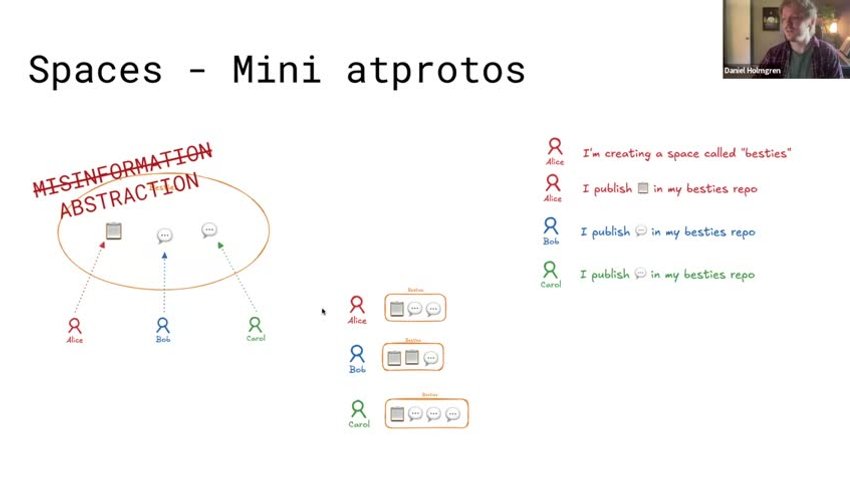
FediForum Talk: Introduction to Atproto Spaces
By Daniel Holmgren, head of protocol at Bluesky PBC. A technical overview of the recent extension of AT Protocol beyond public data to cover permissioned data and private group spaces.
Other PDS
Compare other ATproto Personal Data Servers (PDS): see providers, regions, and tips for choosing where your handle and social data should live.

Other PDS
Compare other ATproto Personal Data Servers (PDS): see providers, regions, and tips for choosing where your handle and social data should live.

Lots of awesome OS for the PDS posts flying around today, but what about a PDS in the OS? Here's a peek at the native Linux rewrite of @aetheros.computer, built on NixOS with PDS backed user accounts and experimental support for spaces. Still WIP, but stay tuned for more info later this year...
You know what I want: a "headless" PDS. @roomy.space needs a way to create an ATProto account for every space that is created. That means we need a legit PDS repo. We don't want to implement a PDS ourselves, so we'd rather use Tranquil or the reference PDS.
the single most important part of atproto is the PDS as a user-controlled auth and storage layer to which clients can connect directly. death to appviews

Authenticated Transfer Enables Orchestration - nekomimi
blog.nekomimi.petBeen thinking about what digital ownership could look like on atproto: NOT NFTs/speculation, but real transferable digital objects. An album, artwork, book, etc. with its own DID, provenance, rights, lending, gifting & resale. Access is a service; ownership is an object. PDS to PDS transfer.
This seems like a crucial questions about what "data ownership" means for atproto. If the 3rd party doctrine applies, as Mike suggests, then I'm not sure it's possible to claim ownership unless it's self-hosted or it doesn't apply to your PDS host. Something to watch when permissioned data lands.

Alana Purdy’s Husband ⁂
@masnick.com I’m listening to your interview with @reckless.bsky.social. This third party doctrine is interesting. Do you think that atproto data would be considered properly owned by the account individual? Would be interesting implications if that public data fall under search and seizure rights.
An underappreciated #atproto feature is that whenever apps want to update your data: 1. they ask your PDS for permission, 2. your PDS asks you, 3. you can say no, + 4. your PDS enforces your wishes As of today, the @tranquil.farm PDS UX lets you give "partial no" answers to question 3. Bravo!

Trezy
This is awesome. I made a PR last week to add better support and display for permission-sets to the OAuth consent screen for @tranquil.farm. Now every time I log in to my Atmosphere account, I can actually see my fingerprints on Tranquil. 😍 #atproto


