

Opinion | YouTube, the Great Radicalizer (Published 2018)
The videos it recommends seem to get more and more extreme.

Redesigning algorithms to intervene on social norm misperceptions during a national election
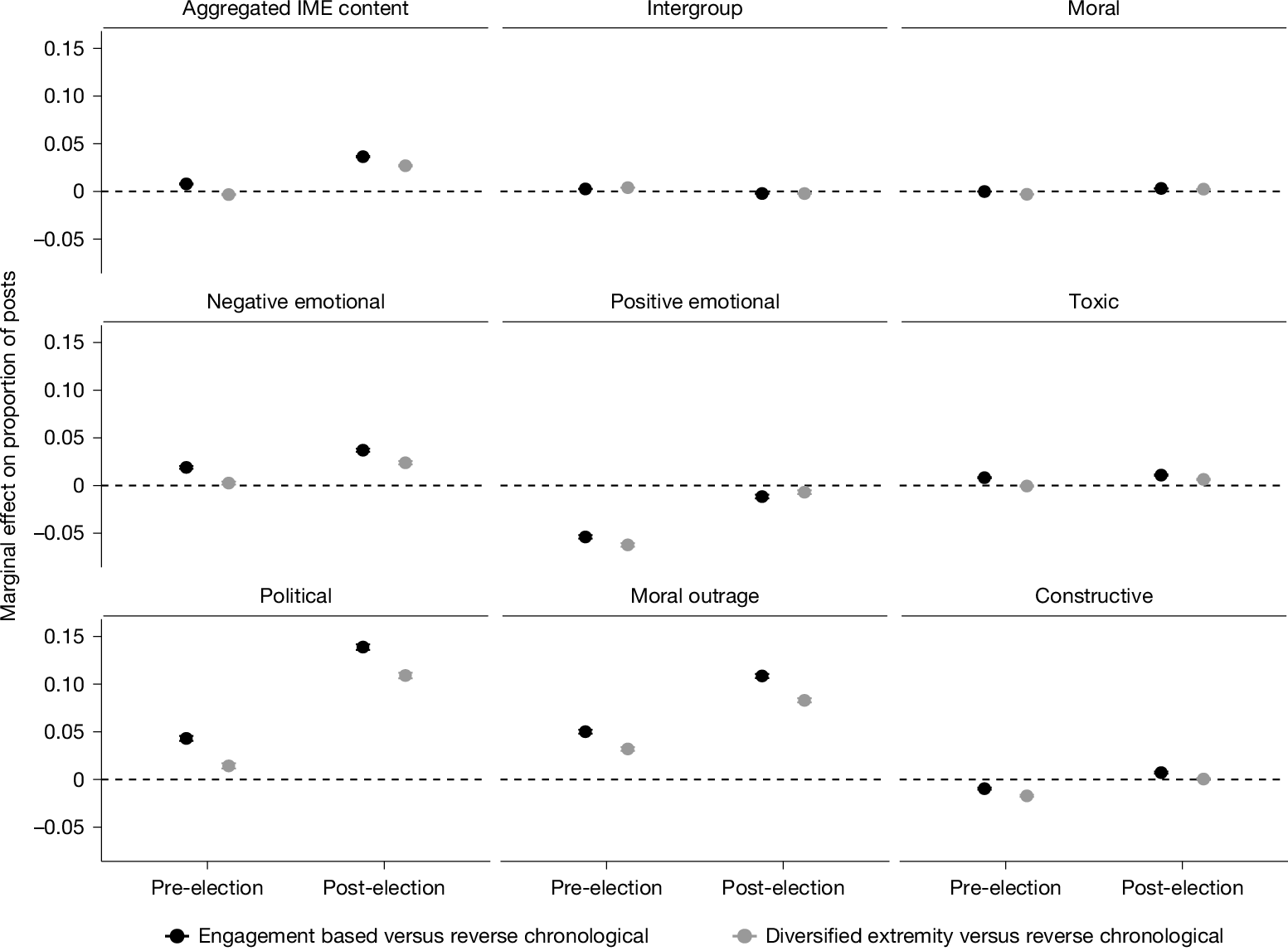
For the first time in history, civic discourse commonly occurs in digital environments in which algorithms influence exposure to social information1,2. It is increasingly important to understand whether and how these algorithms affect political discourse3–5. Here we built custom feed-ranking algorithms with full control over their features, and randomly assigned 2,000 participants to use them for 8 weeks (before and after the 2024 US presidential election). We tested whether an engagement-based algorithm (used on major social media platforms6,7) amplifies intergroup, moralized and emotional (IME) information in ways that skew perceptions of social norms around political dialogue5,8, and whether it increased engagement with IME content and perceptions of partisan animosity (compared with a reverse-chronological feed9,10). We also developed and tested a ‘diversified extremity’ algorithm to reduce the influence of extreme users11–13 to improve the accuracy of social norm perception14–16 and reduce perceptions of partisan animosity. We found that engagement-based feeds amplified IME and toxic content relative to reverse-chronological feeds, with the largest increases in moral outrage and political content. Engagement-based feeds also reduced prescriptive norm perception accuracy (albeit in an unexpected direction) and increased perceived partisan animosity. However, they did not significantly alter users’ own engagement behaviours. The diversified extremity algorithm reduced IME and toxic content exposure, improved prescriptive norm accuracy, yet maintained comparable platform enjoyment—suggesting that reducing the influence of extreme users can curb algorithmic distortions without diminishing user experience.
Redesigning algorithms to intervene on social norm misperceptions during a national election
For the first time in history, civic discourse commonly occurs in digital environments in which algorithms influence exposure to social information1,2. It is increasingly important to understand whether and how these algorithms affect political discourse3–5. Here we built custom feed-ranking algorithms with full control over their features, and randomly assigned 2,000 participants to use them for 8 weeks (before and after the 2024 US presidential election). We tested whether an engagement-based algorithm (used on major social media platforms6,7) amplifies intergroup, moralized and emotional (IME) information in ways that skew perceptions of social norms around political dialogue5,8, and whether it increased engagement with IME content and perceptions of partisan animosity (compared with a reverse-chronological feed9,10). We also developed and tested a ‘diversified extremity’ algorithm to reduce the influence of extreme users11–13 to improve the accuracy of social norm perception14–16 and reduce perceptions of partisan animosity. We found that engagement-based feeds amplified IME and toxic content relative to reverse-chronological feeds, with the largest increases in moral outrage and political content. Engagement-based feeds also reduced prescriptive norm perception accuracy (albeit in an unexpected direction) and increased perceived partisan animosity. However, they did not significantly alter users’ own engagement behaviours. The diversified extremity algorithm reduced IME and toxic content exposure, improved prescriptive norm accuracy, yet maintained comparable platform enjoyment—suggesting that reducing the influence of extreme users can curb algorithmic distortions without diminishing user experience.
‘It’s frightening’: How far right is infiltrating everyday culture
Extremist messaging now woven into music and YouTube videos, with one expert saying: ‘You can be radicalised sitting on your couch’
What do they put in those things?
68K votes, 906 comments. 719K subscribers in the NonPoliticalTwitter community. Twitter and Bluesky without the politics. Come vibe with us as we…
Priorities | celeste4sos.com
The right to vote, better representation and election integrity.

Mainstreaming the populist radical right? Online news exposure and voting behavior in the 2019 European Parliament election
How does media exposure relate to support for radical right populist parties (RRPPs)? We contribute to this classic debate by analyzing the web browsing histories and survey responses of six thousand study participants in France, Germany, Italy, Spain, and the UK during the 2019 European Parliament election. Linking direct measures of online news exposure to voting behavior allows us to assess the effects of the salience of issues politicized by RRPPs on their electoral support. The likelihood to vote for RRPPs was higher when the EU was more salient in individual media diets, while exposure to the less salient issue of immigration did not increase the propensity to vote for RRPPs. Alongside consistent results for other party families and interactions with pre-existing voting intentions, the findings indicate that the electoral effects of online media are contingent on the overall salience of a specific issue and voters’ predispositions.

Anyone know if this works?
71K votes, 1.5K comments. 719K subscribers in the NonPoliticalTwitter community. Twitter and Bluesky without the politics. Come vibe with us as we…
Scam!
64K votes, 1.2K comments. 719K subscribers in the NonPoliticalTwitter community. Twitter and Bluesky without the politics. Come vibe with us as we…
How the internet flips elections and alters our thoughts | Aeon Essays
The internet has spawned subtle forms of influence that can flip elections and manipulate everything we say, think and do
Public support for the <i>cordon sanitaire</i> : Descriptive evidence from Spain
Reactions to the rise of far-right parties that advocate democratic backsliding, and the dilution of socially liberal democratic norms present a dilemma for existing political parties. How should existing political parties respond to this challenge? A commonly adopted strategy is to apply a cordon sanitaire which excludes radical right-wing challengers from the government-forming process. Do voters support this policy? Leveraging data from Spain – where the mainstream right has accommodated the radical right-wing party, VOX, via numerous governing coalitions – I rely on individual citizens’ views on how parties should respond to rise of the far-right party, to answer this question. Empirically, the results show very low-level support for the cordon sanitaire in Spain. Indeed, the modal position of the electorate, regardless of their ideological position, is to treat the party just like any other. These results are not conditioned by the propensity of individuals to identify VOX as indeed being a “radical right” party. These descriptive findings suggest that whilst radical right-wing parties may present an inimical threat to democratic norms, citizens do not necessarily view the means of squashing this threat to be one of strategic exclusion. This likely explains why the mainstream right has been able to institutionalise VOX as a political ally: where strategic exclusion is not expected, the mainstream right need not fear violating an expectation that does not exist.
How do social media feed algorithms affect attitudes and behavior in an election campaign?
We investigated the effects of Facebook’s and Instagram’s feed algorithms during the 2020 US election. We assigned a sample of consenting users to reverse-chronologically-ordered feeds instead of the default algorithms. Moving users out of algorithmic feeds substantially decreased the time they spent on the platforms and their activity. The chronological feed also affected exposure to content: The amount of political and untrustworthy content they saw increased on both platforms, the amount of content classified as uncivil or containing slur words they saw decreased on Facebook, and the amount of content from moderate friends and sources with ideologically mixed audiences they saw increased on Facebook. Despite these substantial changes in users’ on-platform experience, the chronological feed did not significantly alter levels of issue polarization, affective polarization, political knowledge, or other key attitudes during the 3-month study period.

Lost in translation
74K votes, 423 comments. 719K subscribers in the NonPoliticalTwitter community. Twitter and Bluesky without the politics. Come vibe with us as we…


