

Inside the Democrats’ Campaign Spam Machine | KQED
We talk about the system behind campaign fundraising texts, how it works, who profits and why changes could be on the horizon.

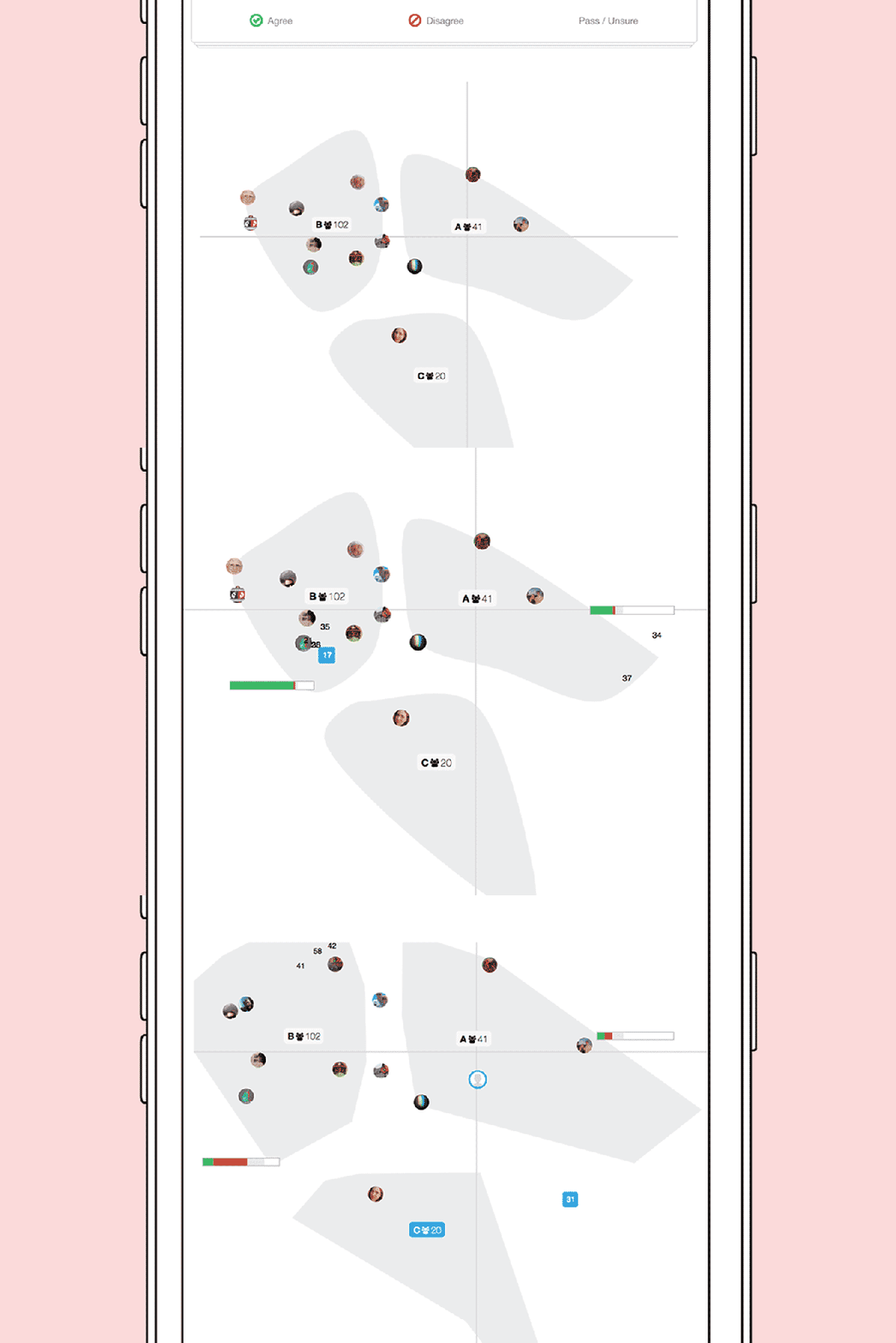
The Internet Doesn’t Have to Be Bad for Democracy
A new form of online survey uses crowdsourcing and data visualization to reveal the hidden nuances in partisan debates.
My Journey to the Center of America’s Political Spam Text Hell
I’ve gotten nearly 2,000 campaign fundraising texts that were meant for someone else. I tried to find out why—and uncovered a labyrinth of politicians, data brokers, and shady tactics.

How to Run Surveys: A Guide to Creating Your Own Identifying Variation and Revealing the Invisible
Surveys are an essential approach for eliciting otherwise invisible factors such as perceptions, knowledge and beliefs, attitudes, and reasoning. These factors are critical determinants of social, economic, and political outcomes. Surveys are not merely a research tool. They are also not only a way of collecting data. Instead, they involve creating the process that will generate the data. This allows the researcher to create their own identifying and controlled variation. Thanks to the rise of mobile technologies and platforms, surveys offer valuable opportunities either to study broadly representative samples or to focus on specific groups. This article offers guidance on the complete survey process, from the design of the questions and experiments to the recruitment of respondents and the collection of data to the analysis of survey responses. It covers issues related to the sampling process, selection and attrition, attention and carelessness, survey question design and measurement, response biases, and survey experiments.

Generative AI Meets Open-Ended Survey Responses: Research Participant Use of AI and Homogenization
The growing popularity of generative artificial intelligence (AI) tools presents new challenges for data quality in online surveys and experiments. This study examines participants’ use of large language models to answer open-ended survey questions and describes empirical tendencies in human versus large language model (LLM)-generated text responses. In an original survey of research participants recruited from a popular online platform for sourcing social science research subjects, 34 percent reported using LLMs to help them answer open-ended survey questions. Simulations comparing human-written responses from three pre-ChatGPT studies with LLM-generated text reveal that LLM responses are more homogeneous and positive, particularly when they describe social groups in sensitive questions. These homogenization patterns may mask important underlying social variation in attitudes and beliefs among human subjects, raising concerns about data validity. Our findings shed light on the scope and potential consequences of participants’ LLM use in online research.

Give Lively - A Free Fundraising Platform For Nonprofits
We built and support a powerful and practical fundraising platform that is free for nonprofits and intuitively easy to use for donors. Sign up today for Fundraising Pages, Text-to-Donate, Peer-to-Peer, Event Ticketing, and more!

This tool makes everyone a campaign finance expert
Introducing PaidForBy.info, a new app created by Popular Information

Political Quizzes | The Paper Pilot
The Paper Pilot's digital garden of thoughts on philosophy, politics, and sociology
Chatbots and the Ballot Box: Evaluating Accuracy, Sourcing, and Language Gaps in AI Answers to Election Questions
ISD assesses how reliably six leading AI models provide accurate, complete information on US election procedures and voter access.
Improving social media for democratic discourse
Social media have expanded opportunities for communication and political participation, but today's dominant platforms are optimized primarily for engagement and advertising revenue, contributing...

Simon Willison on Twitter / X
Billing different based on text contained in the system prompt is a really bad look https://t.co/15meK1YIe2— Simon Willison (@simonw) April 5, 2026
Questioning the Survey Responses of Large Language Models
The world's premier source for conference proceedings, offering Print-on-Demand, DOI, and Content Hosting services.

Watch out! It's not a good idea to ask AI chatbots about the U.S. elections because they get it wrong—especially in Spanish. - Factchequeado.com
By Laura ZommerThe six leading AI chatbots provided inaccurate, incomplete, or outdated answers to 29% of basic questions…

Project MUSE -- Verification required!
In order to better serve you and keep this site secure, please complete this challenge. If you are trying to perform text/data mining, please contact Customer Service for assistance.
What's verification on the open social web for? With @gui.do and @emily.space we put together a draft statement and roadmap for democratic account verification. For everyone, without IDs. The draft is here, please contribute and comment. Open until 31 May tangled.org/sherif.eurosky.social/atmosph…


