

Grace (@gracekind.net)
For my part, seeing AI catch up to my abilities in several domains has been painful. I feel a sense of loss. And I’m in a position where I have (a tiny bit of) leverage and control over the process. I can only imagine how painful it would be if I felt like it were completely out of my hands

Arvind Narayanan (@aisnakeoil)
There’s a big, under-appreciated reason why people may have very different experiences and opinions about using AI for work — are they using it for tasks they’re already an expert at, or tasks they can’t do themselves? The former leads to a growth cycle and the latter leads to a dependence spiral. When I use AI to do something I’m an expert at, like coding, I treat it as a tool. I can build quickly, maintaining an understanding of the code, knowing that if necessary, I can fix the code myself. It feels empowering. It frees up my time to think about the complex, judgment-oriented parts of software engineering that I can’t or won’t delegate to AI. That means my own skills improve rapidly, and I get to climb the ladder of complexity and develop higher-level skills, much more so than when I write the code myself. I feel in control. I can lock in and achieve a flow state — when AI is working, I’m reviewing, building understanding, and planning the next steps. I never get the feeling that the tool is about to replace me. This is the growth cycle. (Of course, the growth cycle is not automatic. I still need to exercise agency to use AI responsibly. But it’s the same challenge with any productivity-enhancing technology, and those who’ve navigated such transitions before are well-equipped to navigate it with AI as well.) On the other hand, if I use it for tasks I don’t understand and haven’t learned to perform myself, I have no choice but to treat it as a superintelligence. If something breaks, the best I can do is ask AI to fix it and hope for the best. I generally can’t evaluate the quality of the output myself. The only way to find out if it's any good is if and when the work is ultimately reviewed by an actual expert. The experience is confusing, unsettling and disempowering. And forget about flow state. By over-relying on AI, I risk losing whatever skill I had at the task in the first place, even if it boosts productivity in the short term. This is the dependence spiral. It’s no wonder that entry-level workers and students preparing to enter the workforce find themselves in a bind. To compete with the AI-enabled productivity of more seasoned workers, they must adopt AI themselves, but doing so risks the dependence spiral. I have some thoughts on solutions that I will share in later posts, but I think having a clear diagnosis of the problem is a useful first step.

Measuring AI Ability to Complete Long Tasks
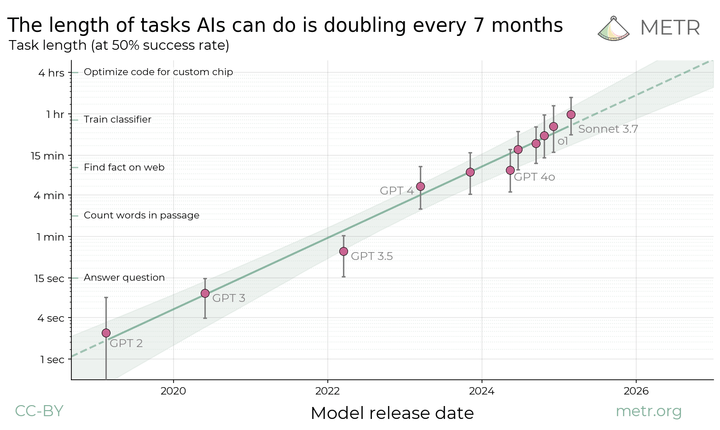
We propose measuring AI performance in terms of the *length* of tasks AI agents can complete. We show that this metric has been consistently exponentially increasing over the past 6 years, with a doubling time of around 7 months. Extrapolating this trend predicts that, in under a decade, we will see AI agents that can independently complete a large fraction of software tasks that currently take humans days or weeks.
AI Research Evaluation: Negative Findings and Failure Modes | Arvind Narayanan posted on the topic | LinkedIn
📢AI agents can autonomously conduct AI research when the result is easily verifiable, but what about open-ended AI research? That’s much harder to study, and our new preprint is our first crack at doing so. Our main finding is negative, and we identify five recurring failure modes. https://lnkd.in/eGKYi4Sa Our results are tentative, and we are working to address the limitations (sample size, potential scaffold improvements). But if the finding holds up, what are the implications? It depends on whether you think recursive self improvement can be achieved simply by hill climbing at scale (I personally don’t think so) and whether you think current limitations of open-ended research like judgment and creativity could change quickly (I’m personally very open to this possibility). We plan to continue this style of evaluation — which we call shadow evaluation — on a regular basis. We’ve wanted to do this for two years, but it took so long because we wanted to get the method right. The idea behind shadow evaluation was suggested by some of the UK AISI coauthors of the paper and refined by the Princeton team. This method has important advantages (and limitations) over the current ways of evaluating agents’ ability to conduct AI research. If you’re an AI researcher interested in working with us on a shadow evaluation based on one of your papers, we’d love to hear from you. https://lnkd.in/ecyp55SW This type of evaluation necessarily involves a ton of researcher flexibility in design, execution, and interpretation. Members of the core team have a particular position in the debate on recursive self-improvement / superintelligence, and this could influence how we conduct the research. We have a detailed section in the paper on our potential biases and how we address them. We sought out a team of collaborators who don’t all share our priors, and we explicitly surface the interpretive disagreements that resulted. For future evaluations, we are interested in having “adversarial collaborators” as part of the core team. This paper exists because of the careful, time-consuming and very much human work that Peter Kirgis, Sayash Kapoor, Andrew Schwartz, and Stephan Rabanser did over the last few months. I’m also very grateful to the larger group of collaborators and co-authors. The work is part of the larger CRUX project that pushes frontier AI agents beyond what benchmarks can measure (https://cruxevals.com/). We are looking for a senior researcher to join the team: https://lnkd.in/e9dC22X5

AI Is Forcing Employees to Work Harder Than Ever
Another new study adds to the understanding that AI is actually making work more demanding for employees instead of making it easier.

AI research speeds up. Monitoring gets harder. - Sensemaker
OpenAI says coding agents now run 3.1 days for every human research day, while its chief scientist warns the lab’s main monitoring method is weakening.
On the Value of Doing a PhD in the Age of AI
Many students who are just now embarking on a PhD in AI are understandably anxious. It feels like our field is zooming forward ever faster. Our clever methods are often surpassed before they are published. Our deep insights seem less critical to frontier lab progress. AI is automating aspects of the research process that used to require years of specialized training.
Using AI for Just 10 Minutes Might Make You Lazy and Dumb, Study Shows
New research suggests that reliance on AI assistants can have a negative impact on people’s ability to think and problem solve.

Want to understand the current state of AI? Check out these charts.
According to Stanford’s 2026 AI Index, AI is sprinting, and we’re struggling to keep up.

On Taste, Effort & Curiosity - again
When AI collapses how long it takes to ship, what’s left is judgment, experimentation, and knowing what not to build.
Measuring the Impact of Early-2025 AI on Experienced Open-Source Developer Productivity
Despite widespread adoption, the impact of AI tools on software development in the wild remains understudied. We conduct a randomized controlled trial (RCT) to understand how AI tools at the February-June 2025 frontier affect the productivity of experienced open-source developers. 16 developers with moderate AI experience complete 246 tasks in mature projects on which they have an average of 5 years of prior experience. Each task is randomly assigned to allow or disallow usage of early 2025 AI tools. When AI tools are allowed, developers primarily use Cursor Pro, a popular code editor, and Claude 3.5/3.7 Sonnet. Before starting tasks, developers forecast that allowing AI will reduce completion time by 24%. After completing the study, developers estimate that allowing AI reduced completion time by 20%. Surprisingly, we find that allowing AI actually increases completion time by 19%--AI tooling slowed developers down. This slowdown also contradicts predictions from experts in economics (39% shorter) and ML (38% shorter). To understand this result, we collect and evaluate evidence for 20 properties of our setting that a priori could contribute to the observed slowdown effect--for example, the size and quality standards of projects, or prior developer experience with AI tooling. Although the influence of experimental artifacts cannot be entirely ruled out, the robustness of the slowdown effect across our analyses suggests it is unlikely to primarily be a function of our experimental design.

Monthly Roundup #45: August 2026
As AI has escalated increasingly quickly, more and more of my posts have ended up focusing on AI.
Software engineering may no longer be a lifetime career
I don’t think there’s compelling evidence that using AI makes you less intelligent overall1. However, it seems pretty obvious that using AI to perform a task means you don’t learn as much about performing that task. Some software engineers think this is a decisive argument against the use of AI. Their argument goes something like this:

Peter Wildeford🇺🇸🚀 on Twitter / X
Great to see @tristanharris talking on his podcast about recursive self-improvement. Here's how his guest, Tim Fist, puts it -- "Over the last few months we've had all three of the leading US AI labs say that having the option for a global slowdown or pause in AI development is… https://t.co/s5UURtkEjQ— Peter Wildeford🇺🇸🚀 (@peterwildeford) June 21, 2026
Is AI ruining our skills? Early results are in — and they’re not good
Reliance on artificial-intelligence tools degrades the abilities of physicians and software engineers, studies show.

AI is getting too advanced
genuinely, if you're not re-evaluating your position on AI at least once every 1-2 months and re-evaluating how it performs for the types of tasks important to you, then you are not actually challenging your priors. i know this is crazy! but thats how fast things are moving right now.

hailey
one thing i will say is that things are changing fast enough that if your priors are more than a month old, you need to challenge them again! astra for example is a very significant step forward for a lot of people's tasks.
Sep 7, 2026 at 9:42 PM