

If you want mass adoption and you don't already have dominance, I think you have to get people who genuinely enjoy understanding the problems and needs and desires of Actual Others involved from the beginning. I do not think there is a cheat for empathy and taste.
Mar 23, 2026 at 4:46 PM
Nurturing our humanity: how domination and partnership shape our brains, lives, and future
Nurturing Our Humanity offers a new perspective on our …

Nurturing Our Humanity: How Domination and Partnership Shape Our Brains, Lives, and Future - The Center for Partnership Systems
By Riane Eisler and Douglas P. Fry Nurturing Our Humanity: How Domination and Partnership Shape Our Brains, Lives, and Future, by Riane Eisler and Douglas P. Fry, holds the key to a clear perspective on our personal and social options in today’s world, showing how to structure our environments – from family and gender relations […]

Opinion: A gender gap is emerging in AI adoption, and women risk being left behind
Women appear less inclined to use AI tools, producing a disadvantage they can ill afford

Against Empathy
Most people see the benefits of empathy as too obvious to require justification.

It's okay if child liberation & family abolition make you uncomfortable.
Ask questions, acknowledge your feelings -- these are the growing pains of considering a radically new idea.

Taming the Mammoth: Why You Should Stop Caring What Other People Think
We all care way too much what other people think of us. Here's why.

Moderating With Humans, For Humans - Trust Issues
Moderating With Humans, For Humans - Trust Issues
My AI Adoption Journey
My experience adopting any meaningful tool is that I've necessarily gone through three phases: (1) a period of inefficiency (2) a period of adequacy, then finally (3) a period of workflow and life-altering discovery.
say eugenics, say it again
For individuals This suggestion is to get comfortable and familiar with the concept of eugenics - a concept that holds a lot of information about cultura...

Scientific institutions have a long history of anticipatory obedience
Societies should learn from this and speak up to support inclusion

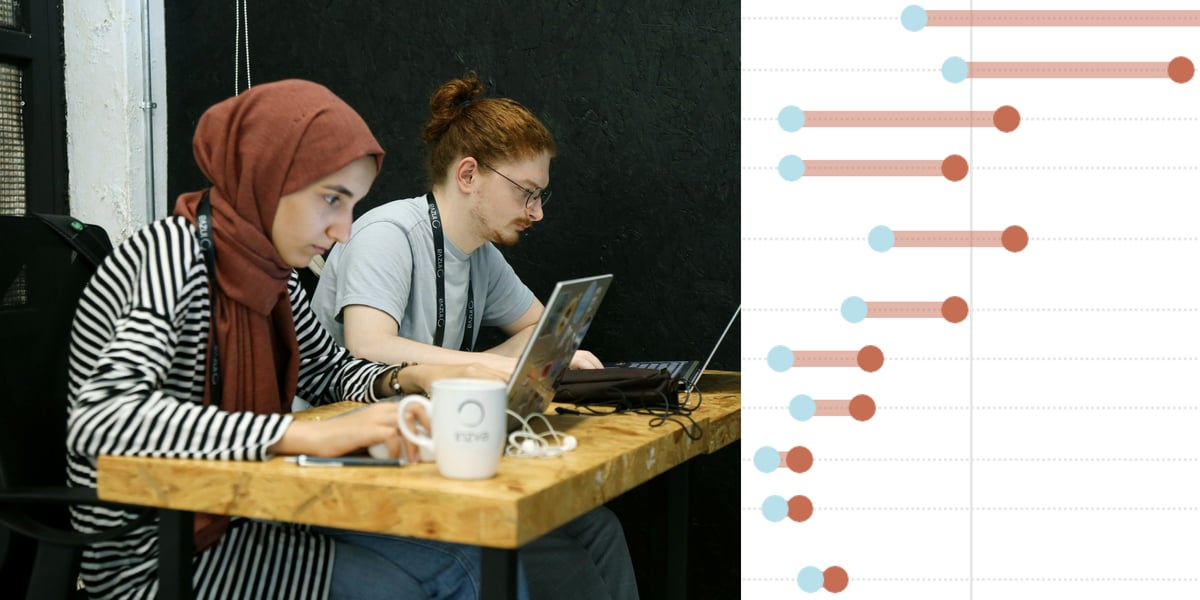
The AI gender gap | Datawrapper Blog
In this Weekly Chart, we examine the gender gap in AI adoption.
The Ecological Theatre of Selfish Elements
Abstract. Some selfish genetic elements enhance their transmission to the next generation by interfering with and eliminating competing variants within the

AI adoption higher among men than women: Survey
This large gap — 81.3% compared to 58.8% — stems from the higher representation of women in skilled trades, where AI usage remains extremely low.
Relational values of nature: leverage points for nature policy in Europe
Relational values reflect the qualities of the relationships between humans and nature, such as care, social bonding, place attachment and spiritual meanings. In this perspective article, we argue ...

Children’s Sense of Fairness as Equal Respect
One influential view holds that children’s sense of fairness emerges at age 8 and is rooted in the development of an aversion to unequal resource distributions. Here, we suggest two amendments to this view. First, we argue and present evidence that children’s sense of fairness emerges already at age 3 in (and only in) the context of collaborative activities. This is because, in our theoretical view, collaboration creates a sense of equal respect among partners. Second, we argue and present evidence that children’s judgments about what is fair are essentially judgments about the social meaning of the distributive act; for example, children accept unequal distributions if the procedure gave everyone an equal chance (so-called distributive justice). Children thus respond to unequal (and other) distributions not based on material concerns, but rather based on interpersonal concerns: they want equal respect.
