My journey to the heart of the forgotten internet
Slowly but surely, huge swaths of the internet are vanishing. But the artefacts of the early web are still out there, and they have lessons for the future.

Part I: The Next Great Online Community
There’s a lack of innovation in community software. Let's dive into internet history, and get inspired!

The Dark Forest Anthology of the Internet
A book about how to survive on the internet. It’s about the cozy web, the dark web, the dark forest, the clear net, the dark net, and a new social world emerging around us. This is the Dark Forest Anthology of the Internet.

What Was the Internet?
As AI overtakes the web, five writers reflect on how far it’s fallen and what comes next.

What Was the Internet?
As AI overtakes the web, five writers reflect on how far it’s fallen and what comes next.
AI Might Be Our Best Shot At Taking Back The Open Web
I remember, pretty clearly, my excitement over the early World Wide Web. I had been on the internet for a year or two at that point, mostly using IRC, Usenet, and Gopher (along with email, naturall…


The Case for Open Sovereignty in a Fragmenting Internet
Once, the Internet promised to dissolve borders. It was humanity’s great experiment in connection — a place where ideas, innovation, and communities could move freely, unburdened by geography or...

Why Open Source Failed
(If you like this essay, you may be interested in my follow-up, “Save Open Source, Save the World”)

The open, social web
I was in Europe for the past week and half, ending up in Leuven, Belgium to speak at the Twiist.be conference. The topic of my talk was “The Open, Social Web.” (PDF) At first I struggle…
Eaten by the Internet
This book makes internet infrastructure visible as a force of political power, which is transforming the social world, from the bottom up—through fifteen chapters contributed by a global set of researchers, activists, and techies. We are living a unique moment: internet technologies are the default infrastructure for society, not just how we communicate but also how we organise our social life, politics, and economy, all the way down to our material environments, like cities. Our world is eaten by the internet. This means that those who control the internet control the bounds of public speech, economic production, social cohesion, and politics, making its infrastructure a core political terrain in the networked age. The book’s chapters cover a wide set of topics, spanning from the global politics of content moderation by internet infrastructure to the colonialism inherent in the race to plug the moon, from the harms wrought by blockchain companies in rural America to the particularities of online censorship across Asia. The chapters take on thorny topics, discussing power consolidation in the advertisement and cloud industry, the role of internet infrastructure in the war in Ukraine, and tech’s environmental impact—amongst others. In doing so, this book roots contemporary technology debates in the politics of internet infrastructure and urges us to ask how can we ensure our infrastructures sustain us, rather than consume us?
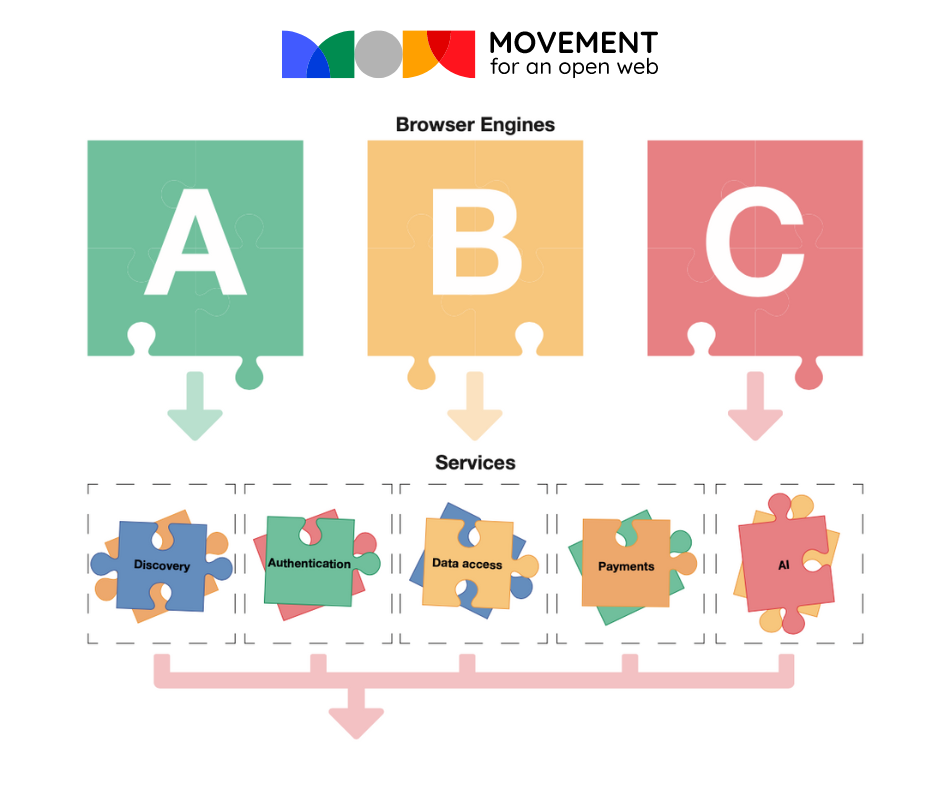
Break up the Browsers. A Proposal to Save the Open Web. - Movement For An Open Web
The Open Web is one of the world’s modern wonders. Based on core, universally recognised technical standards and owned and controlled by no one body, it is a unique structureRead More
Art or tool?
The Internet spaces I tend to inhabit have more polarisation than at many other recent times, and little explication of the worldviews that lead to different premises for discussion, that in turn...

Rethink: Web - Open Space
When we struggle to explain the inherent qualities of a medium, we tend to defer to analogies and metaphors. This is especially true of the internet. Clouds, highways, streams, and real estate are just a few examples of the concepts employed to represent this intangible invention. Staring into a screen, it’s easy to imagine an […]

Historical pragmatism and the internet
This article argues that the literature describing the internet revolution in the 1990s was characterized by the rhetoric of the technological sublime. This rhetoric suffered from three fatal flaws: (1) it was not sufficiently grounded in the historical development of technology; (2) it viewed the internet in isolation, failing to consider the wider technological context; and (3) it failed to examine the internet in view of the social, economic, religious and political circumstances of its users. Several examples from history are cited, demonstrating that changes in various systems for the production, dissemination and preservation of cultural information both border and deborder the world. The article suggests that if internet researchers take a pragmatic, historically grounded approach, they will discover that the introduction of internet technology can be seen to have similar consequences. While the technology overcomes many boundaries (of space and time, politics and economics), other social borders may be created at the same time. It is easier to see old boundaries coming down than to see new ones being erected. Rather than being swept by utopian or dystopian enthusiasms, the article insists that the really interesting discoveries are to be made in locating the subtle social shifts taking place, relatively unnoticed, as a consequence of technological change.

Clouded skies for open networks
Last week, I finished an essay about platform design affordances and content moderation expectations and community-level context collapse on Bluesky for Tech Policy Press and set it aside to cool before a last read-through. An hour later, the Trump administration brought to Bluesky a propaganda-zombie army made