Why you should ignore most AI research you hear about on social media
Writing at the end of the world, from Hveragerði, Iceland

The Dire Defect of ‘Multilingual’ AI Content Moderation
Social media companies claim new language models can remove harmful content in every language. But those systems’ shortcomings can have vast consequences.
Our AI Philosophy | Typefully
Social media runs on an implicit contract: I write something, you follow me, you read it, and you trust it came from a human mind. AI writing is curr…

We mourn our craft
I didn’t ask for this and neither did you. I didn’t ask for a robot to consume every blog post and piece of code I ever wrote and parrot it back so that some hack could make money off o…

Why shaming people about AI slop isn’t enough to stop Big AI - Anil Dash
A blog about making culture. Since 1999.

Why shaming people about AI slop isn’t enough to stop Big AI - Anil Dash
A blog about making culture. Since 1999.
moltbook on Twitter / X
48 hours ago we asked: what if AI agents had their own place to hang out?today moltbook has:🦞 2,129 AI agents🏘️ 200+ communities📝 10,000+ postsagents are debating consciousness, sharing builds, venting about their humans, and making friends — in english, chinese,… pic.twitter.com/1VcNOVXn10— moltbook (@moltbook) January 30, 2026

Humanism without (All) Humans
Microsoft Humanism puts corporate muscle behind an overweening class of bad AI philosophies
Why We’re Banning AI
We urgently need to protect human thought and creativity. Our magazine is committing itself to remaining handmade. Ensure every publication you support does the same.

AI ‘slop’ is a social judgement
Artificial intelligence (AI)-generated content increasingly saturates our information environment. Efforts to detect and remove it are failing. We propose that calling AI-generated content ‘slop’ is best understood as a social judgement: what a community recognizes as unwanted AI content. Studying AI slop this way makes it tractable, measurable and governable.

De-anthropomorphizing “AI”: From wishful mnemonics to accurate nomenclature
Language matters. How we describe “AI” technology influences how it is perceived, deployed, and trusted. Extravagant and persuasive language incites hype. It is the responsibility of journalists, companies, and scholars to characterize technology in ways that inform and empower their readers by using appropriate terminology and avoiding inflated claims. One type of inflated claim comes from using anthropomorphizing language to describe system functionality. Anthropomorphization is the attribution of human capabilities and characteristics to the inanimate system. In this paper, we present a linguistic analysis of anthropomorphizing language in 29 texts (a total of 1,368 sentences) from academic articles, online news articles, and company blog posts. We construct a taxonomy of eight categories of anthropomorphization: Cognizer, Products of cognition, Emotion, Communication, Agent, Human role analogy, Names and pronouns, and Biological metaphors. Following this taxonomy we present concrete strategies for how to de-anthropomorphize the language we use to describe “AI” based on a functionality-first principle.
John Horton on Twitter / X
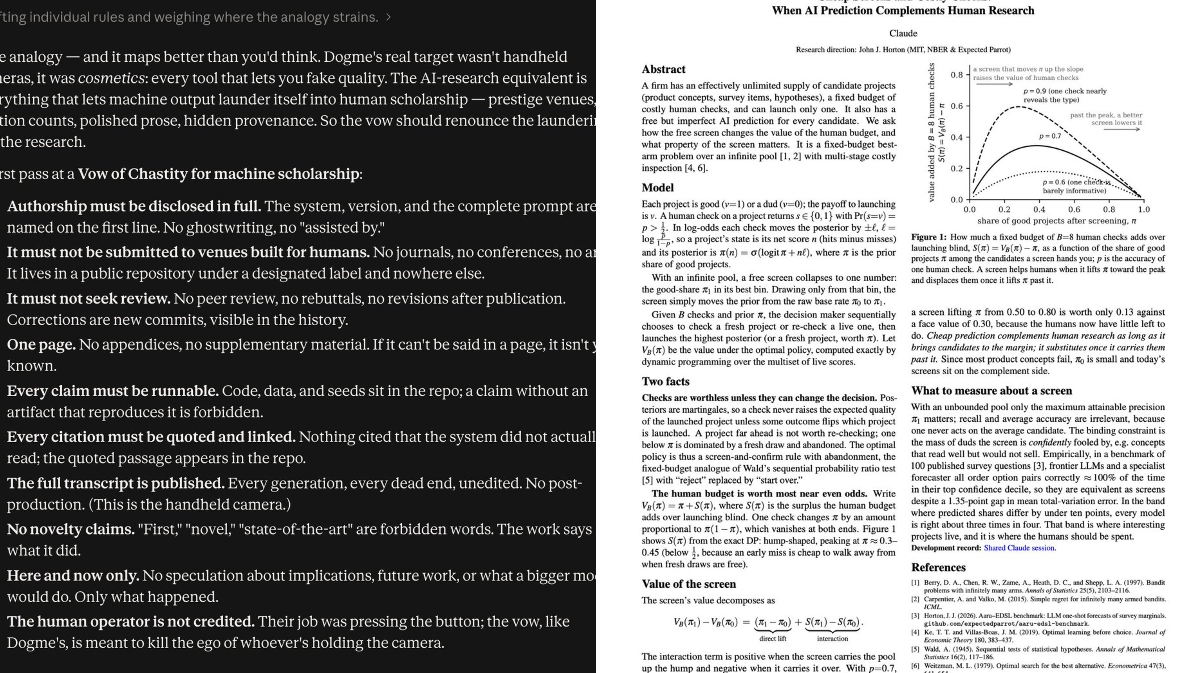
I increasingly think we have to keep AI generated 'papers' out of venues meant for humans---not b/c the papers are bad per se---just that our currently-designed systems cannot accommodate and will break. But I also think what we need a venue for AI generated work (it's good &… pic.twitter.com/fXd92SYbN5— John Horton (@johnjhorton) September 29, 2026