One of the innumerable negative externalities arising from LLM technology is the way in which scientific publishing is being swamped with AI slop. I've been suggesting publication caps for a while and I'm glad to see societies experimenting with them.

American Journal of Political Science (AJPS)
AJPS has introduced a new submission cap policy, effective today. Under the new policy, individuals may submit up to three manuscripts as an author or co-author in a 12-month period, with an option to request a waiver for a fourth submission. Read more: ajps.org/2026/11/04/new-ajps-submissio…
Nov 8, 2026 at 12:18 AM
Why AI Will Not End Scholarly Publishing (and the Publish-or-Perish Institution)
The machine may not be consuming itself. It may be acquiring a much more efficient engine.
New Studies Confirm Today’s Academic Publishing System Is A Terrible Deal For Society · Techdirt
Walled Culture has just written about the possibility that recent AI breakthroughs might accelerate a move to open access, at least in the field of mathematics. It would be particularly welcome against a backdrop of relatively slow progress in the open access world. That is not because the need for different business models that provide...
The Drain of Scientific Publishing
The domination of scientific publishing in the Global North by major commercial publishers is harmful to science. We need the most powerful members of the research community, funders, governments and Universities, to lead the drive to re-communalise publishing to serve science not the market.

Book Publishers Are Quietly Using More AI. Staff Are Revolting
Workers at three major publishing houses tell WIRED that LLMs are being used for publicity, cover art, back cover copy, and emails, as some execs push junior staff to champion the tech.

AI is eating the academic publishing industry alive, but some good might come of it
In a publish-or-perish environment where numbers count much more than quality, artificial intelligence has become the great disruptor. But what this could ultimately lead to is universities rebuilding…

Illicit Use of AI by Philosophers Refereeing for Journals - Daily Nous
In 2024, a study found that “7–17% of the sentences in the reviews [of computer science manuscripts] were written by LLMs”. It was only a […]
Why We’re Banning AI
We urgently need to protect human thought and creativity. Our magazine is committing itself to remaining handmade. Ensure every publication you support does the same.

Why the Stockholm Declaration will never work
Abstract The Stockholm Declaration calls for a moral reformation of scientific publishing—replacing commercial publishers with scholar-led journals, rewarding quality over quantity and instituting independent oversight. While noble in spirit, it fundamentally misdiagnoses the disease. The crisis of science stems not from paper mills or profit motives but from systemic incentives that reward volume, novelty and prestige over validity and reliability. Non-profit ownership will not neutralize the prestige economy, sleuth-led policing cannot scale, and ‘integrity registries’ would merely replace metrics with surveillance. True reform requires rebuilding the publishing infrastructure as a public utility: publicly funded, free to publish and read, and stripped of hierarchy and financial incentives.

What's so wrong with everyone and anyone publishing "research"?
We need to make the status of every contribution visible and portable, reward the replication, correction and synthesis that make other work dependable, and let AI help authors check before they ask the rest of us to.
When AI Makes Publish-or-Perish Obsolete – tembeling 2.0
For decades, academia has operated on a convenient assumption: academic productivity is a reasonable proxy for academic quality.
AI in scientific publishing: Slower, worse, and more expensive
There’s a saying in the management world, popularized by NASA administrator Daniel Goldin in the 1990s, that the goal of technological improvements is to make products faster, better, and cheaper. Although this strategy had some success in the aerospace industry, the zealots of artificial intelligence (AI) have been making the same argument regarding how it will transform work, claiming that so little human effort will be required that humanity will enter an era of radical abundance, free from disease, drudgery, and danger, among other benefits, leaving society with more time for creative pursuits. But history tells a different story. When machines began to increase productivity during the second industrial revolution, American engineer Frederick Winslow Taylor’s The Principles of Scientific Management encouraged corporations to use surveillance to get employees to work harder and longer, an approach that exhausted and discouraged workers and led to the transfer of knowledge and any decision-making from workers to management, while enriching the profits for only those at the top. Yet, it remains foundational to the American economic enterprise. Indeed, scientific publishing is starting to experience some Taylorism with the insertion of AI. Rigorous human checking of AI-generated research papers is creating bottlenecks as publishers strive to maintain the integrity of the scientific record. The challenge is requiring even more human effort, making the whole endeavor slower and more expensive.

AI Use in The Scholarly Kitchen - The Scholarly Kitchen
Some thoughts on the reader response the Scholarly Kitchen has seen regarding AI use by authors, a recent Nature News article on the efficacy of AI detection tools, and why it's important to keep experimenting to figure out what's ethically acceptable.
I Used AI to Fake a Scientific Paper. Here’s What Happened
My experiment with an IEEE journal revealed AI’s threats to scholarly publishing

Bending the Curve: How AI is Transforming Scientific Discovery
Discover how researchers use LLMs and specialized AI models like AlphaFold as complementary tools to accelerate innovation and expand the scientific frontier.

John Horton on Twitter / X
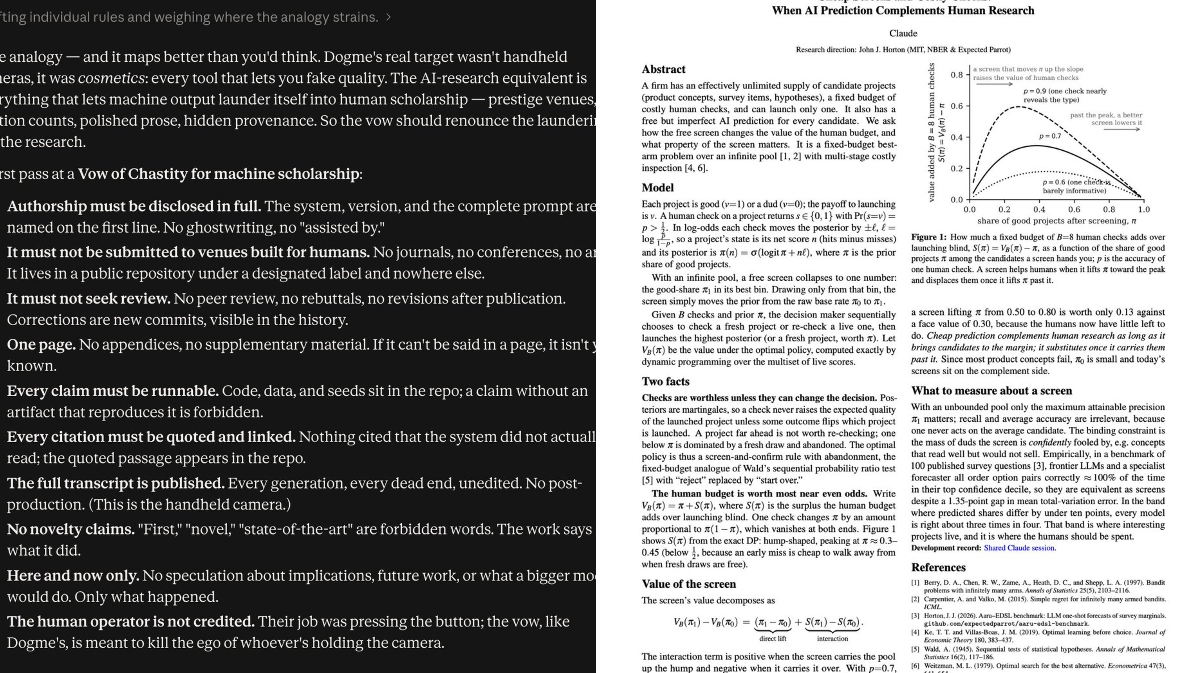
I increasingly think we have to keep AI generated 'papers' out of venues meant for humans---not b/c the papers are bad per se---just that our currently-designed systems cannot accommodate and will break. But I also think what we need a venue for AI generated work (it's good &… pic.twitter.com/fXd92SYbN5— John Horton (@johnjhorton) September 29, 2026
Scientific Publishing: Enough is Enough
Why we're no longer funding journal publications