

Since I don’t have time to dig into this yet, question: if I build a service that relies on this (say, @squire.quest) what happens to users with a PDS that doesn’t support this implantation yet. What’s the planned experience?

dad (aka miguel)
oh shit, offprints about to pop off atproto.com/blog/atproto-spaces-alpha
Aug 21, 2026 at 10:02 PM
What is required to make a PDS implementation?
This Github thread from July 2024 had a long answer by Bryan Newbold that is included below:
Proposal: OAuth-based account creation · bluesky-social atproto · Discussion #4587
We recently added to the reference PDS (and underlying OAuth Provider) implementation support for Initiating User Registration via OpenID Connect 1.0, however, what I wasn't aware of when I add...

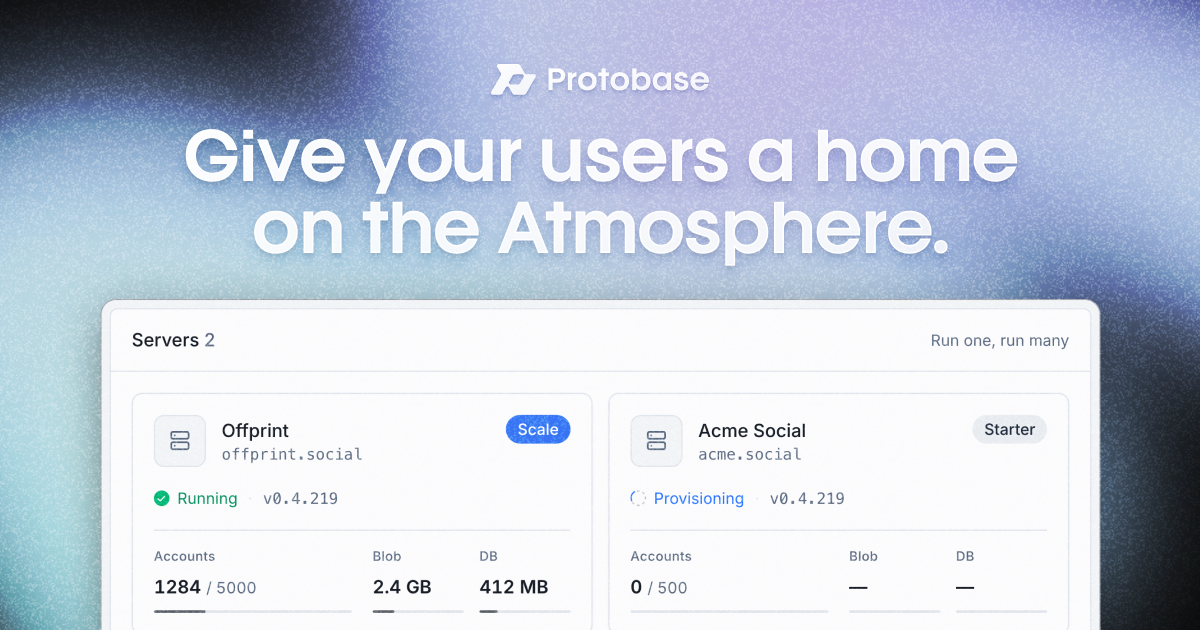
Protobase
Managed AT Protocol PDS infrastructure for your brand. Give your users a home on the Atmosphere — we handle the heavy lifting.
Shower thought idea: What about expanding the role of the PDS for account management? E.g. when signing up on atproto with any app/service for the first time, redirect to the already existing account interface (`/account/`) already present on reference PDS, making this flow mandatory to support.
Great question. My biggest takeaway: we need to come to an agreement on how to advertise PDS/service capabilities. MOST of the PDS implementations I'm testing support community.lexicon.service.describe, which works v well. #atproto

Scooter
So what were your major takeaways?
I think we need a "PDS as a Service". There are a bunch of little apps I'd love to make, but I don't want to have to host a PDS for each of them for anyone who doesn't already have an account. But I'd be fine with allowing them to register to a PDS with my app's domain and pay a fee per sign up.
Yesterday we launched a new feature and now our existing web users can bring their own DID or we can be a temporary custodian of a new identity. Either way, now every user's PDS is the source of truth for public events and rsvps. openmeet.net/your-identity-your-events #ATprotocol

Your Identity, Your Events: How OpenMeet Gives Every User an AT Protocol Account
openmeet.netConsider this still a beta. It definitely won't mess up your PDS (it only requests access over Atcade records), but it honestly could use more QA. But you can challenge anyone to a game with just their Bluesky handle! atcade.com

atcade
atcade.comOk, this will sound a little crazy, but if I'm managing my keys, what would happen if I turned my browser into my PDS? Like, I only use my PDS when im logged in, everything else gets mirrored by relays ... What would happen if my PDS was running locally as my browser?

Sam Goto
I made a decision on this: I'm going to keep using did:plc. There are many technical pros/cons, but I'm going to take a bet on people and use this product as the people designing it are using it too. Here is to changing ones mind!
I feel like the logical endpoint is ISPs giving you an atproto identity when you sign up, if you don’t already have one. Would that make things easier? Would we be okay with that, assuming nothing breaks and you can change your PDS afterward?

Ariel M. (she/her)
Changing your phone provider = changing your atmosphere provider → keep your phone number = keep your identity (username) Changing your phone = changing what app you use* → keep your contacts & photos = keep your followers, following, posts, etc. You can change providers without changing phones.
It's true — fetching authenticated data directly from a PDS is a pain in the butt. And it's totally worth it.

Making Websites is More Complicated These Days - And That's a Good Thing
alexanderson.leaflet.pubOk, this will sound a little crazy, but if I'm managing my keys, what would happen if I turned my browser into my PDS? Like, I only use my PDS when im logged in, everything else gets mirrored by relays ... What would happen if my PDS was running locally as my browser?
Sam Goto
I made a decision on this: I'm going to keep using did:plc. There are many technical pros/cons, but I'm going to take a bet on people and use this product as the people designing it are using it too. Here is to changing ones mind!


