

Black square (“and so on to infinity…” inscribed in Latin around its edges) representing the nothingness that was prior to the universe, as pictured by the great occult philosopher Robert Fludd, who himself passed into infinity #onthisday in 1637. publicdomainreview.org/essay/black-on-black?utm_cont… #OTD
Sep 8, 2026 at 11:47 AM
The Public Domain Review (@publicdomainrev.bsky.social)
Black square (“and so on to infinity…” inscribed in Latin around its edges) representing the nothingness that was prior to the universe, as pictured by the great occult philosopher Robert Fludd, who himself passed into infinity #onthisday in 1637. publicdomainreview.org/essay/b... #OTD

Black on Black
Should we consider black a colour, the absence of colour, or a suspension of vision produced by a deprivation of light? Beginning with Robert Fludd's attempt to picture nothingness, Eugene Thacker reflects* on some of the ways in which blackness has been used and thought about through the history of art and philosophical thought.


Infinity Category Theory Offers a Bird's-Eye View of Mathematics
Mathematicians have expanded category theory into infinite dimensions, revealing new connections among mathematical concepts

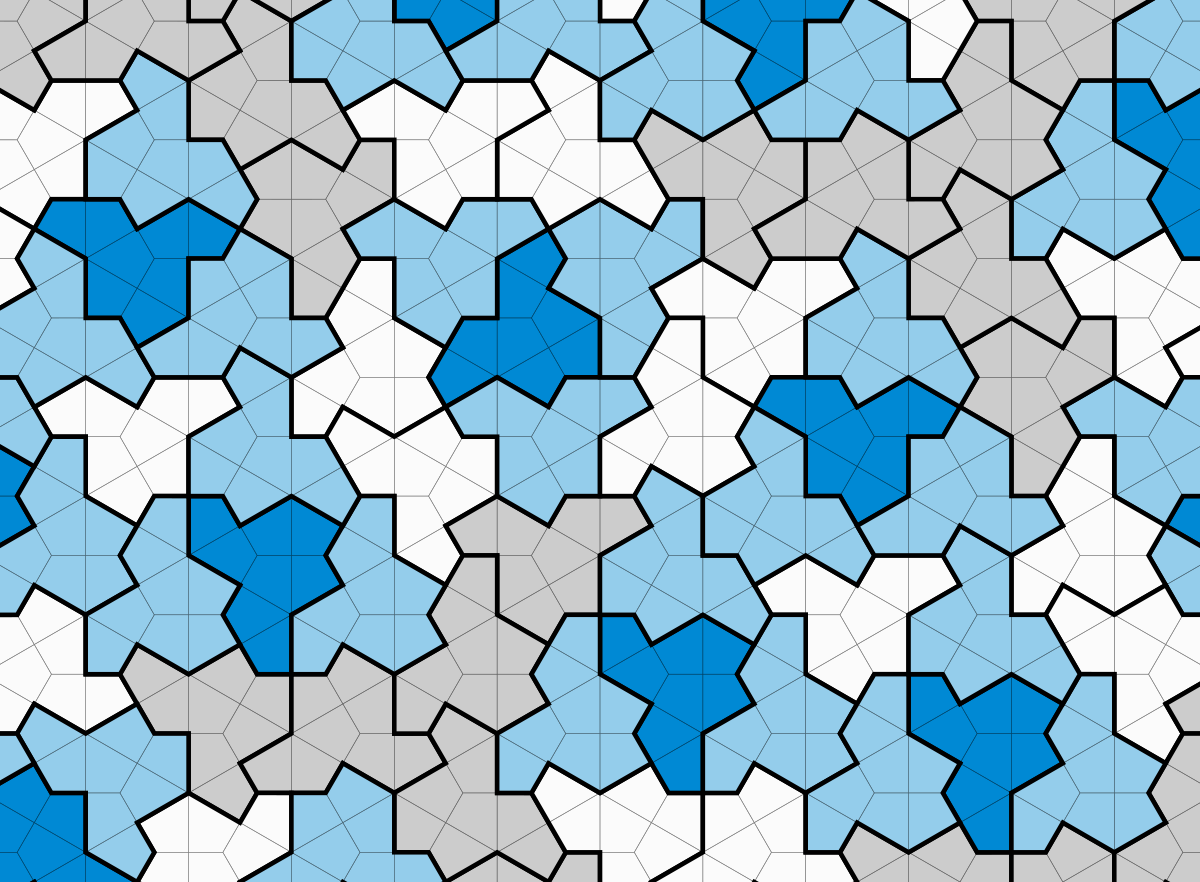
Newfound Mathematical 'Einstein' Shape Creates a Never-Repeating Pattern
A new shape called an einstein has taken the math world by storm. The craggy, hat-shaped tile can cover an infinite plane with patterns that never repeat.
Cosmic Voids and Void Lensing in the Dark Energy Survey Science...
Galaxies and their dark matter halos populate a complicated filamentary network around large, nearly empty regions known as cosmic voids. Cosmic voids are usually identified in spectroscopic...

The era of precision cosmology with voids
Cosmic voids, the large underdense regions of our Universe, have emerged over the past decade as powerful cosmological laboratories: their simple dynamics, sensitivity to local gravitational...
Precision cosmology with voids in the final BOSS data
We report novel cosmological constraints obtained from cosmic voids in the final BOSS DR12 dataset. They arise from the joint analysis of geometric and dynamic distortions of average void shapes...

The World Doesn’t Exist: William Gibson, William Blake, and Navigating an Algorithmic Hall of Mirrors | ODDCRITIC
Scrolling the TL revealed distorted realities, shaped by algorithms and biases.

Dark matter
In astronomy and cosmology, dark matter is an invisible and hypothetical form of matter that does not interact with light or other electromagnetic radiation. Dark matter is implied by gravitational effects that cannot be explained by general relativity unless more matter is present than can be observed. Such effects occur in the context of formation and evolution of galaxies, gravitational lensing, the observable universe's current structure, mass position in galactic collisions, the motion of galaxies within galaxy clusters, and cosmic microwave background anisotropies. Dark matter is thought to serve as gravitational scaffolding for cosmic structures. After the Big Bang, dark matter clumped into blobs along narrow filaments with superclusters of galaxies forming a cosmic web at scales on which entire galaxies appear like tiny particles.

Genesis 1 (KJV)
In the beginning God created the heaven and the earth. And the earth was without form, and void; and darkness was upon the face of the deep. And the Spirit of God moved upon the face of the waters. And ...

ε/δ Thinking
We live in a world shaped by, and highly conducive to, discrete or 0/1 thinking. But not so long ago, we lived in a world shaped by, and highly conducive to, a…

Black hole
A black hole is an astronomical body so compact that its gravity prevents anything, including light, from escaping. Albert Einstein's theory of general relativity, which describes gravitation as the curvature of spacetime, predicts that any sufficiently compact mass will form a black hole. The boundary of no escape is called the event horizon. In general relativity, crossing a black hole's event horizon traps an object inside but produces no locally detectable change. General relativity also predicts that every black hole should have a central singularity, where the curvature of spacetime is infinite.

Infinite scrolling
Infinite scrolling, also known as endless scrolling, is an approach to web design where new material is continually dynamically added to the bottom of the page as the user scrolls downward, leading to the apparent ability to scroll forever. This is in contrast to pagination, where material is divided into discrete pages.

