

The opposite of a "Walled Garden" is an "Open Ecosystem", but that phrase is memetically weak. To most people it just sounds like blabla and does not get the point across sufficiently. Non-techies see Bluesky as Twitter-clone with fewer people, and ATProto as something nerds talk about.
Jul 2, 2026 at 9:17 PM
Ecosystem Review
A review of decentralized social media ecosystems published by Twitter's "bluesky" team on the 21st January 2021

Closed platform
A closed platform, walled garden, or closed ecosystem[1][2] is a software system wherein the carrier or service provider has control over applications, content, and/or media, and restricts convenient access to non-approved applicants or content. This is in contrast to an open platform, wherein consumers generally have unrestricted access to applications and content.
A varied ecosystem and terminology. - Nel Ramblings
Your platform is not an ecosystem
Another day, another exhortation to join an “ecosystem” that’s anything but. I could pick a hundred examples, but one that recently caught my eye was an ad placed in the Financial Times by the Singapore stock exchange, SGX Group, promising “multiple growth avenues, one trusted ecosystem”. SGX wants companies to list on its exchange rather than, say, the Hong Kong one which has more or less the same exclusive offer. SGX promises “access (to) Asia through our trusted ecosystem anchored in Singapore.” Ecosystems can be a lot of things. ‘Trusted’, by which they mean centrally policed to achieve defined, lower-risk outcomes, is not one of them. Calling built environments ‘ecosystems’ is common everywhere from financial services to supply chains to – quite a stretch, here – a retirement living complex. But it’s most often used in the tech world to describe the relations between software, services and hardware typically owned by a single company. For example, it’s how Google describes everything that hangs off the Android operating system. These kinds of proprietary and deterministic architectures are called ecosystems so often that we’ve stopped noticing. And that’s kind of the point. We need to start seeing this metaphor again, and what it’s hiding in plain sight. But first, a reminder of what an ecosystem actually is.
On discourse and decentralisation
Over the last year, as Bluesky got more popular, conversations about whether Bluesky and ATProto are really ‘decentralised’ have gotten more “popular” as well. These conversations ranged from high-quality, productive back-and-forth articles to people just saying a lot of dumb stuff on the internet (shocker, I know). As time went on, this discourse has grown […]

Benefits of an open network
While Bluesky looks like other social apps, it’s actually quite different. It’s an open network.
Winning back the Open Web
Walled gardens dominate because their massive data collection lets them deliver superior user experiences. To win back the open web, we need to build alternatives that respect users, embrace open standards, and still feel unmistakably better to use.
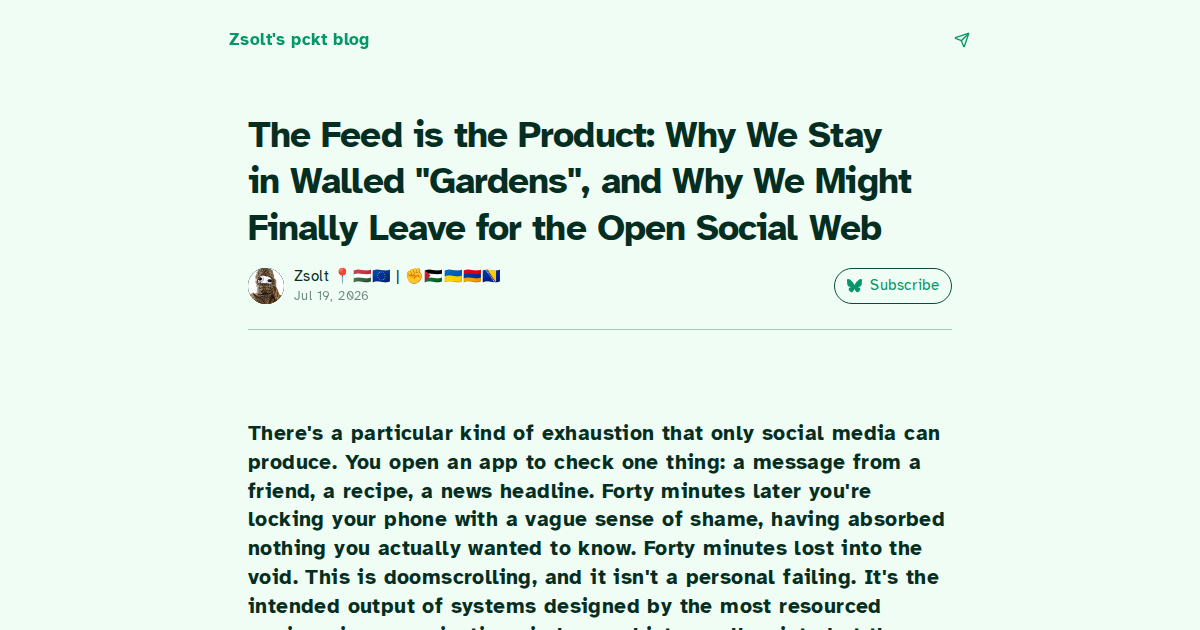
The Feed is the Product: Why We Stay in Walled Gardens, and Why We Might Finally Leave for the Open Social Web - Zsolt's pckt blog
We have known this for years. We have known that the major platforms are bad for our attention, our sleep, our politics, our children, and our sense of reality....
Bluesky’s statement deriding Threads users as “guinea pigs” is not representative of Blacksky Algorithms, the atproto ecosystem or the open social web more broadly. Communities form around communication networks. And communities should never be trolled for whatever tool helps them find each other.
Maybe the real moats are the drawbridges we'll build along the way? In my latest augment piece, I re-think "moats" for the open social web by seeing what @standard.site, @blackskyweb.xyz's Acorn, and bridges like @ap.brid.gy + @wafrn.net have done for the ecosystem.

Moats & Drawbridges
www.augment.inkCurrent platforms are trying to be the only place you hangout. In the real world, we call that a trap. Bluesky is a distribution engine — we send people to off platform experiences. Go read that blog on @beehiiv.com or watch the livestream on @stream.place.


