

I'm going to be blunt and harsh. I've seen similar comments in the past months, some mild, some spicy, some clearly rage bait. Let's assume corps are evil and bad for argument's sake. What have non-evil corps/people done to avoid this? Very little! 🧵

Sacha Greif
This is great for the Astro team, but it's honestly worrying for the web as a whole. More and more open-source project teams (Astro, Bun, Nuxt, Svelte…) are joining bigger corporations instead of being able to remain independant. blog.cloudflare.com/astro-joins-cloudflare
Jan 18, 2026 at 9:33 AM
Guide to Responsible, Strategic Reporting on Hate and Extremism
Recommendations for researchers, journalists and others on how to avoid unintentionally bolstering extremists and causing additional harm.

On Friday Deploys: Sometimes that Puppy Needs Murdering (xpost)
(Cross posted from its original source) ‘Tis the season that one of my favorite blog posts gets pulled out and put in rotation, much like “White Christmas” on the radio station. I’m speaking, of co…

How the U.S. Military Learned to Embrace AI Warfare
A review of Katrina Manson, “Project Maven: A Marine Colonel, His Team, and the Dawn of AI Warfare” (Norton, 2026).
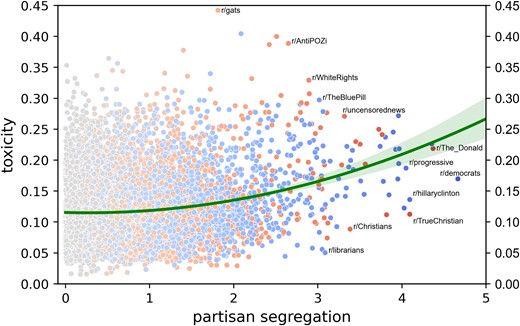
The social media discourse of engaged partisans is toxic even when politics are irrelevant
Abstract Prevailing theories of partisan incivility on social media suggest that it derives from disagreement about political issues or from status competition between groups. This study—which analyzes the commenting behavior of Reddit users across diverse cultural contexts (subreddits)—tests the alternative hypothesis that such incivility derives in large part from a selection effect: Toxic people are especially likely to opt into discourse in partisan contexts. First, we examined commenting behavior across over 9,000 unique cultural contexts (subreddits) and confirmed that discourse is indeed more toxic in partisan (e.g. r/progressive, r/conservatives) than in nonpartisan contexts (e.g. r/movies, r/programming). Next, we analyzed hundreds of millions of comments from over 6.3 million users and found robust evidence that: (i) the discourse of people whose behavior is especially toxic in partisan contexts is also especially toxic in nonpartisan contexts (i.e. people are not politics-only toxicity specialists); and (ii) when considering only nonpartisan contexts, the discourse of people who also comment in partisan contexts is more toxic than the discourse of people who do not. These effects were not driven by socialization processes whereby people overgeneralized toxic behavioral norms they had learned in partisan contexts. In contrast to speculation about the need for partisans to engage beyond their echo chambers, toxicity in nonpartisan contexts was higher among people who also comment in both left-wing and right-wing contexts (bilaterally engaged users) than among people who also comment in only left-wing or right-wing contexts (unilaterally engaged users). The discussion considers implications for democratic functioning and theories of polarization.
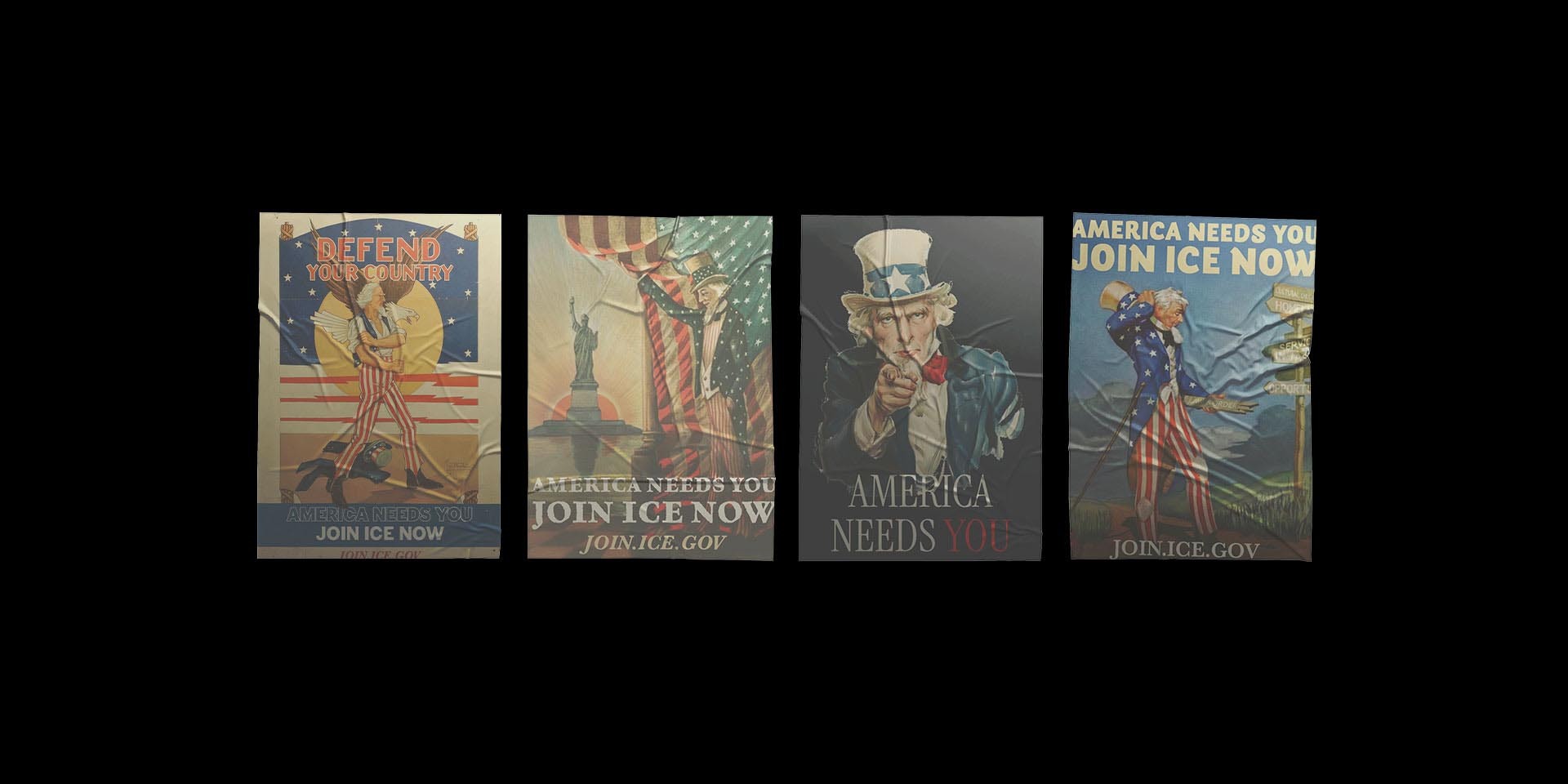
DHS deploys white nationalist, anti-immigrant graphics to recruit
The Department of Homeland Security’s deportation efforts under Trump have energized and validated some hate groups.
Army survivors of deadly attack in Kuwait dispute Pentagon's account, say unit "was unprepared" to defend itself
Survivors of an Iranian attack that killed six U.S. service members have disputed the Pentagon's description of events and said their unit in Kuwait was left dangerously exposed.

Struggle Session: Are People Tolyamorous Under Duress? Whatever Happened to Ethical Non-Monogamy? Is That Lighter Fluid or Snake Oil? And More!
Every Thursday I respond to comments from my readers and listeners. These posts are for Magnum Subs exclusively. So, if you’re already my sub, thank you and read on! If you’d like to become a sub, head over here! Magnum Subs get the Magnum Savage Lovecast (more guests, more calls, no ads), the Maxi Savage […]
The Case for User Agent Extremism - Anil Dash
A blog about making culture. Since 1999.
Digital Social Norm Enforcement: Online Firestorms in Social Media
Actors of public interest today have to fear the adverse impact that stems from social media platforms. Any controversial behavior may promptly trigger temporal, but potentially devastating storms of emotional and aggressive outrage, so called online firestorms. Popular targets of online firestorms are companies, politicians, celebrities, media, academics and many more. This article introduces social norm theory to understand online aggression in a social-political online setting, challenging the popular assumption that online anonymity is one of the principle factors that promotes aggression. We underpin this social norm view by analyzing a major social media platform concerned with public affairs over a period of three years entailing 532,197 comments on 1,612 online petitions. Results show that in the context of online firestorms, non-anonymous individuals are more aggressive compared to anonymous individuals. This effect is reinforced if selective incentives are present and if aggressors are intrinsically motivated.
Digital Social Norm Enforcement: Online Firestorms in Social Media
Actors of public interest today have to fear the adverse impact that stems from social media platforms. Any controversial behavior may promptly trigger temporal, but potentially devastating storms of emotional and aggressive outrage, so called online firestorms. Popular targets of online firestorms are companies, politicians, celebrities, media, academics and many more. This article introduces social norm theory to understand online aggression in a social-political online setting, challenging the popular assumption that online anonymity is one of the principle factors that promotes aggression. We underpin this social norm view by analyzing a major social media platform concerned with public affairs over a period of three years entailing 532,197 comments on 1,612 online petitions. Results show that in the context of online firestorms, non-anonymous individuals are more aggressive compared to anonymous individuals. This effect is reinforced if selective incentives are present and if aggressors are intrinsically motivated.
Redesigning algorithms to intervene on social norm misperceptions during a national election
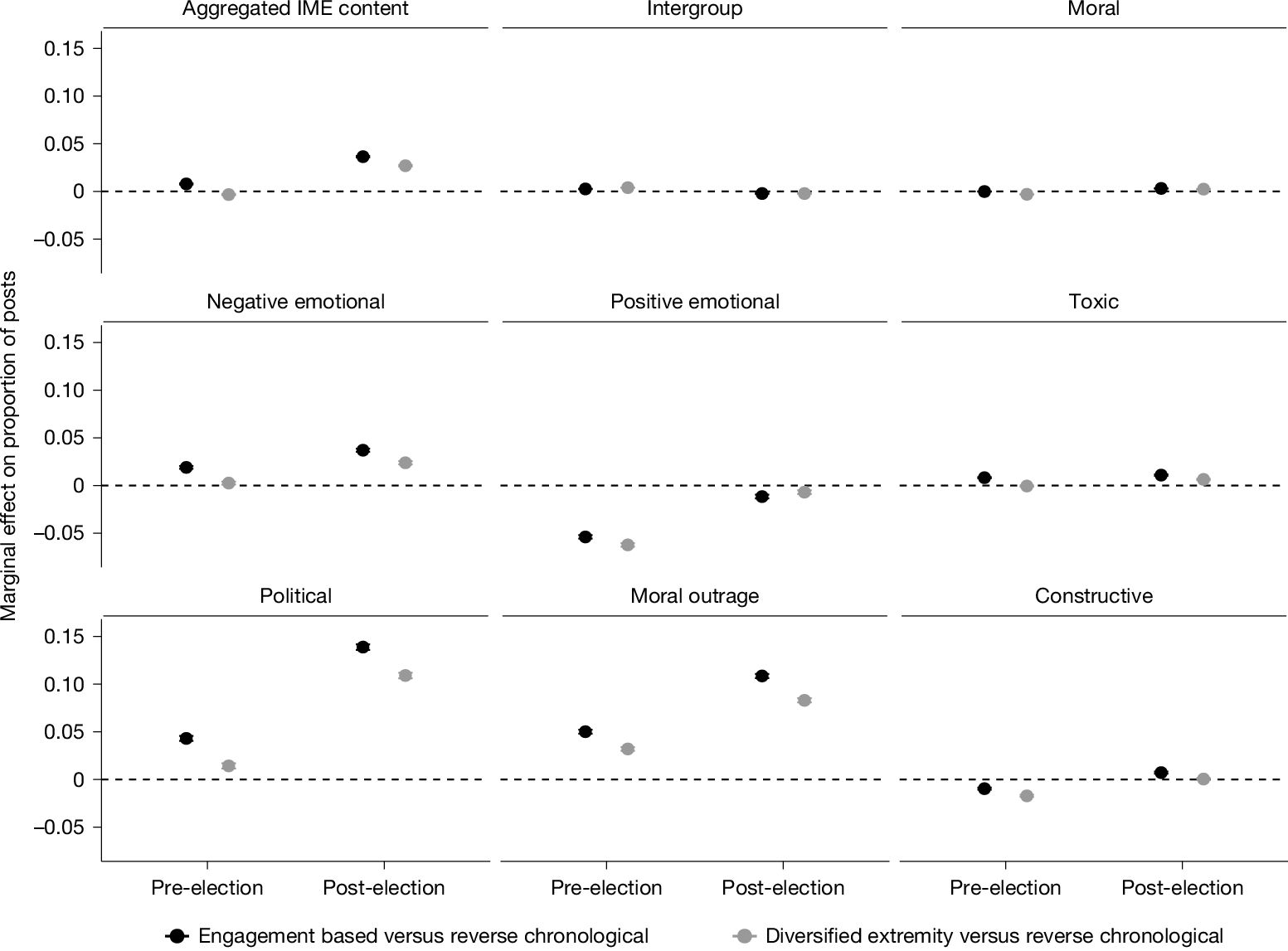
For the first time in history, civic discourse commonly occurs in digital environments in which algorithms influence exposure to social information1,2. It is increasingly important to understand whether and how these algorithms affect political discourse3–5. Here we built custom feed-ranking algorithms with full control over their features, and randomly assigned 2,000 participants to use them for 8 weeks (before and after the 2024 US presidential election). We tested whether an engagement-based algorithm (used on major social media platforms6,7) amplifies intergroup, moralized and emotional (IME) information in ways that skew perceptions of social norms around political dialogue5,8, and whether it increased engagement with IME content and perceptions of partisan animosity (compared with a reverse-chronological feed9,10). We also developed and tested a ‘diversified extremity’ algorithm to reduce the influence of extreme users11–13 to improve the accuracy of social norm perception14–16 and reduce perceptions of partisan animosity. We found that engagement-based feeds amplified IME and toxic content relative to reverse-chronological feeds, with the largest increases in moral outrage and political content. Engagement-based feeds also reduced prescriptive norm perception accuracy (albeit in an unexpected direction) and increased perceived partisan animosity. However, they did not significantly alter users’ own engagement behaviours. The diversified extremity algorithm reduced IME and toxic content exposure, improved prescriptive norm accuracy, yet maintained comparable platform enjoyment—suggesting that reducing the influence of extreme users can curb algorithmic distortions without diminishing user experience.
Ukraine Symposium – Terrorizing Civilians and the Law of Armed Conflict - Lieber Institute West Point
Attacking civilians is a clear LOAC violation, but intentionally spreading terror amongst the civilian population is a more nuanced violation.

New: When a gang of motorcycle-riding members of Boko Haram attacked a military base in eastern Nigeria, they were stymied by a defensive trench surrounding the complex. The extremists regrouped. Before launching another assault, they asked A.I. for help. nytimes.com/2026/07/10/us/politics/ai-ter…

How Terrorist Groups Are Using A.I. to Gain an Edge in Battle (Gift Article)
www.nytimes.comLately I have noticed anti-immigrant rhetoric from #WSocial users - as well as posts containing hate speech that are NOT moderated. Thankfully I subscribe to @blackskyweb.xyz moderation and I want to thank @jdot.blacksky.team and his team for labeling one of the worst W accounts. #WSocialPics
Hey everyone! I’m starting a monthly blog about trends in moderation from Blacksky’s Trust and Safety team called: “What’s Happening on My Feed?” The first post: “Putting the Trust back in Trust and Safety” is out now, check it out: whatshappeningonmyfeed.leaflet.pub/3mpont6fedc2z

Putting the Trust back in Trust and Safety
whatshappeningonmyfeed.leaflet.pub


