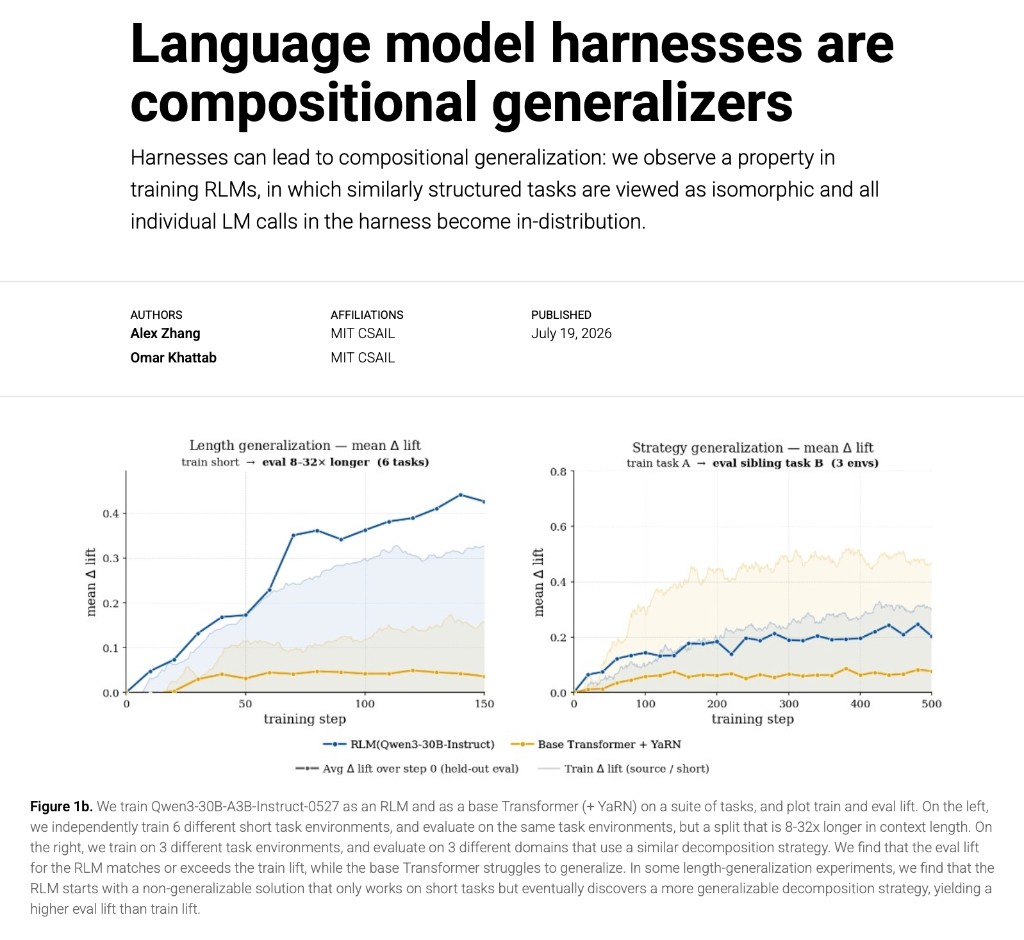
Language model harnesses are compositional generalizers
Harnesses can lead to compositional generalization: we observe a property in training RLMs, in which similarly structured tasks are viewed as isomorphic and all individual LM calls in the harness become in-distribution.
Systems programming the model
This paper examines the status of the language model object in generative AI, arguing that what we call a ‘model’ is inseparable from the systems deploying it. I first theorize how these objects emerge from systems-level interactions between trained artifacts, prompting mechanisms, and sampling methods, drawing on the philosophy of digital objects as well as software studies to show how models gain their objective character. Such interactions converge on programming, not prompting, language models, and I illustrate how critical code studies can therefore track these dynamics. In an overview of language model programming approaches, I discuss how prompt and program converge, demonstrating how this confluence tends toward the production of new feedback loops wherein models become models of and for themselves. Understanding these feedback loops is essential in view of recent efforts to infrastructuralize AI, in which multiple models cascade into compound systems that abstract toward a unified model of models. Thus the need, I argue, for a systems-level view that can address this new order of abstraction and complexity by identifying where and how the model emerges from the system.

Introducing Mu language model and how it enabled the agent in Windows Settings
We are excited to introduce our newest on-device small language model, Mu. This model addresses scenarios that require inferring complex input-output relationships and has been designed to operate efficiently, delivering high performance while runnin

Large language models are cultural technologies. What might that mean?
Four different perspectives

The mythical matched modules | Proceedings of the 24th ACM SIGPLAN conference companion on Object oriented programming systems languages and applications
Certified compilers are complex software systems. Like other large systems, they demand modular, extensible designs. While there has been progress in extensible metatheory mechanization, scaling extensibility and reuse to meet the demands of full ...

Scaling Laws Across Model Architectures: A Comparative Analysis of...
The scaling of large language models (LLMs) is a critical research area for the efficiency and effectiveness of model training and deployment. Our work investigates the transferability and...

Alex Russell | Web Components and Model Driven Views | Fronteers 2011
There's a lot of tension between today's markup and the semantics we're trying to express in our apps. HTML5 adds a few new types to help describe common cases, but what about when there's no allegory in markup for what you're building? What we need now is infrastructure, not guilt about being "non-semantic". This talk explores new standards-track work in WebKit that's going to enable say-what-you-mean development in completely new ways.

Designing a Language by Asking the Language Models — using an LLM panel as a syntax usability lab (from the kaish project)
Designing a Language by Asking the Language Models — using an LLM panel as a syntax usability lab (from the kaish project) · GitHub

The Return of Language-Oriented Programming | Middle of Nowhere
I’ve been wondering what LLMs mean for language design and implementation. Some believe that, because language models are obviously trained on existing content, they are inherently less capable of assisting users with new programming languages. Intuitively this makes sense. However:
The Anatomy of an Agent Harness
Learn how agent harnesses transform AI models into autonomous work engines. Explore core components: filesystems, sandboxes, and memory.

Issues · WebAssembly/component-model
Repository for design and specification of the Component Model - Issues · WebAssembly/component-model
Test-Driven Approaches to Software Engineering with Large Language...
Tests increasingly participate in the decisions made by large language models and software engineering agents. They specify intended behavior, guide program construction and repair, select...
What is an Agent Harness? | Rubric Labs
A harness is the software that translates a model into a system that can affect its environment. Agent = Model + Harness.
Issues in Component Computing: A Synthetic Review
This paper provides a review of the rhetoric behind the component movement in educational software, and a critical analysis and synthesis of issues underlying the movement. We draw on case studies ...