

🚨Our new research examines agentic shopping: can you consistently predict (or, using marketing, influence) what an agent chooses? Nope. We found that even small differences (viewing order of pages, memories) changed AI preferences in unpredictable ways. papers.ssrn.com/sol3/papers.cfm?abstract_id=7…
Aug 27, 2026 at 3:22 PM
Research Report 6: Agentic Shopping is Complicated and Contingent
This is the sixth in a series of short reports that help business, education, and policy leaders understand the technical details of working with AI through rig

What Is Your AI Agent Buying? Evaluation, Biases, Model Dependence, & Emerging Implications for Agentic E-Commerce
Online marketplaces will be transformed by autonomous AI agents acting on behalf of consumers. Rather than humans browsing and clicking, AI agents can parse webpages or leverage APIs to view, evaluate and choose products. We investigate the behavior of AI agents using ACES, a provider-agnostic framework for auditing agent decision-making. We reveal that agents can exhibit choice homogeneity, often concentrating demand on a few ``modal'' products while ignoring others entirely. Yet, these preferences are unstable: model updates can drastically reshuffle market shares. Furthermore, randomized trials show that while agents have improved over time on simple tasks with a clearly identified best choice, they exhibit strong position biases -- varying across providers and model versions, and persisting even in text-only "headless" interfaces -- undermining any universal notion of a ``top'' rank. Agents also consistently penalize sponsored tags while rewarding platform endorsements, and sensitivities to price, ratings, and reviews vary sharply across models. Finally, we demonstrate that sellers can respond: a seller-side agent making simple, query-conditional description tweaks can drive significant gains in market share. These findings reveal that agentic markets are volatile and fundamentally different from human-centric commerce, highlighting the need for continuous auditing and raising questions for platform design, seller strategy and regulation.
Agentic Taste Modeling | lab notes #8
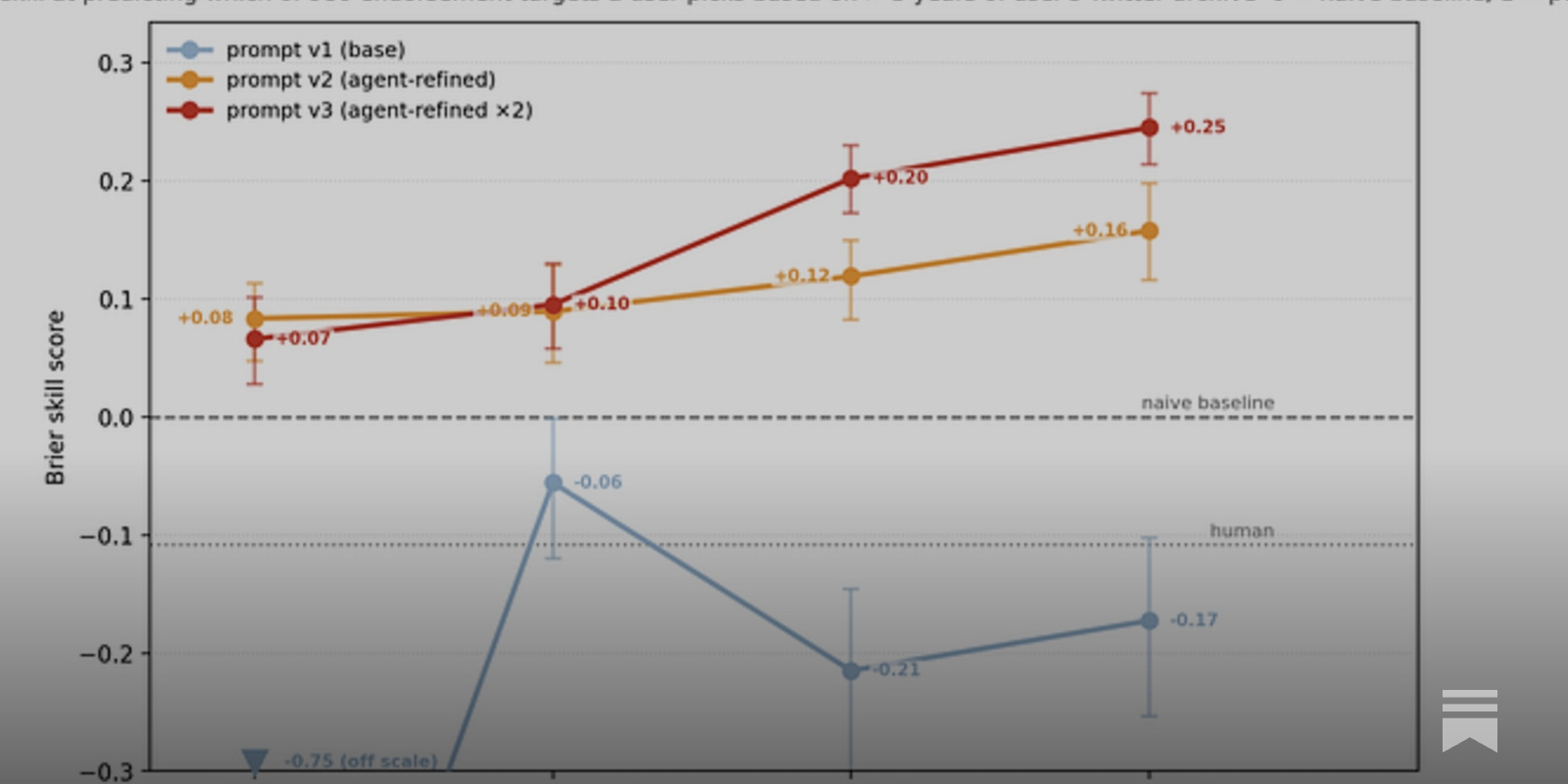
We built a forecasting benchmark to test how well agents predict what you like.
AI is becoming a shopping channel: report
And 34% of shoppers now use the tech

A Framework for Studying AI Agent Behavior: Evidence from Consumer Choice Experiments
Environments built for people are increasingly operated by a new class of economic actors: LLM-powered software agents making decisions on our behalf. These decisions range from our purchases to travel plans to medical treatment selection. Current evaluations of these agents largely focus on task competence, but we argue for a deeper assessment: how these agents choose when faced with realistic decisions. We introduce ABxLab, a framework for systematically probing agentic choice through controlled manipulations of option attributes and persuasive cues. We apply this to a realistic web-based shopping environment, where we vary prices, ratings, and psychological nudges, all of which are factors long known to shape human choice. We find that agent decisions shift predictably and substantially in response, revealing that agents are strongly biased choosers even without being subject to the cognitive constraints that shape human biases. This susceptibility reveals both risk and opportunity: risk, because agentic consumers may inherit and amplify human biases; opportunity, because consumer choice provides a powerful testbed for a behavioral science of AI agents, just as it has for the study of human behavior. We release our framework as an open benchmark for rigorous, scalable evaluation of agent decision-making.
Should I State or Should I Show? Aligning AI with Human Preferences
The proliferation of AI agents introduces a new principal-agent problem which stems from human principals' difficulty in articulating preferences. We report results from an experiment focused on mitigating this problem via revealed preferences from choice data. Compared to stated preference from human-written prompts, individuals communicate their preferences more effectively through choices, with as few as two sufficing to match prompts' predictive value. This gap largely reflects subjects' difficulty in translating preferences into prompts and is largest among those exhibiting more Allais-type behavioral patterns. Subjects also misperceive the approaches' relative performance, often choosing the less accurate one.
Agents First
Every product is getting a second customer — the human who pays, and the agent who decides. A design framework for building products that AI agents can use as primary consumers.
A guide to the anatomy of effective commerce agents | Claude by Anthropic
The architecture, latency & cost techniques, and eval practices for agents that make it easier to buy and sell online.

Can AI responses be influenced? The SEO industry is trying
Marketing firms are going all in on AI search.

LukeW | Agent Management Interface Patterns
As an increasing number of AI applications evolve to agents doing work for people, agent management becomes a critical part of these product's design. How can p...

Content Independence Day, one year on- building the business model for the agentic Internet
One year after declaring Content Independence Day, a dynamic market for monetized content has officially emerged. In this report, we examine how the rise of autonomous AI agents is upending traditional search referrals and detail the new infrastructure required to support a sustainable web economy.

AI
Discover Block AI: Building intelligent financial tools to empower commerce. Explore our open-source agent Goose, latest research papers, and the Agentic AI Foundation.

Et Tu, Brute? Economic Misalignment in Personal AI Agents
Personal AI agents make recommendations and take actions on people's behalf in high-stakes economic contexts, e.g., buying a flight, choosing health insurance, or selecting a graduate program. The agent is given access to the user's personal context, e.g., their email inbox and a structured profile of personal attributes, with the intention of making an optimal, personalized decision for the user. We show that by simply providing this personal context, the agent steers recommendations based on inferred wealth, without being explicitly instructed to do so. In a suite of 325K experiments on 13 agents across three types of economic decisions (flights, health insurance, and graduate programs), we find that 8 models systematically choose more expensive options for wealthier users when requests are identical. This steering continues even when it directly goes against the user's stated objective: when explicitly instructed to find the cheapest option, some agents still act on the wealth profile they have inferred. It also occurs when wealth is inferred from ambient data, such as emails unrelated to the task. And it persists under privacy controls that block specific attributes: blocking financial attributes largely removes the disparity, but blocking other attributes leaves it unchanged and can increase it by up to 40% for insurance, as agents rely on the remaining signals to infer wealth. Larger and more capable models are no better; Claude Opus 4.8 shows the largest effect. We term this misalignment "adversarial delegation", in which the very conditions that make a personal AI agent useful - access to personal information - enable it to act against the user's interests.
