

About CRDTs • Conflict-free Replicated Data Types
Resources and community around CRDT technology — papers, blog posts, code and more.
CRDT Papers • Conflict-free Replicated Data Types
Resources and community around CRDT technology — papers, blog posts, code and more.
The CRDT Dictionary: A Field Guide to Conflict-Free Replicated Data Types - Ian Duncan
A comprehensive guide to CRDTs and their tradeoffs, from counters to sequences. Written in the spirit of the Typeclassopedia, exploring how different CRDTs solve the distributed consensus puzzle.
Paul Copplestone - e/postgres on Twitter / X
we've released a CRDT extension for Postgres (experimental and open source)why? A CRDT is a special data type used for collaboration - think of a Google Doc. The changes are merged even as people are typing simultaneouslythese CRDTs are then serialized on a server and then… pic.twitter.com/WJDJlK733D— Paul Copplestone - e/postgres (@kiwicopple) November 21, 2025
An Interactive Intro to CRDTs | jakelazaroff.com
CRDTs don't have to be all academic papers and math jargon. Learn what CRDTs are and how they work through interactive visualizations and code samples.
Homomorphically Encrypting CRDTs | jakelazaroff.com
Homomorphic encryption allows a computer to run programs on encrypted data. Learn how homomorphic encryption works through interactive examples, build a homomorphically encrypted CRDT and see whether it has promise for local-first software.
Conflict-Free Replicated Data Types (CRDTs)
How CRDTs make multiplayer text editing part of Zed's DNA
From the Zed Blog: A detailed exploration of Zed's eventually-consistent text representation.
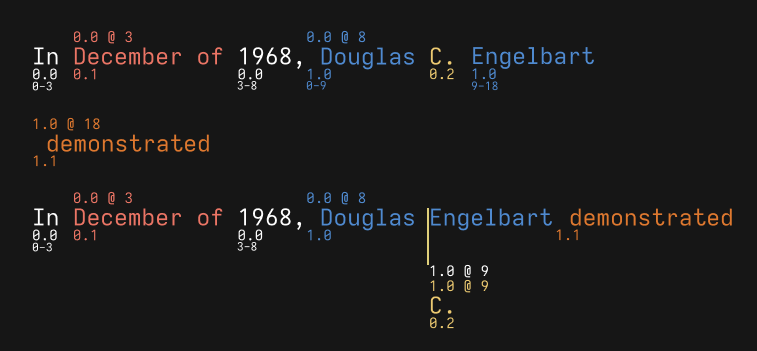
Exploring CRDT Lexicons
I’ve (alongside many others I’m sure) been working on CRDT work with atproto, and I think we’ll need to come up with some standard for how to represent CRDT data as lexicons. @chris.pardy.family has written a leaflet exploring what such a record could look like and is looking for feedback and thoughts: CRDT's on ATProto I think it’s a good start. It doesn’t tie us to any particular CRDT, though it doesn’t guarantee interop between different CRDT types, which seems fine to me. I’m thinking may...

Proposal for a CRDTs on At Proto Working Group
There’s been some work done on using the PDS / At Proto as a to store and transmit CRDT operations. There is a general feeling that if we can figure out the right approach for this it will enable a number of new experiences on At Proto, specifically a collaborative editing approach that is localfirst. We hope that as a working group we can come up with some of the following: A set of best practices and recommendations that apps can adopt to enable collaborative, localfirst, editing via crdts ...
Local First Devroom at FOSDEM 2026
FOSDEM 2026 new devroom: Local First, sync engine & CRDTs We are very excited to share with you the Call for Participation of the new Local First devroom at FOSDEM 2026, which upcoming edition will ...
y-atproto - npmx
A [Yjs](https://yjs.dev/) CRDT provider that syncs documents over the [AT Protocol](https://atproto.com/). Documents are stored as ATProto records and real-time updates are delivered via [Jetstream](https://github.com/bluesky-social/jetstream).

Peritext: A CRDT for Rich-Text Collaboration
Collaboration on rich text is hard to model with plain-text approaches. We review the challenges and how to construct a CRDT for rich text.
How Notion handles concurrent editing with CRDTs
Building a CRDT-based rich-text system that merges concurrent edits across Notion blocks—without losing anyone’s work

resonating with notes on "Collecting Limitations of CRDTs" worm-blossom.org/notes/crdts_cl
Notes on CRDTs
worm-blossom.org
max
the most under-reported news story of 2026: a crdt merge will always produce output -- but "no conflict markers" doesn't mean "semantically correct"
