

Common Fabric
A social computing lab. We are building a medium for software that revolves around people, not apps.
digital garden
A digital garden is effectively an interconnected set of publicly available notes. You can think of it as a highly personal wiki, except its objective isn’t ...
A Standard and Clean Series A Term Sheet | Y Combinator
We’ve noticed a common problem: founders don’t know what “good” looks like in a term sheet. This makes sense, because it is often, literally, the first time in their careers that they’ve seen one. This puts founders at a significant disadvantage because VCs see term sheets all the time and know what to expect. Because we’ve invested in so many founders over the years and have seen hundreds of Series A term sheets, we know what “good” looks like. We work with our founders to understand where term
Building a spreadsheet from the ground up | Prabhanshu Gupta
BTS Informatique et Réseaux - Administration
Le BTS CIEL "Cybersécurité, Informatique et réseaux, ELectronique" option A : Informatique et Réseaux à Aubenas (07), formation publique & gratuite
Issue 084: Spreadsheets
Welcome to the 84th issue of De Programmatica Ipsum, about Spreadsheets. In this edition, we declare spreadsheets the most popular software programming environment of all time; in the Library section, we learn how to use Lotus 1-2-3 for science reading "Spreadsheet Physics" by Charles Misner and Patrick Cooney; and in our Vidéothèque section, we discover that Excel is a Turing-complete, functional programming language through the eyes of Dr. Felienne Hermans.

Your connected workspace for wiki, docs & projects | Notion
A new tool that blends your everyday work apps into one. It's the all-in-one workspace for you and your team.
The corporation—a return to origins?
This paper contributes to contemporary debates in political theory about the power of business corporations by offering a genealogy of the corporation through the lens of a series of historical mutations of the corporate form. Originally, there were two corporate forms, both non-profit: member corporations (today's associations) and property corporations (today's charitable foundations). The contemporary business corporation arguably is a hybrid of both of these original forms, introducing unique commercial features (shares with profit distribution rights that are transferable). These commercial features are largely responsible for the corporation's extractive nature, that is, its tendency to prey on non-shareholder interests. The future of the corporation may well lie in a partial return to the two original non-profit forms. Two corporate forms developed in the nineteenth century can provide the format for such a return: cooperatives (which reinforce the idea of membership) and foundation-owned companies. The cooperative structure is a halfway house between a business corporation and a member corporation (association), and in a parallel fashion, a foundation-owned company is a halfway house between a business corporation and a property corporation (foundation). If we want to reduce corporations’ extractive nature, facilitating the spread of cooperatives and foundation-owned companies seems the way forward.

A Very Early History of Algebraic Data Types
Been quiet around here! I’ve been putting almost all of my writing time into Logic for Programmers and my whole brain is book-shaped. Trust me, you do not want to read my 2000-word rant on Sphinx post-build LaTeX customization. But I spent the past week in a historical rabbit hole and had to share what I found. It started with Algebraic [Data] Types are not Scary, Actually. The post covers AlgDTs1 in more detail, but a quick overview is:
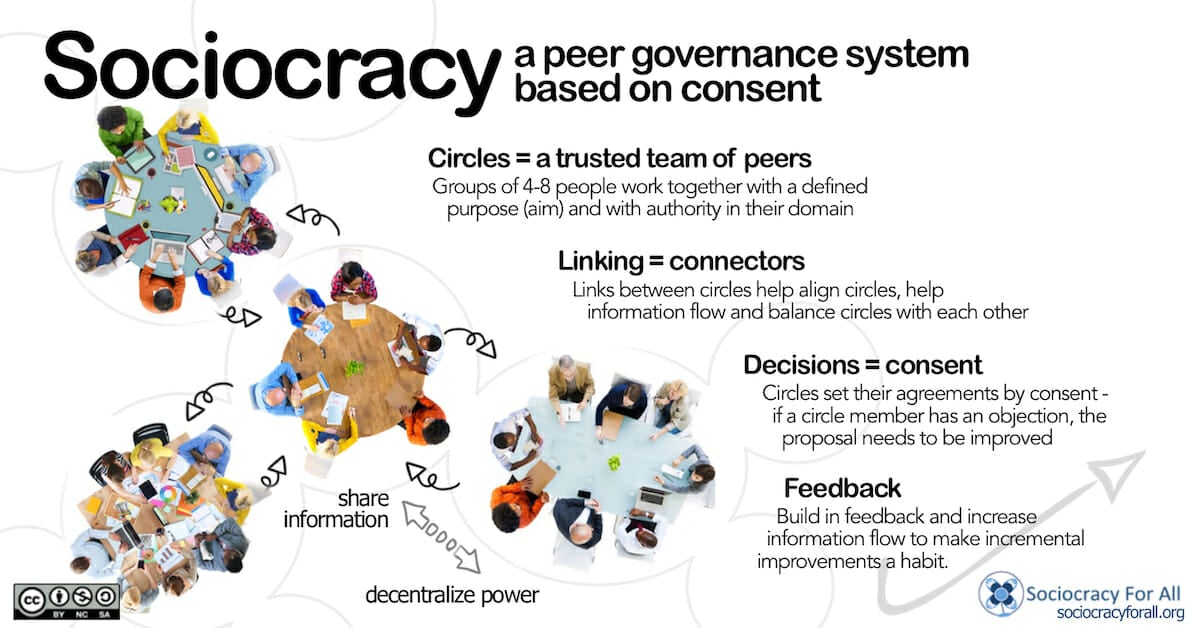
Sociocracy - basic concepts and principles
Brief overview of sociocracy: basic concepts and principles, history, its use in organizations, its limits and differences to voting, consensus and hierarchical forms of organizing.
ATProto ideas longform.social/post/did:plc:ticz2qmqh2vqxneh…
ATProto ideas
longform.socialAnd I did an episode where I explain what I'm interested in -- orgs that have some 1) form of sharing, 2) some transparency about their finances, 3) a non-growth goal in the form of knowing when they are sufficient, and 4) #multisolving. buzzsprout.com/2396702/episodes/16595444-the…

The Four Factors for Organizations - Future Mending Radio
www.buzzsprout.comIt's hard for non-technical people to understand that #atproto (Bluesky, and friends) really is a different breed of social software. One where our data, and connections are no longer taken hostage by the platform and we're free to store our data wherever we want


