

A shell exclamation mark is not for yelling. Be lazy. | Filip Roséen - refp.se
Event designators have been hiding in not-so-plain-sight since the late 1970s — so powerful that forgetting might be part of a massive conspiracy to wear out developer keyboards faster than otherwise.
The intent pipeline: why most prompt guides miss how people actually use AI
Most prompt guides assume that people interact with AI by carefully authoring prompts. In practice, that is rarely how AI is used. Most…

The future of Siri, or: why private inference isn’t private enough
Yesterday Apple announced a big step towards deploying real AI in their Siri ecosystem. In most ways this is good and inevitable: Siri is one of the world’s most widely-used voice agents, and…

Why ChatGPT Keeps Interrupting You — Dr. Tom Shapland, LiveKit
Voice AI & Voice Agents | An Illustrated Primer
A comprehensive guide to voice AI in 2026
AI is teaching us to speak like bots, and it’s a problem - Fast Company
AI is creeping into our everyday conversations, making us less patient and teaching us to 'prompt' others instead of talking to them.

Michael R. Crusoe (@biocrusoe@fairpoints.social)
Oh, I like this part > No AI-generated text in human-to-human communication > When our maintainers volunteer their time to review your issue, PR, or proposal, they do not want to talk to a machine. This is a basic principle of respect. https://mastodon.gamedev.place/@godotengine/116839550229253906
Apple Execs Defend Siri Delays, AI Plan and Apple Intelligence | WSJ
Why doesn’t Siri activate during keynotes?
Activation-Steered Personas in Task-Oriented LLM Agent Simulations
Large language models are increasingly used to simulate both user and system behavior in task-oriented dialogue (TOD). Yet personality control in these simulations remains largely prompt-based, making trait expression difficult to regulate and verify across dialogue turns. We investigate activation steering as an inference-time mechanism for inducing and adapting personality in TOD simulation. In our framework, user-side steering (US) applies fixed Big Five trait-pole activation vectors with scalar coefficients to generate users with different trait intensities. System-side adaptive steering (SA) dynamically adapts the system agent at each turn by predicting system-side steering coefficients from the dialogue context. We evaluate four steering conditions: an unsteered Baseline, SA, US, and US+SA, using the Schema-Guided Dialogue benchmark across the Restaurants and Movies domains. Qwen2.5-7B-Instruct is used as the primary model, and Llama-3.1-8B-Instruct is used as a robustness setting. Our results show that activation-level personality control affects TOD behavior, but its benefits depend on domain, trait observability, and steering strength. Compared with the unsteered Baseline, SA improves standard task metrics slightly, with larger gains in pairwise-judged user satisfaction and truthfulness, mainly in Restaurants, where dialogues contain richer personality-relevant slots and preferences. User-side steering produces observable personality expression only for some traits: socially or affectively expressive traits such as careless, outgoing, compassionate, and nervous become more detectable at stronger steering, while consistent and solitary remain difficult to observe in short TOD interactions. Adding SA to steered users yields modest task-level changes but a statistically significant improvement in pairwise-judged truthfulness (+8.3 pp) and user satisfaction (+2.7 pp). System-side composition analysis further shows that SA does not directly mirror the user's trait; it usually defaults to Conscientiousness-centered system behavior and becomes more socially adaptive when user trait expression is observable especially at higher steering scalar. Overall, activation steering is a viable alternative to prompt-based personality conditioning for controlled TOD simulation, but its effects must be evaluated with respect to trait observability, steering strength, and the personality relevance of the task domain.
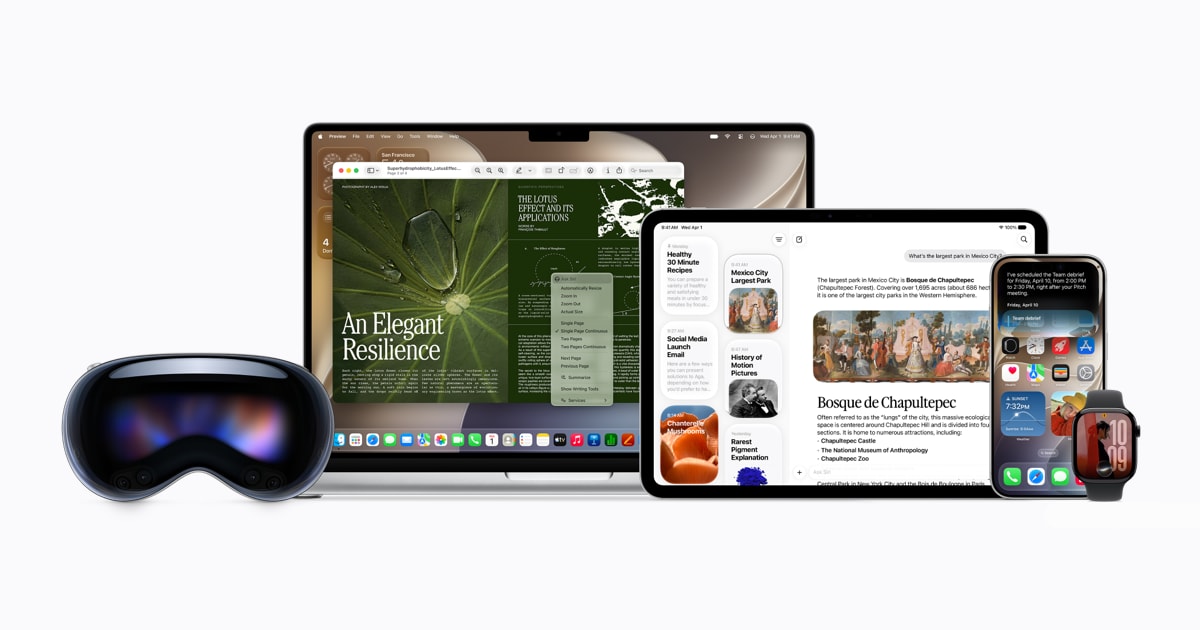
Apple introduces Siri AI, a profoundly more capable and personal assistant
Apple introduces Siri AI, a profoundly more capable and personal assistant powered by Apple Intelligence, with personal context, world knowledge, and onscreen awareness.
Role play with large language models
As dialogue agents become increasingly human-like in their performance, we must develop effective ways to describe their behaviour in high-level terms without falling into the trap of anthropomorphism. Here we foreground the concept of role play. Casting dialogue-agent behaviour in terms of role play allows us to draw on familiar folk psychological terms, without ascribing human characteristics to language models that they in fact lack. Two important cases of dialogue-agent behaviour are addressed this way, namely, (apparent) deception and (apparent) self-awareness.
Expert asterisks
Watching discussions happening online, I see a frequent unfortunate tic I’ll call the Expert Asterisk. A beginner is asking for help, and experts are answering.
I think of all of the AI / ML / CS tech out there, speech generation freaks me out the most.

Opensourcing TADA: Fast, Reliable Speech Generation Through Text-Acoustic Synchronization
www.hume.aiNo prompt AI tools

AI tooling with no prompts
turantekin/Parrot
Browse code by meaning
reasoncommons.com

Shaping the future of AI interaction by reimagining the mouse pointer

How to Stop AI from Killing Your Critical Thinking | Advait Sarkar | TED
Half Formed Thought


