

Some initial thoughts, and a complicated mix of feelings. Wow. I mean, Erdos problems are cool (I genuinely mean that), I didn't know about the Jacobian conjecture before it got disproved. But this newest batch from OpenAI hits home in a way the previous announcements did not.
Aug 1, 2026 at 10:35 PM
Has an AI discovered new maths?
Shouqiao Wang on Twitter / X
I solved 6 open Erdős problems in 5 days, using @OpenAI GPT-5.6 Sol.I have a math background, but the Codex workflow I used does not require deep mathematical knowledge.Here’s exactly how I approached it, including my prompts 🧵— Shouqiao Wang (@Qiaoqiao2001) July 22, 2026
AI contributions to Erdős problems
A community database for the problems on the erdosproblems.com site - teorth/erdosproblems
OpenAI Just Claimed a Huge Math Discovery. Some Academics Are Crying Foul
A landmark announcement by the frontier AI lab has been overshadowed by accusations of impropriety.

Statements — AHM
Yesterday, on October 6th, 2026, OpenAI – which is currently defending lawsuits against accusations of illegal plagiarism, copyright infringement, and trademark dilution – released a repository of manuscripts purporting to contain solutions to a number of high-profile problems in mathematics.
The Jacobian Conjecture is False Per Anthropic (Link in Description)
945 votes, 354 comments. Normally I would be extremely skeptical, but the result is checkable by simple computation. Remarkable! The two-dimensional…

Ten advances in mathematics and theoretical computer science
OpenAI shares new results on long-standing open problems in mathematics and theoretical computer science, including advances in geometry, cryptography, and complexity.
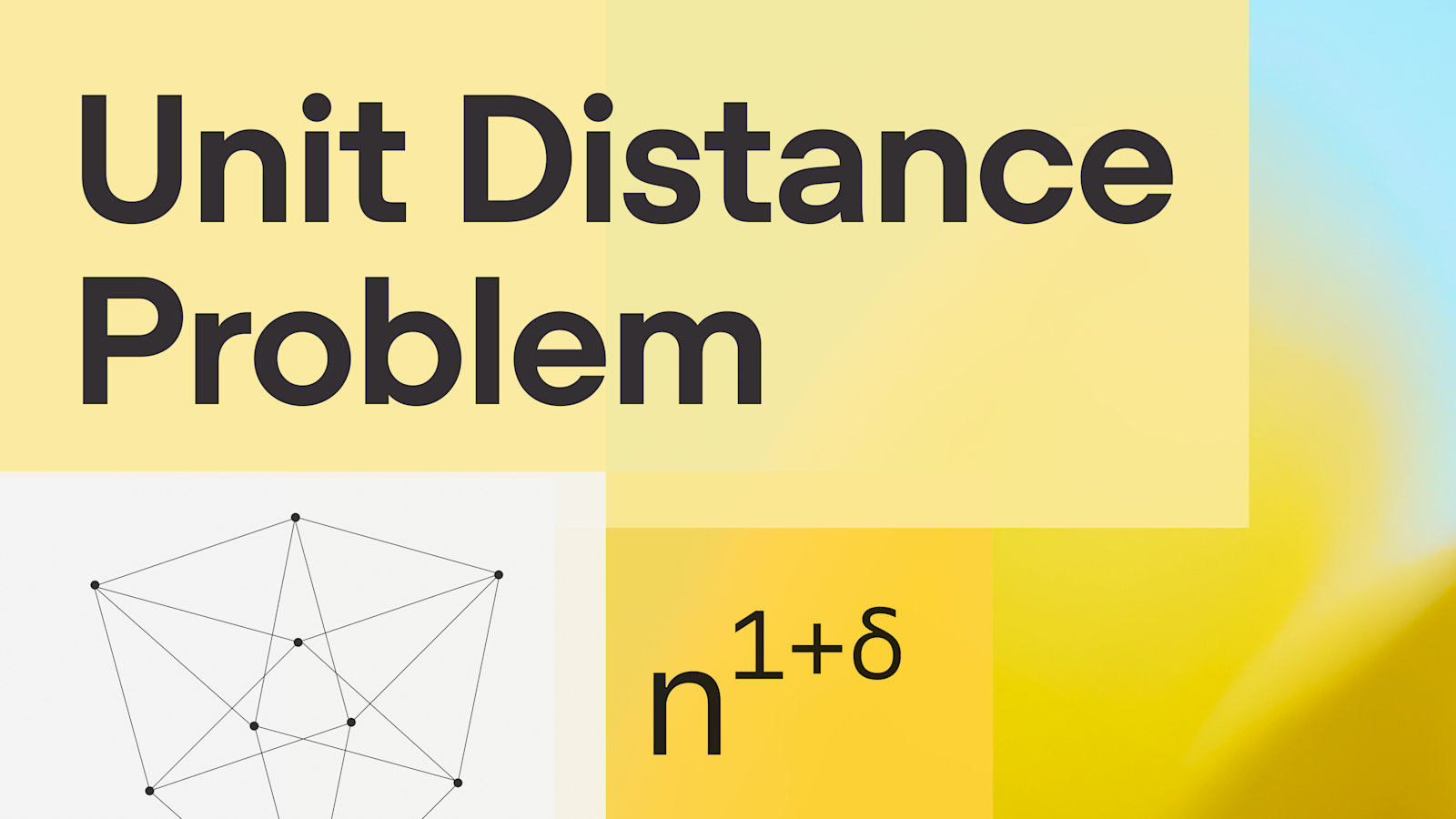
An OpenAI model has disproved a central conjecture in discrete geometry
An OpenAI model solved the 80-year-old unit distance problem, disproving a major conjecture in discrete geometry and marking a milestone in AI-driven mathematics.
OpenAI's Unreleased Model Astra Solves Ten Major Open Mathematics Problems
Math is hard.

I'll just comment on my impressions of their conclusions in a thread here. Worth sharing how I see it unfolding internally. (I signed up for their email spam to read this so yes, I am a hero.)

Sue Smith
"The AI engineering impact data shows that output is up. It also shows that the work required to ensure that output is safe, correct, and maintainable has not decreased. It has increased substantially." Aye, if only any of us had been saying this from day one 🤡 faros.ai/blog/ai-acceleration-whiplash…
I'll just comment on my impressions of their conclusions in a thread here. Worth sharing how I see it unfolding internally. (I signed up for their email spam to read this so yes, I am a hero.)
Sue Smith
"The AI engineering impact data shows that output is up. It also shows that the work required to ensure that output is safe, correct, and maintainable has not decreased. It has increased substantially." Aye, if only any of us had been saying this from day one 🤡 faros.ai/blog/ai-acceleration-whiplash…
Great post -- Sophie makes an important point: the results OpenAI announced with great fanfare are "normal for the current state of technology". The credit goes above all to the data -- the communal knowledge of mathematicians they relied to train their LLM

Sophie Huiberts
Guest blog by me
@henryyuen.bsky.social I have heard you commented on the recent announcement by OpenAI on X, about one of the 10 problems very, very close to your own research. Would you be OK discussing it here as well?
OpenAI just blooped hundreds of proofs and counterexamples to open problems: github.com/openai/math/tree/main/preprin… Boggling.

math/preprints at main · openai/math
github.com


