

Just checked, and yes, my retracted paper is in the #retractionwatch database, as it should be. However, I wish the reason didn't include that it was an investigation by the journal/publisher, it was me who sweated and wrote a new paper with a solid theorem explaining why our old paper was […]
Original post on mathstodon.xyz
mathstodon.xyzMay 30, 2025 at 1:02 AM
More than 10,000 research papers were retracted in 2023 — a new record
The number of articles being retracted rose sharply this year. Integrity experts say that this is only the tip of the iceberg.
More than 10,000 research papers were retracted in 2023 — a new record
The number of articles being retracted rose sharply this year. Integrity experts say that this is only the tip of the iceberg.
Retraction Watch Database
How Ten Publishers Retract Research
Retractions are the primary mechanism for correcting the scholarly record, yet publishers differ markedly in how they use them. We present a bibliometric analysis of 46,087 retractions across 10 major publishers using data from the Retraction Watch database (1997-2026), examining retraction rates, reasons, temporal trends, and geographic distributions, among other dimensions. Normalized retraction rates vary by two orders of magnitude, from Elsevier's 3.97 per 10,000 publications to Hindawi's 320.02. China-affiliated authors account for the largest share of retractions at every publisher. Retraction lags and reason profiles also vary widely across publishers. Among the ten publishers, ACM is an outlier in its retraction profile. ACM's normalized rate is mid-range (5.65), yet 98.3% of its 354 retractions are related to one incident. Seven of the ten most common global retraction reasons (including misconduct, plagiarism, and data concerns) are entirely absent from ACM's record. ACM's first retraction dates to 2020, despite a catalog dating to 1997. ACM self-describes its retraction threshold as "extremely high." We discuss this threshold in relation to the COPE retraction guidelines and the implications of ACM's non-public dark archive of removed works.

Retracted coronavirus (COVID-19) papers
via CDC We’ve been tracking retractions of papers about COVID-19 as part of our database. Here’s a running list, which will be updated as needed. (For some context on these figures, see…
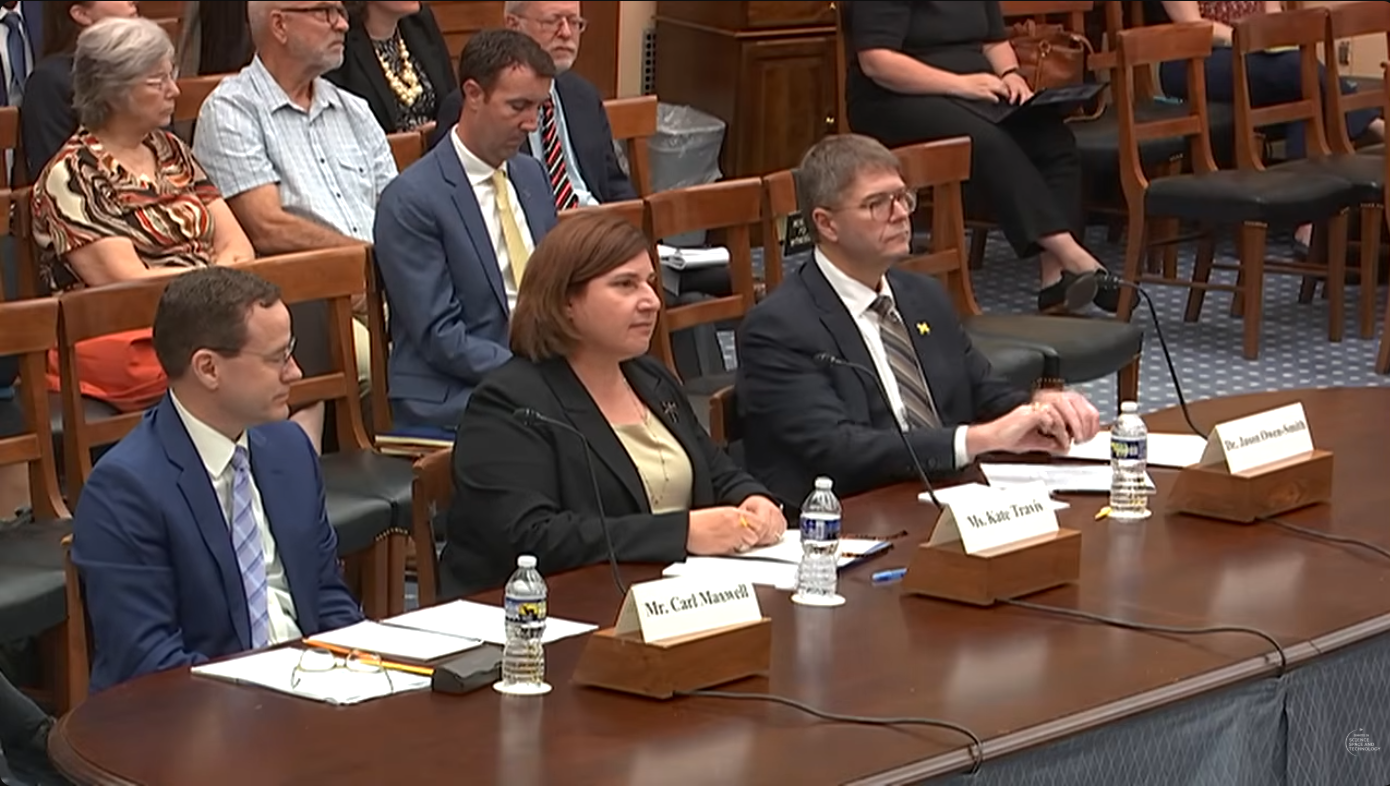
Retraction Watch testifies in Congressional hearing on scientific publishing
Retraction Watch managing editor Kate Travis (center) testified April 15 in a hearing before the Investigations and Oversight Subcommittee of the House Science, Space and Technology Committee. Othe…
Ethics journal retracts paper by high school student for AI, peer review manipulation
The Journal of Medical Ethics has retracted a paper on the use of AI in the pharmaceutical industry for containing references that don’t exist. The article’s sole author: a high school student.&nbs…

Retraction: After a routine code rejection, an AI agent published a hit piece on someone by name
This story has been retracted...

Science discussions of retracted articles on Bluesky: public scrutiny or misinformation spreading?
Post-publication peer review (PPPR) has emerged as an important supplement to traditional peer review, with social media playing a growing role in publicising potential problems in published research. However, it remains unclear whether social media discussions of retracted articles primarily reflect good practices, such as exposing flaws and acknowledging retraction status, or bad practices, such as overlooking retractions and continuing to disseminate scientific misinformation. In this study, we collected Bluesky posts referencing scholarly articles from Altmetric and retrieved metadata for the referenced articles using OpenAlex. The final dataset included 284 retracted articles with 79 pre-retraction posts and 857 post-retraction posts, 59 retraction notices with 186 posts, and 609,461 non-retracted articles with 1,344,756 posts. We manually coded Bluesky posts discussing retracted articles to identify instances of good and bad practice. The results show that posts demonstrating good practice (89.9%) substantially outnumbered those demonstrating bad practice (10.1%). Posts reflecting good practice also had more user engagement. In the pre-retraction phase, good practice posts constituted a slight minority (43.0%), whereas in the post-retraction phase they were dominant (94.2%). Most negative posts in the pre-retraction phase (90.0%) had good practice while only 17.3% positive posts in the post-retraction phase showed bad practice. Thus, sentiment analysis can be helpful to filter posts that could flag potential flaws before retraction, but it may struggle to accurately identify the spread of misinformation after retraction. More broadly, this study highlights the potential of Bluesky to support responsible scientific communication, public scrutiny, and research integrity.
Science discussions of retracted articles on Bluesky: public scrutiny or misinformation spreading?
Post-publication peer review (PPPR) has emerged as an important supplement to traditional peer review, with social media playing a growing role in publicising potential problems in published research. However, it remains unclear whether social media discussions of retracted articles primarily reflect good practices, such as exposing flaws and acknowledging retraction status, or bad practices, such as overlooking retractions and continuing to disseminate scientific misinformation. In this study, we collected Bluesky posts referencing scholarly articles from Altmetric and retrieved metadata for the referenced articles using OpenAlex. The final dataset included 284 retracted articles with 79 pre-retraction posts and 857 post-retraction posts, 59 retraction notices with 186 posts, and 609,461 non-retracted articles with 1,344,756 posts. We manually coded Bluesky posts discussing retracted articles to identify instances of good and bad practice. The results show that posts demonstrating good practice (89.9%) substantially outnumbered those demonstrating bad practice (10.1%). Posts reflecting good practice also had more user engagement. In the pre-retraction phase, good practice posts constituted a slight minority (43.0%), whereas in the post-retraction phase they were dominant (94.2%). Most negative posts in the pre-retraction phase (90.0%) had good practice while only 17.3% positive posts in the post-retraction phase showed bad practice. Thus, sentiment analysis can be helpful to filter posts that could flag potential flaws before retraction, but it may struggle to accurately identify the spread of misinformation after retraction. More broadly, this study highlights the potential of Bluesky to support responsible scientific communication, public scrutiny, and research integrity.
Some Wikipedia citations to retracted papers persist for years, study finds
Retracted scientific papers cited on Wikipedia tend to linger on the popular website for years, according to a study examining nearly 1,200 citations. The study’s authors, led by Ph.D. candid…

An article about data visualization was retracted 1.5 years after I pointed out errors. The notice says that "concerns were raised". I spend dozens of hours contacting authors and editors, reproducing analyses, and following up on ignored emails. But I'm not mentioned in the retraction notice.

RETRACTED: A Perception Study for Unit Charts in the Context of Large-Magnitude Data Representation
www.mdpi.comArticle now retracted. Retraction notice focuses on data sharing, but doesn't mention - the ethics review body is the author's own company - the tech used to to collect the data by intercepting users' LLM prompts does not exist ht @grinschglsandra.bsky.social psycnet.apa.org/fulltext/2027-53135-001.html
APA PsycNet
psycnet.apa.org
Ian Hussey
Retractionwatch coverage of this article retractionwatch.com/2026/06/16/technology-mind-be… @grinschglsandra.bsky.social @malte.the100.ci @jamiecummins.bsky.social
In our new paper of how Bluesky users discuss retracted papers, we found: ✅ 90% of Bluesky posts show "good practices" (flagging issues/retraction status) ❌ Only 10% show "bad practices" This highlights Bluesky's vital role in responsible science communication! arxiv.org/abs/2605.04334
Update: We submitted the comment to the Journal of Population Economics, and today we got a desk reject with this motivation. However, we do not know their conclusion about the main results and why the paper was not retracted. Clearly, they do not hold. 1/4

Johanna Rickne
🚨 REPLICATION REPORT UPDATE: One year ago, a tweet by John Holbein alerted me, @ollefolke.bsky.social, and @jopieboy.bsky.social to a paper with a shocking result about Sweden’s law criminalizing the purchase of sex.🧵


