

How LLMs are and are not like the brain
Hi from buttondown! At the bottom of this newsletter is a bit of administrivia about the new platform How LLMs are and are not like the brain Beneath all the...
LLMs are a tool for thought
The oxygen from the air diffuses into your bloodstreams, is used for cellular respiration, and is transformed into carbon dioxide.
There Is No ‘Hard Problem Of Consciousness’
Consciousness is not separate from the physical world — our “soul” is of the same nature as our body and any other phenomenon of the world.

Google DeepMind Paper Argues LLMs Will Never Be Conscious
Philosophers said the paper’s argument is sound, but that “all these arguments have been presented years and years ago.”

Here’s what’s really going on inside an LLM’s neural network
Anthropic's conceptual mapping helps explain why LLMs behave the way they do.

LLMs are not like manufacturing machines - Ross Wintle
LLMs are not just machines. They are machine-building machines! This comes with way more responsibility. And understanding it may change how you use them.

There's Something Fundamentally Wrong With LLMs
LLMs aren't trained on the "vast majority of speech," experts warn, a major blind spot that could have sweeping consequences.

LLMs are bullshitters. But that doesn't mean they're not useful.
Note: This is a personal essay by Matt Ranger, Kagi's head of ML In 1986, Harry Frankfurt wrote On Bullshit. He differentiates a lying from bullshitting: Lying means you have a concept of what is true,...

Why do LLMs make stuff up? New research peers under the hood.
Claude's faulty "known entity" neurons sometimes override its "don't answer" circuitry.
How and why exactly did consciousness become a problem? | Aeon Essays
How exactly did consciousness become a problem? And why, after years off the table, is it a hot research subject now?

Can only meat machines be conscious?
Computational functionalism claims that executing certain computations is sufficient for consciousness, regardless of the physical mechanisms implementing those computations. This view neglects a compelling alternative: that subcomputational biological mechanisms, which realize computational processes, are necessary for consciousness. By contrasting computational roles with their subcomputational biological realizers, I show that there is a systematic tension in our criteria for consciousness: prioritizing computational roles favors consciousness in AI, while prioritizing subcomputational biological realizers favors consciousness in simpler animals. Current theories of consciousness are 'meat-neutral', but if specific physical substrates are necessary, AI may never achieve consciousness. Understanding whether consciousness depends on computational roles, biological realizers, or both, is crucial for assessing the prospects of consciousness in AI and less complex animals.


There Is No Hard Problem of Consciousness
Expecting a verifiable answer makes no sense. Here’s why.

What Happens, Exactly, When a Person Talks to an LLM?
A phenomenology of thinking with a model.

The science of consciousness does not need another theory, it needs a minimal unifying model
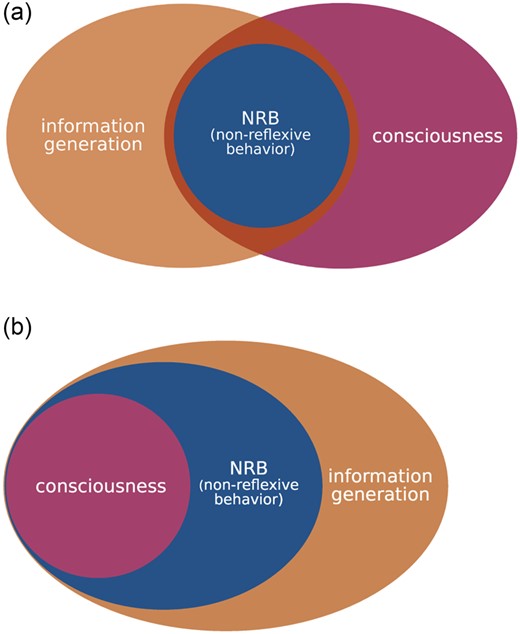
Abstract. This article discusses a hypothesis recently put forward by Kanai et al., according to which information generation constitutes a functional basi
LLMs and self-referentiality
I woke up yesterday with the following thoughts, which are probably either obvious or dumb. A central thesis that many readers, including me, took from Douglas Hofstadter’s Gödel Escher Bach when y…

