

Do you remember when people were saying "I think my phone is listening to me, i'm getting ads for stuff I spoke about" and people said "They arent listening to you, they're just this good at predicting your interests"? Well, it happens they were doing exactly that. cbsnews.com/news/google-voice-assistant-l…

Google to pay $68 million over allegations its voice assistant eavesdropped on users
www.cbsnews.comFeb 1, 2026 at 9:44 PM
Variety Effects in Mobile Advertising
Mobile app users are often exposed to a sequence of short-lived marketing interventions (e.g., ads) within each usage session. This study examines how an increase in the variety of ads shown in a session affects a user's response to the next ad. The authors leverage the quasi-experimental variation in ad assignment in their data and propose an empirical framework that accounts for different types of confounding to isolate the effects of a unit increase in variety. Across a series of models, the authors consistently show that an increase in ad variety in a session results in a higher response rate to the next ad: holding all else fixed, a unit increase in variety of the prior sequence of ads can increase the click-through rate on the next ad by approximately 13%. The authors then explore the underlying mechanism and document empirical evidence for an attention-based account. The article offers important managerial implications by identifying a source of interdependence across ad exposures that is often ignored in the design of advertising auctions. Furthermore, the attention-based mechanism suggests that platforms can incorporate real-time attention measures to help advertisers with targeting dynamics.

Remembering the pre-Google web, when search was an experiment
Most people have completely forgotten how chaotic it really was."
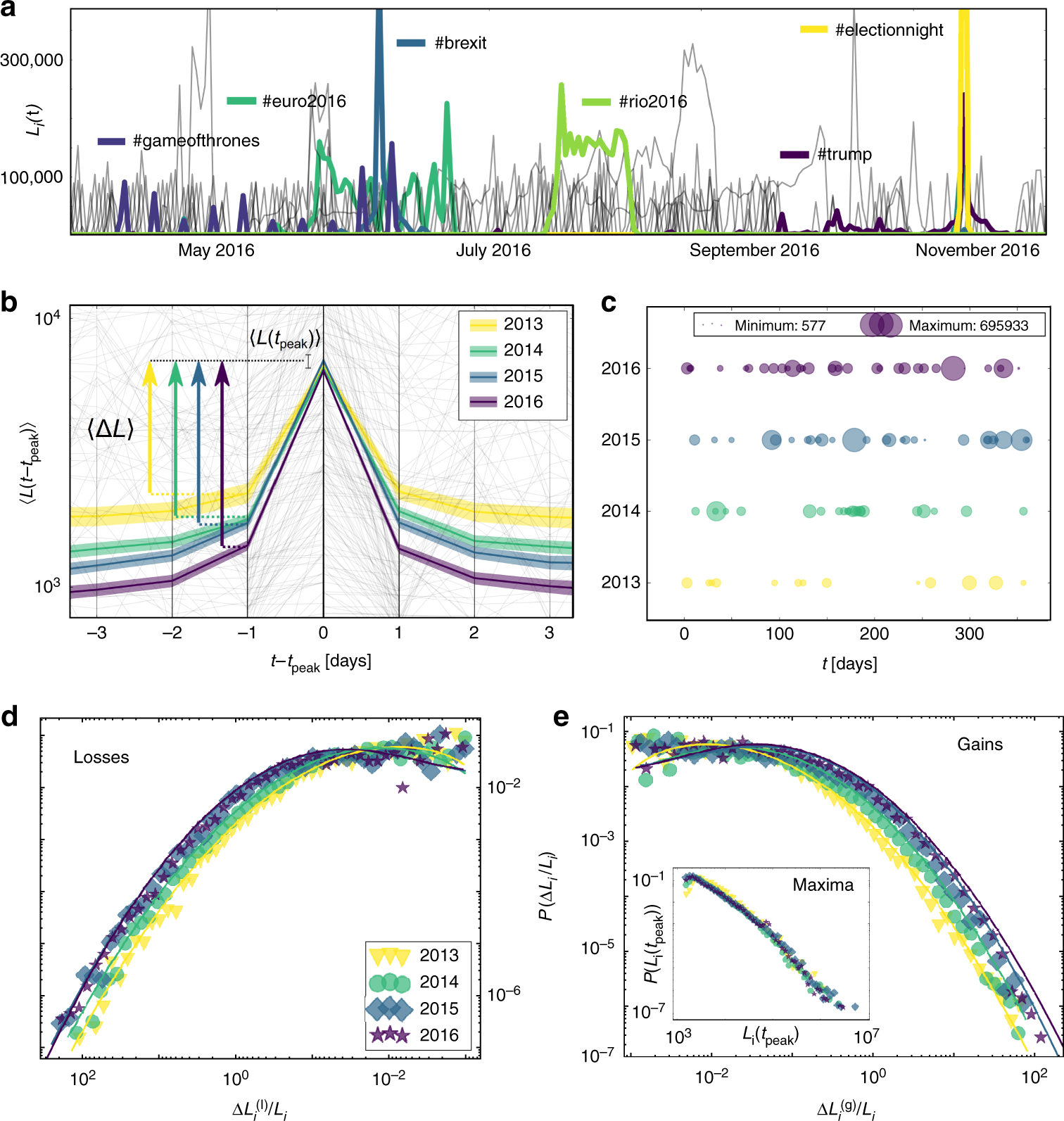
Accelerating dynamics of collective attention
With news pushed to smart phones in real time and social media reactions spreading across the globe in seconds, the public discussion can appear accelerated and temporally fragmented. In longitudinal datasets across various domains, covering multiple decades, we find increasing gradients and shortened periods in the trajectories of how cultural items receive collective attention. Is this the inevitable conclusion of the way information is disseminated and consumed? Our findings support this hypothesis. Using a simple mathematical model of topics competing for finite collective attention, we are able to explain the empirical data remarkably well. Our modeling suggests that the accelerating ups and downs of popular content are driven by increasing production and consumption of content, resulting in a more rapid exhaustion of limited attention resources. In the interplay with competition for novelty, this causes growing turnover rates and individual topics receiving shorter intervals of collective attention.
The post-search Google era begins | The Vergecast
The Hatred of Podcasting | Brace Belden
In 2015, if you said, “I heard it on a podcast,” you were trying to sound smart. In 2025, it’s better to lie.
People are not friction
The Gell-Mann Amnesia Effect of AI is a pretty well documented phenomenon: The Gell-Mann amnesia effect is a cognitive bias describing the tendency of individuals to critically assess media reports in a domain they are knowledgeable about, yet continue to trust reporting in other areas despite recognizing similar potential inaccuracies.
Opinion | Stop Googling. Let’s Talk. (Published 2015)
What have we done to face-to-face conversation?

The Feed Is Fake
That “viral” song, movie, influencer, and celebrity drama you scrolled by recently was likely the result of a stealth marketing campaign.
Blacksky - Apps on Google Play
Discover communities, trending conversations, and social media built for you.

Republicans accused Facebook, Google and Twitter of bias. Democrats called the hearing ‘dumb.’
Facebook, Google and Twitter on Tuesday sought to defend themselves against accusations from Republican lawmakers that the tech giants censor conservative news and views during a congressional hearing that devolved into a political sniping match.

Phantom Fluency
Why listening to smart people doesn't make you more thoughtful. You're not bad at remembering podcasts. Podcasts are bad at being remembered.
Discerning Audiences Through Like Buttons · Issue 6.1, Winter 2024
Column Editor’s Note: The ‘like button’ is a ubiquitous and infamous feature of social media platforms. ‘Likes’ ostensibly allow users to interact and engage with one another, but platform developers hope that data generated by users’ likes allows them to model, predict and even manipulate both individual and collective affective states. This Mining the Past column by communication scholar Carina Albrecht explores the history of the like button from “Little Annie,” developed at CBS in the mid-twentieth century, to the Cambridge Analytica scandal. Throughout this history, researchers and tech developers hoped to make ‘subjectivities’—emotions, preferences, personalities, political orientations—into ‘objectivites’; they sought to turn inner worlds into profitable data. Albrecht’s history reveals that the like button is best understood not as a passive recorder of preexisting affect and sentiment, but rather as a data technology that generated the emotive effects the button claimed to measure.

The Truth About Social Media as an "Advertising Industry," Bluesky's Gamble, and "Reclaiming Conversation" - Nightflight
Stop Using Google Trends
Alternatively titled ‘Be aware of context, and maybe start using Google AdWords’ Instead

When did Google get so f-ing weird?
I recently had an experience while doing a simple Google search that was so profoundly weird that it stopped me in my tracks. Understanding this Google se...

News Influencers Fact Sheet
About one-in-five U.S. adults say they regularly get news from news influencers on social media, and this is especially common among younger adults.

