


Mathematician/particle physicist turned privacy researcher. Java Rockstar #Oxford Building a better web - private, self-sovereign identity, p2p, social - with @peergos.org. Public social media undermines democracy. #covidisairborne #maskswork #cleantheair
revolution.social with @rabble
What’s in a name? A forward view of anonymity online
Demos is Britain’s leading cross-party think-tank. We produce original research, publish innovative thinkers and host thought-provoking events.
Scientists no Longer Find Twitter Professionally Useful, and have Switched to Bluesky
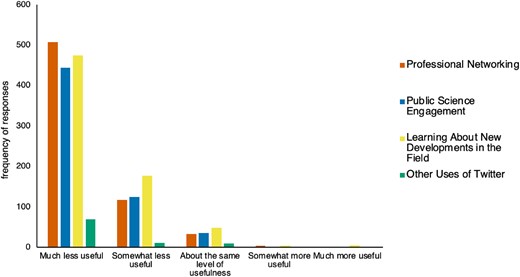
Synopsis Social media has become widely used by the scientific community for a variety of professional uses, including networking and public outreach. For the past decade, Twitter has been a primary home of scientists on social media. In recent years, new leadership at Twitter has made substantive changes that have resulted in increases in the prevalence of pseudoscience, conspiracy theory, and harassment on the platform, causing many scientists to seek alternatives. Bluesky has been suggested as a good alternative to Twitter, but the phenomenon of academics switching social media platforms has not previously been studied. Here we report on the results of a survey distributed to scientists on Twitter and Bluesky (n = 813). Results overwhelmingly confirm that changes to Twitter have made the social media platform no longer professionally useful or pleasant, and that many scientists have abandoned it in favor of Bluesky. Results show that for every reported professional benefit that scientists once gained from Twitter, scientists can now gain that benefit more effectively on Bluesky than on Twitter.
Blaine (@blaine.bsky.social)
Sociotechnologist, activist. First employee @ Twitter, built that and pioneered social decentralization, created OAuth. Shy cloud-observer, mostly. Building Roundabout for local communities at @newpublic.org.

Shreya Shankar on Twitter / X
This problem has gotten significantly worse. As Twitter and other social media have become primary channels for sharing research, academics are now expected to make the same ideas legible and appealing to both the general public (to go "viral") and senior scholars (to get the… https://t.co/zPF3tKzbVa— Shreya Shankar (@sh_reya) July 25, 2026
Ursula von der Leyen (@vonderleyen.ec.europa.eu)
Warm Welcome to all followers on W 👌 User friendly 🔓 Open source AT Protocol 🔒 Privacy preserving 🧑🤝🧑 Humans only / No bots And 🇪🇺 European!

Banning anonymous social media accounts will do more harm than good | James Ball
Labour’s Angela Rayner wants to end online abuse, but she fails to understand the lives of those outside the political and media bubbles, says former Guardian special projects editor James Ball
Perplexity CEO: Browser Wars, Taking on Google, White Collar Jobs and More!
Anonymity, pseudonymity, and the agency of online identity: Examining the social practices of r/Gonewild
A debate is currently raging regarding the value of anonymity online. On one side of the debate is Facebook, the world’s largest social network site. Facebook demands that people use their real names and is one of the leading forces behind the push towards a “real name” Internet. On the other side of the debate are scholars such as danah boyd and Bernie Hogan and sites such as 4chan and Reddit that view anonymity and pseudonymity as important to how people construct identity online. While much has been written about the benefits of anonymity and pseudonymity, there is a lack of published research examining specific practices enabled by pseudonyms. This paper provides a detailed account of the behaviors enabled through pseudonymous identity construction through a case study of the subreddit r/gonewild. The main contribution of the article is to provide a specific account of the costs of a totalizing embrace of the “real name” Internet.
Anonymity, pseudonymity, and the agency of online identity: Examining the social practices of r/Gonewild
A debate is currently raging regarding the value of anonymity online. On one side of the debate is Facebook, the world’s largest social network site. Facebook demands that people use their real names and is one of the leading forces behind the push towards a “real name” Internet. On the other side of the debate are scholars such as danah boyd and Bernie Hogan and sites such as 4chan and Reddit that view anonymity and pseudonymity as important to how people construct identity online. While much has been written about the benefits of anonymity and pseudonymity, there is a lack of published research examining specific practices enabled by pseudonyms. This paper provides a detailed account of the behaviors enabled through pseudonymous identity construction through a case study of the subreddit r/gonewild. The main contribution of the article is to provide a specific account of the costs of a totalizing embrace of the “real name” Internet.
Shirky: In Praise of Evolvable Systems
Clay Shirky's writings about the Internet, including Economics and Culture, Media and Community, Open Source, and Genetics As Information Science
Erlend Sogge Heggen (@erlend@writing.exchange)
3.88K Posts, 688 Following, 1.28K Followers · Bullish on kindness. Founder of Spicy Lobster studios and Weird. https://weird.one Formerly VP of Community / Product Lead at Discourse. #opensource #gamedev #fediverse

The Filter Bubble
Lynn Parramore interviews Internet activist Eli Pariser, board president of MoveOn.org, about the filter bubble our internet habits create:
Okay... This looks very cool. 👏🏻👏🏻👏🏻 For researchers and reporters looking to find and collate material from across the web, imagine a search and bookmarking tool that's social. 📝📝📝 @semble.so let's you log in with your BlueSky account.

Semble
Wondering what Semble is all about and how to use it? Check out our video guides on our docs page to learn more! docs.cosmik.network/semble
Social media algorithms don't allow us to understand or control what we see online and why... until now! Top scholars @jonathanstray.com and @noupside.bsky.social are sharing @mysky.social, a tool that allows users to adjust their feed’s priorities and explains why certain posts appear over others.

🎛️📲 Meet the algorithm you can actually control and understand
newpublic.substack.com
