

Quoted (with @zephoria.bsky.social and Jeff Hancock) in this @acm.org article about what happens when people retreat to AI over their social interactions -- the loss of friction, trust, and effort could be devastating. 1/ cacm.acm.org/news/is-ai-creating-a-culture…
Is AI Creating a Culture of Avoidance? – Communications of the ACM
cacm.acm.orgAug 3, 2026 at 3:39 PM
3: Consulting the Record: AI Consistently Fails the Public - AI Now Institute
Amid the excitement over AI’s (speculative, hypothetical) potential, we have lost sight of the sobering reality of its present and recent past. AI is already intermediating critical social infrastructures, materially reshaping our institutions in ways that ratchet up inequality and concentrate power in the hands of the already powerful. It is consistently deployed in ways […]
AI Is a Mass-Delusion Event
Three years in, one of AI’s enduring impacts is to make people feel like they’re losing it.
Study Finds AI Use Eats Away at Users’ Confidence in Their Own Brains
A new study out of Middlesex University argues that the ultimate effects on an AI users' brain come down to how they use it.

Unauthorised AI Bots on Reddit are Eroding Sociality
Where do we go if online discourse is overrun by AI bots?

Reality Roundtable #20 — Hacking Human Attachment: The Loneliness Crisis, Cognitive Atrophy, and Other Personal Dangers of AI - The Great Simplification
Mainstream conversations about artificial intelligence tend to center around the technology’s economic and large-scale impacts. Yet it’s at the individual level where we’re seeing AI’s most potent effects, and they may not be what you think. Even in the limited time that AI chatbots have been publicly available (like Claude, ChatGPT, Perplexity, etc.), studies show that our increasing reliance on them wears down our ability to think and communicate effectively, and even erodes our capacity to nurture healthy attachments to others. In essence, AI is atrophying the skills that sit at the core of what it means to be human. Can we as a society pause to consider the risks this technology poses to our well-being, or will we keep barreling forward with its development until it’s too late?

Researchers Studied What Happens When Workplaces Seriously Embrace AI, and the Results May Make You Nervous
Introducing AI in the workplace can create a vicious cycle that leaves employees overburdened and burned out.

Is AI Creating a Culture of Avoidance?
As chatbots and AI companions emerge as communication tools of choice for humans, a new and unsettling dynamic is taking shape. Tools that can smooth over difficult communication between friends and coworkers—reducing misunderstandings, hurt feelings, or social discomfort—also have a downside. Left unchecked, they may erode human intuition and sabotage empathy.

AI as Social Technology
Our debates about ‘AI’ grow out of 1990s science fiction. Back then, Vinge (1993) wrote essays and novels urging us to face up to the oncoming “Singularity”: a moment of rapid change that would fundamentally transform the human condition. On that day, AI would rapidly evolve from merely human-level intelligence, what some now call ‘artificial general intelligence’ (AGI), into something super-intelligent with its own interests and goals. Humanity would then either be casually eliminated by out-of-control machines, or humans would become as gods, with super-human servitors at our command.
AI is now unpopular. That may not make a difference.
afra wang on Twitter / X
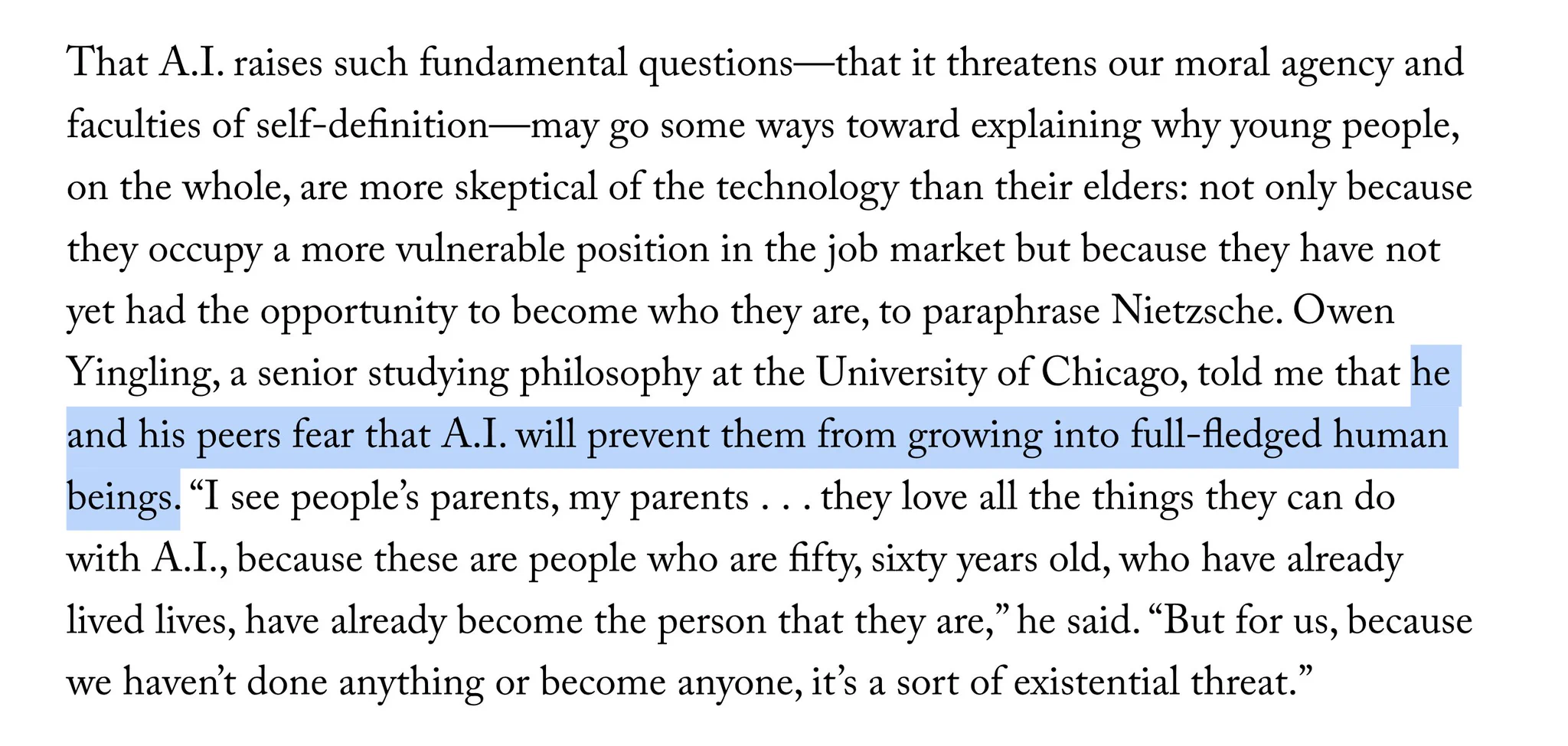
a great @NewYorker essay by Becca Rothfeld on the humanistic reasons behind the anti-AI movement: AI is arriving too early in young people’s lives, and they fear it will prevent them from growing into fully fledged humans—in a sense, an existential threat.… pic.twitter.com/LgqL4TgJEJ— afra wang (@afrazhaowang) October 9, 2026
‘Think Everybody Dead’: How the Threat of AI Is Fueling a New Political Alliance
A billionaire-backed movement from Silicon Valley and populists like Bernie Sanders are eager to stop an AI disaster — but can they overcome their mutual distrust and work together?
I think it’s telling that people very interested in AI (like Eugene and myself) still have no interest in using it as a proxy for human communication. “Being a good writer” is not the same thing as having social agency, and making the models even better at writing won’t change that.

Eugene Vinitsky 🍒
When you deploy heavily LLM text, you currently have no way to prove that you actually read it and therefore cannot convince me to read it
Livetweet @mcxfrank.bsky.social talk: If we care about intelligence and cognition, AI has recently allowed a change; we now have two ways to study them. AI is of course allowing us a lot that we wouldn't dare on our Children (brain surgery, never tell a child about cats...) #acl #conll
Remarkable how over a decade ago @michaelnielsen.bsky.social pointed the way towards solving long standing issues plaguing science to this day (issues that are all the more relevant in the age of AI mediated science)

Ronen Tamari
This is why @atproto.science is so relevant rn This compilation of essays indicates that scientists are most frustrated by insufficient “community tools and resources... Essential infrastructure for sharing, maintaining and building on existing work and data is also badly underdeveloped." >


