

How cognitive dissonance and normalcy bias prevent awareness and resilience to cognitive warfare attacks. Citing @chadbriggs.bsky.social and Janis Sarts. (Apologies to Janis for misspelling his name in the slide deck.) m.youtube.com/watch?v=BGeC-XGQAyI

Normalcy bias prevents resilience to cognitive warfare
m.youtube.comNov 5, 2026 at 8:33 AM
Normalcy bias prevents resilience to cognitive warfare
Cognitive Warfare Through the Lens of Critical Neuroscience: Data, Theory, and Values
This study examines cognitive warfare through the lens of critical neuroscience and situates it within peace research as a methodological contribution. Cognitive warfare-understood as the strategic modulation of perception, belief, and decision-making-highlights how the human mind has become a contested domain of contemporary conflict. The weaponization of neuroscience unfolds within sociocultural contexts where empirical findings, theoretical interpretations, and normative commitments are deeply entangled. Drawing on Johan Galtung’s epistemological triad of data, theory, and values, I propose a framework for analyzing cognitive warfare that makes explicit the normative dimensions of neuroscientific knowledge. This perspective highlights not only the weaponization of neuroscience itself, but also of its reputation: exaggerated claims and neuropolitical imaginaries can shape expectations, distort public discourse, and erode trust in science independently of actual technological capabilities. Applying this framework, the study examines resilience and solidarity as two domains in which empirical mechanisms, theoretical interpretations, and normative priors intersect. Cognitive warfare is shown to undermine resilience by destabilizing shared models of reality, while evolutionary and social dynamics demonstrate the long-term advantages of cooperation, reciprocity, and generosity over manipulation and defection. By integrating critical neuroscience with peace research, the article advances an expanded notion of peace as the safeguarding of mental and social autonomy-conditions under which cognition remains free from systematic manipulation and capable of sustaining cooperative forms of life.
Professor Chad Briggs Discusses Cognitive Warfare (The Gorgon Effect)
The thinking style that makes people vulnerable to extremism | Psyche Ideas
The people most drawn to ideological thinking and authoritarianism aren’t aware of what makes them so susceptible

CFP: Religion, Politics, and Cognitive Warfare | The Journal for Cultural and Religious Theory | JCRT
This call for papers invites work on religion, politics, and cognitive warfare, exploring how belief, media, conspiracy, identity, and power shape struggles over reality, interpretation, and life in an age of disinformat

Epistemic Vigilance
Humans massively depend on communication with others, but this leaves them open to the risk of being accidentally or intentionally misinformed. To ensure that, despite this risk, communication remain...

On Western Terrorism: From Hiroshima to Drone Warfare
In On Western Terrorism Noam Chomsky, world renowned dissident intellectual, discusses Western power and propaganda with filmmaker and investigative journalist Andre Vltchek. The discussion weaves together a historical narrative with the two men's personal experiences which led them to a life of activism. The discussion includes personal memories, such as the New York newsstand where Chomsky began his political education, and broadens out to look at the shifting forms of imperial control and the Western propaganda apparatus. Along the way the discussion touches on many countries of which the authors have personal experience, from Nicaragua and Cuba, to China, Chile, Turkey and many more. A blast of fresh air which blows away the cobwebs of propaganda and deception, On Western Terrorism is a powerful critique of the West's role in the world which will inspire all those who read it to think independently and critically.
It's Safer in the Front
Faced with intensifying repression and state violence, there is an understandable inclination to seek safety by avoiding confrontation. But this is not always the most effective strategy.


Situational awareness
I consider this article to be a form of American propaganda. There are a number of things in here I agree with, or believe may happen, but don't necessarily ...

Anti-democratic attitudes are highly contagious, new psychology study finds
The rise of anti-democratic sentiments might be driven by social contagion. Researchers have discovered that citizens often adapt their personal support for authoritarian rule to align with the political views of those around them.
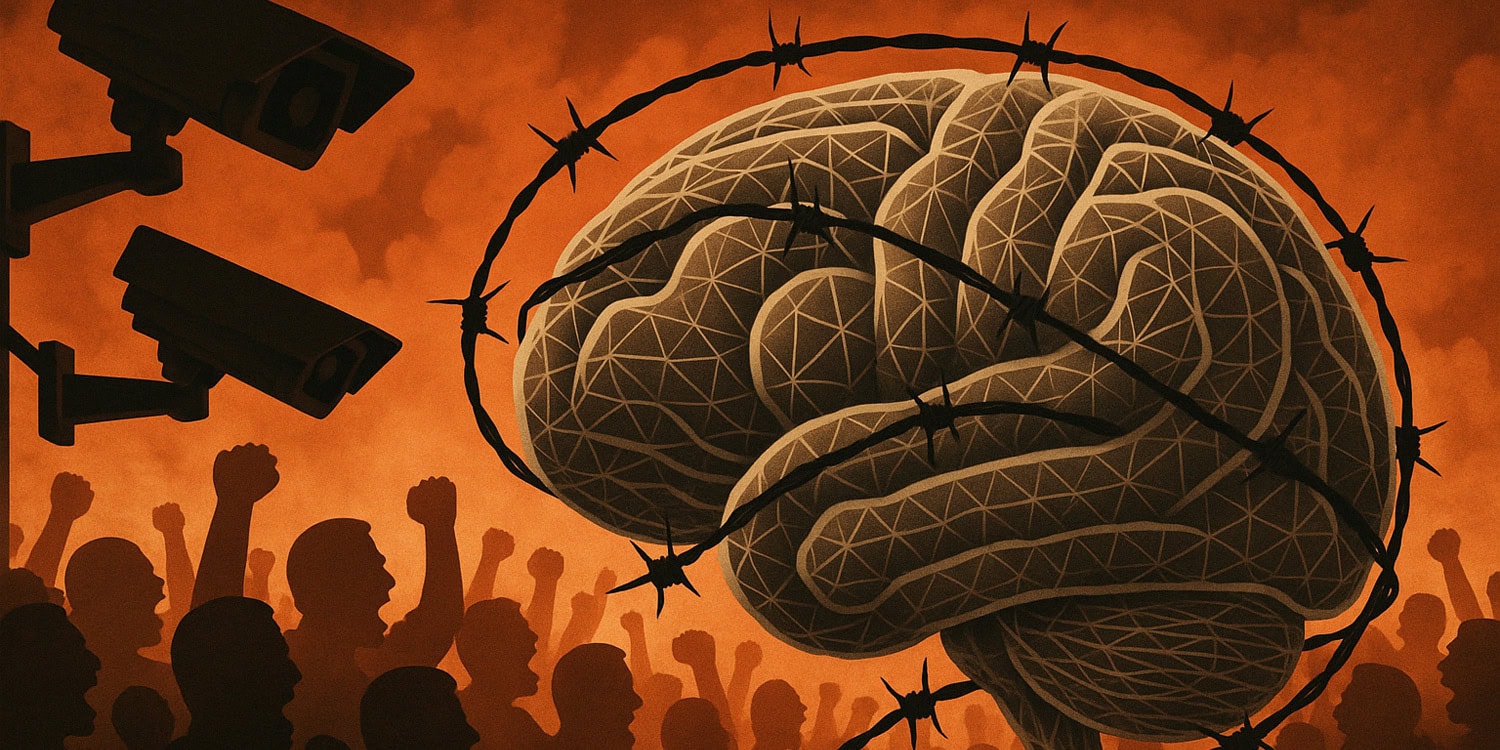
Remotely Coerced Violence: 764, The Com Network, and the Hybridization of Threats - Combating Terrorism Center at West Point
Abstract: This article examines 764 and the wider Com Network as a case study in remotely coerced violence and the hybridization of contemporary terrorist and violent extremist threats. It argues that nihilistic violent extremism is best understood as a victim-driven, youth-centered online ecosystem in which status, belonging, and identity are earned through the production, circulation, … Continued
Guide to Responsible, Strategic Reporting on Hate and Extremism
Recommendations for researchers, journalists and others on how to avoid unintentionally bolstering extremists and causing additional harm.

Capturing our Attention by @neillevy.bsky.social "we possess sophisticated capacities of epistemic vigilance, which work reasonably well to distinguish reliable from unreliable information, but ... we do not have parallel defences against attentional capture" > tandfonline.com/doi/full/10.1080/00048402.202…
A primer on cognitive warfare. One goal is to induce paralysis. Anyone can use these tactics—cognitive war can be waged e.g. by individuals, gangs, crime rings, corporations, & nation-states. From @chadmbriggs.bsky.social at the 2026 Cambridge Disinformation Summit. youtu.be/JSI3gjuGGP4?is=5dNXWFayE1n89j…

Professor Chad Briggs Discusses Cognitive Warfare (The Gorgon Effect)
youtu.be
